Authorities: "Not a Level of Concern Compared to the Past"
As market interest rates decline, loan demand is stirring, raising concerns about potential defaults in the financial sector. However, authorities maintain that a significant portion of the loan demand stems from policy mortgages based on actual demand, and that delinquency rates remain at manageable levels compared to past crisis periods.
According to financial authorities on the 29th, household loans across all financial sectors increased by 200 billion KRW in April compared to the previous month. This marks a shift to an upward trend in household loans after eight consecutive months of decline since August last year.
By loan category, mortgage loans increased by 1.9 trillion KRW. This was due to a 2.8 trillion KRW increase in bank mortgage loans offsetting a decrease in second-tier financial sector mortgage loans. Other loans decreased by 1.7 trillion KRW across both banks and second-tier financial institutions.
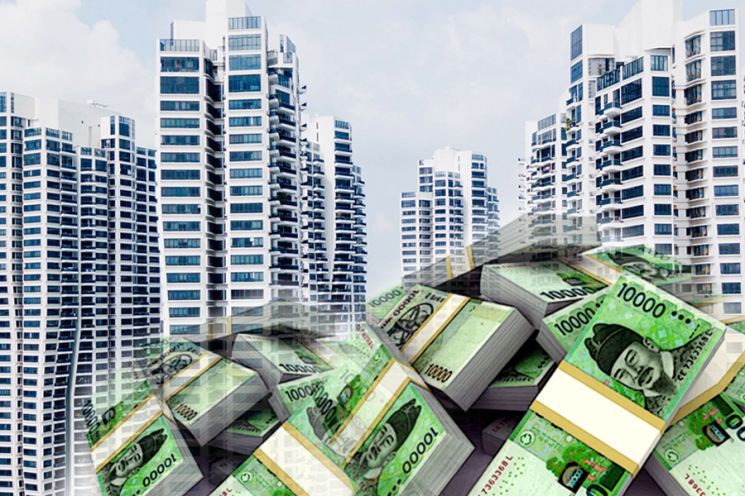
Authorities explain that the increase in household loans, centered on mortgage loans, is influenced by policy mortgages such as the Special BoGeumJaRi Loan. In particular, recent market interest rate cuts have led to a downward stabilization of mortgage loan rates in the banking sector. According to the Korea Federation of Banks, the average mortgage loan interest rates at the five major banks (KB Kookmin, Shinhan, Hana, Woori, NH Nonghyup) ranged from 4.24% to 4.70% last month. This represents a decline of about 1 percentage point on both the upper and lower ends compared to December last year (5.11% to 5.71%).
The financial industry warns that this increase in loan demand, occurring amid a sharp rise in delinquency rates across all financial sectors, could become a trigger for risks in the Korean economy. According to a recent report by the Korea Institute of Finance, the non-performing loans (NPL) ratio of domestic banks is projected to surge from 0.18% in the fourth quarter of last year to 0.33% by the end of this year. In terms of amount, NPLs are expected to expand from 1.7 trillion KRW in Q4 last year to around 3 trillion KRW by year-end.
The Korea Institute of Finance pointed out that while the overall loss absorption capacity of domestic banks is sufficient, the trend of increasing NPLs needs to be closely monitored. The institute stated, "Considering that domestic banks’ capital stood at 279 trillion KRW and net income was 18 trillion KRW at the end of last year, their loss absorption capacity is adequate," but added, "Since the NPL ratio, which had been sharply declining since 2012, is now reversing to a sharp increase, the duration and extent of this trend are the key issues."
However, authorities say this situation is manageable. They cite that the main cause of the household loan increase is the Special BoGeumJaRi Loan (4.7 trillion KRW), while other loans in the banking sector and loans in the second-tier financial sector are declining. They also note that current delinquency rates are similar to levels seen just before the COVID-19 pandemic outbreak and during 2014?2016. Authorities stated, "This is not a serious situation that threatens the soundness or stability of the financial system."
© The Asia Business Daily(www.asiae.co.kr). All rights reserved.
![Clutching a Stolen Dior Bag, Saying "I Hate Being Poor but Real"... The Grotesque Con of a "Human Knockoff" [Slate]](https://cwcontent.asiae.co.kr/asiaresize/183/2026021902243444107_1771435474.jpg)
















