Foreigners Surge from 3% in 2020 to 10%
"Visit for Korean Culture Experience and Self-Reflection"
Growing Interest in Temple Food... "Eco-Friendly"
"Among all my experiences, Temple Stay is undoubtedly the best. Until now, due to language barriers, I could only superficially feel the teachings of Buddhism, but this time I was able to receive many teachings." (Review from a foreign participant at Yeondeung International Seon Center Temple Stay)
As COVID-19 restrictions ease, the number of foreigners participating in Temple Stay is increasing, making Temple Stay a form of 'K-culture.' To accommodate the growing number of foreign participants, each temple is creating customized programs that foreigners can also enjoy.
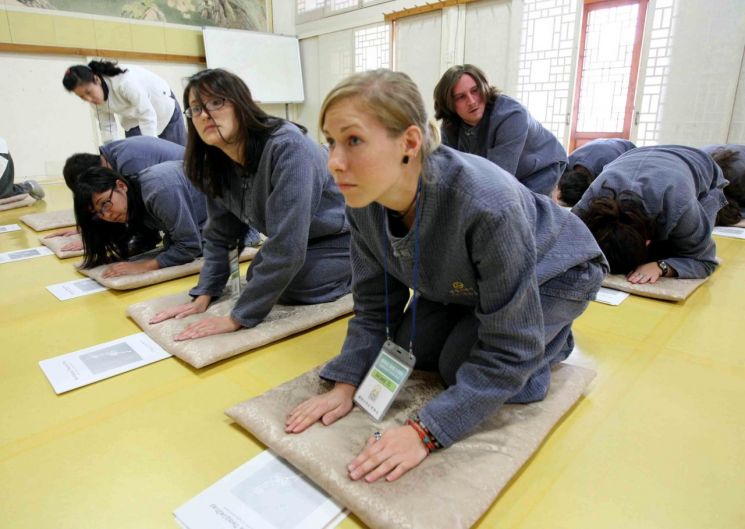
According to the Korean Buddhist Cultural Foundation on the 27th, foreigners accounted for 10% of all participants in Temple Stay during the first quarter of this year. The total number of participants in the first quarter was 92,823, with 9,234 foreigners participating.
With the easing of COVID-19 and the increase in foreign tourists, the number of foreigners participating in Temple Stay is also rising. The proportion of foreigners was 15% in 2018 and 13% in 2019, but it sharply dropped to 3% in both 2020 and 2021 during the height of the pandemic. Last year, when the spread of COVID-19 slowed down compared to before, the figure rose to 9%. The number of foreign participants last year (38,599) also surged about 5.8 times compared to the previous year (6,705). Looking at the nationalities of cumulative participants over the past five years, the United States ranked first, followed by France, Vietnam, Germany, and China.
Foreign visitors were found to participate in Temple Stay for experiencing traditional Korean culture and self-reflection. According to last year's foreign participant satisfaction report, 45% cited 'interest in traditional Korean culture' as their motivation for participation, the highest percentage. This was followed by self-reflection and mental and physical relaxation at 43%, and interest in Buddhist culture at 37%. Hana, a 27-year-old female Chinese international student, said, "If I have the chance, I want to participate in Temple Stay," adding, "I want to relieve stress and have time to understand myself through meditation in a quiet environment and experiences close to nature."
As the number of foreign participants in Temple Stay increases, the Foundation is training multilingual Buddhist interpretation guides to support temples. Individual temples are doing the same. For example, Myogaksa Temple located in Jongno-gu, Seoul, offers a one-day program for foreigners. This program runs from 10 a.m. to 3 p.m. and includes 108 prostrations, meditation, and tea conversation sessions. Golgulsa Temple in Gyeongju, Gyeongbuk Province, also offers various programs such as experiential, relaxation, and one-day types.
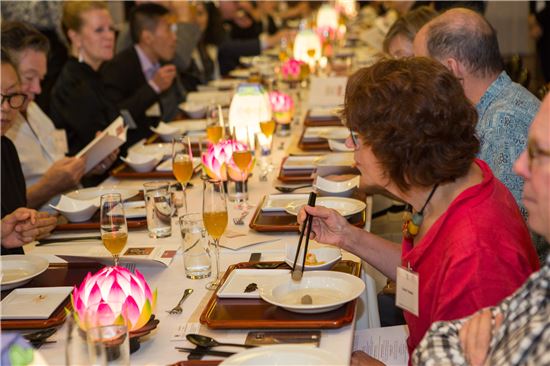
Interest in temple food is growing as much as interest in temple culture. The Korean Buddhist Cultural Foundation stated that at the Korean Temple Food Culture Experience Center, they provide English interpretation every Saturday for the 'K-Temple Food' lecture and operate foreign group programs. A Foundation official explained, "Foreign group programs have increased significantly," adding, "The fact that temple food is nature-friendly and allows for a restrained diet seems to provide philosophical inspiration to foreigners."
© The Asia Business Daily(www.asiae.co.kr). All rights reserved.

















