Bidirectional communication between the next-generation small satellite No. 2, launched aboard the Korean launch vehicle Nuri (KSLV-II), and the ground station was successfully achieved in the early hours of the 26th.
The Ministry of Science and ICT announced this during a briefing at the Sejong Government Complex on the 26th. Following one-way communication after the launch the previous day, bidirectional communication including remote commands was carried out on this day, marking the third Nuri launch as virtually flawless from liftoff and flight to satellite deployment and main payload operation.
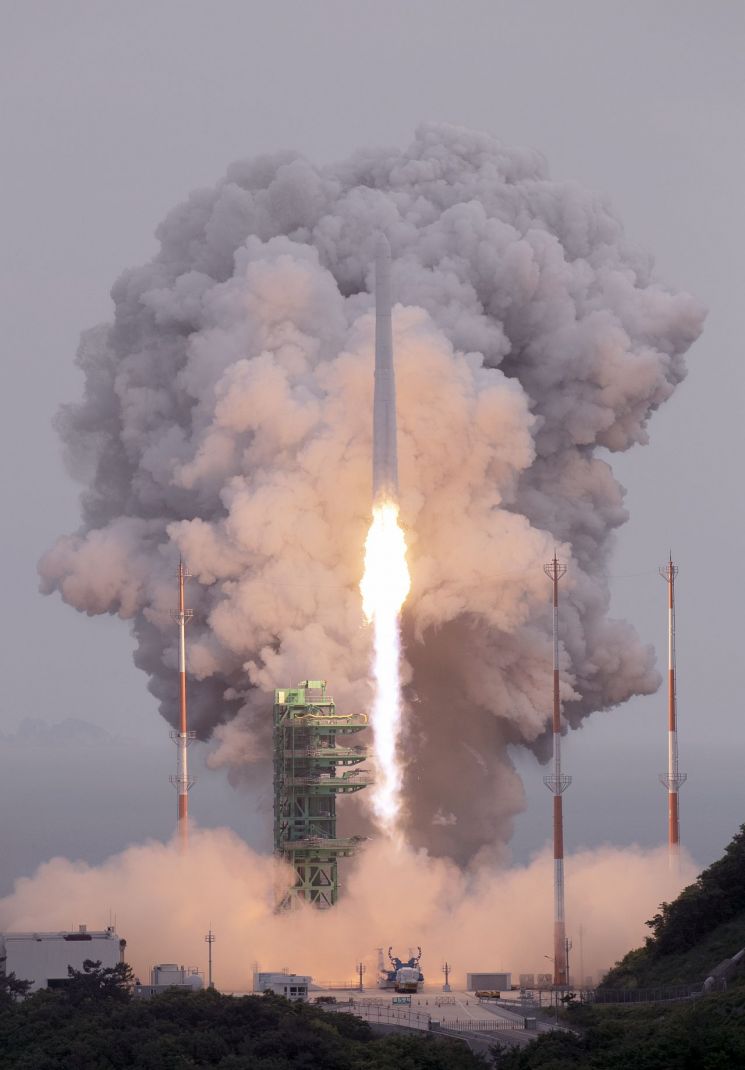
With this, Korea has become a country that has successfully launched a practical satellite on its own. However, only some of the secondary payload CubeSats have succeeded in communication so far.
The Korea Astronomy and Space Science Institute's CubeSat 'Doyosat' communicated with 3 out of 4 satellites, and among the three corporate CubeSats, signals were confirmed from 2 satellites.
According to the Ministry of Science and ICT, the next-generation small satellite No. 2, launched aboard Nuri at 6:24 PM the previous day, successfully reached its target orbit and established bidirectional communication with the Korea Advanced Institute of Science and Technology (KAIST) Satellite Research Center ground station.
Following the first satellite signal reception at the Antarctic King Sejong Station around 7:07 PM the previous day and initial communication through the Daejeon ground station around 7:58 PM, seven additional communications were successfully conducted through Daejeon and overseas ground stations in the early hours of this day.
During the communication, remote telemetry data from the satellite was received, and the normal sun-pointing attitude of the satellite was checked. The Ministry of Science and ICT explained that the satellite’s communication system transmission and reception functions, command and data processing system functions, and power system solar panel power generation functions were all inspected and confirmed to be normal.
The next-generation small satellite No. 2 will continue to monitor its status for the next seven days, deploy its synthetic aperture radar antenna, and stabilize its attitude. It will then undergo initial operations for three months to check payloads and prepare for mission execution, followed by a two-year mission orbiting the Earth approximately 15 times a day in a sun-synchronous orbit.
Doyosat is attempting sequential communication with each satellite: the first unit (Garam) received satellite signals at 8:03 AM the previous day, the second unit (Narae) performed signal reception and bidirectional communication around 6:40 AM this day, and the fourth unit (Raon) was confirmed to have signals at the Daejeon ground station at 6:30 PM this day. However, the third unit (Dasol), whose deployment was not properly confirmed the previous day, has not yet received satellite signals and will continue communication attempts. Doyosat can communicate about 2 to 3 times daily at the Daejeon ground station and about 3 times at overseas ground stations.
Among corporate CubeSats, LUMIR-T1 from Lumir confirmed signals at 7:53 PM the previous day, and KSAT3U from Kairospace confirmed signals at 11:07 PM, according to the Ministry of Science and ICT. Kairospace reported that KSAT3U is operating normally, with battery temperature at 7 degrees Celsius and onboard computer temperature at 35 degrees Celsius, and has transmitted this status report to the ground. JusTech’s 'JAC' is also expected to continue satellite signal reception and communication attempts.
© The Asia Business Daily(www.asiae.co.kr). All rights reserved.
!["The Woman Who Threw Herself into the Water Clutching a Stolen Dior Bag"...A Grotesque Success Story That Shakes the Korean Psyche [Slate]](https://cwcontent.asiae.co.kr/asiaresize/183/2026021902243444107_1771435474.jpg)
















