"Legislation Filling the Gaps" vs Fundamental Rights Restriction
2009 Constitutional Incompatibility · 2014 Limited Unconstitutionality
Experts Also Express "Concerns of Unconstitutionality"
"The Constitutional Court's decision declaring Article 10 of the Assembly and Demonstration Act (집시법) unconstitutional does not mean that nighttime outdoor assemblies are 'unconditionally allowed.' It means that restrictions on nighttime outdoor assemblies or demonstrations are necessary, but the time frame before sunrise or after sunset is unclear and should be limited more specifically and appropriately."
- Yoon Jae-ok, Floor Leader of the People Power Party (remarks at the Party-Government Council for Establishing Public Order and Protecting Citizens' Rights on the 24th)
"It is possible to impose more restrictions on assemblies held at night, but to say in advance that assemblies cannot be held at all would be against the Constitution."
- Song Ki-heon, Senior Deputy Floor Leader of the Democratic Party of Korea (at the National Assembly Steering Committee plenary meeting on the 24th)
The ruling and opposition parties are offering 'different interpretations' of the same ruling. The subject is Article 10 of the Assembly and Demonstration Act (집시법), which contains provisions banning assemblies and demonstrations. The Constitutional Court ruled the provision unconstitutional in 2009 and partially unconstitutional in 2014. The ruling party, which is pushing to amend the Assembly and Demonstration Act to ban late-night assemblies, claims this ruling is the basis for the legislative amendment. The opposition party, on the other hand, argues that this Constitutional Court ruling means that banning assemblies at specific times has unconstitutional elements.
Ruling Party: "Late-night assemblies infringe on others' interests"… Accelerating legislative amendment
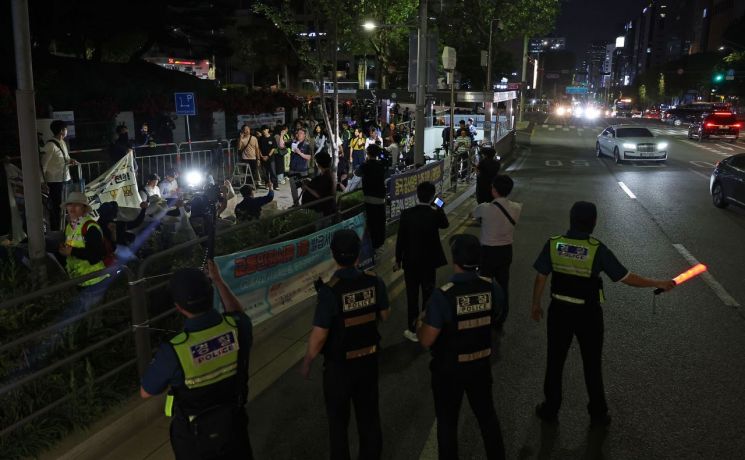
According to political circles on the 29th, the People Power Party is pushing for amendments to the Assembly and Demonstration Act. Earlier, on the 24th, the People Power Party held a party-government council meeting at the National Assembly and announced plans to promote the proposal by Representative Yoon Jae-ok (Floor Leader) to restrict outdoor assemblies from midnight to 6 a.m., and the proposal by Representative Kwon Young-se to strengthen noise regulation standards for assemblies by about 5 to 10 decibels from the current level. On the same day, the party-government council also considered measures to restrict assemblies and demonstrations at the reporting stage if groups with a history of illegal activities clearly pose a direct threat to others, corporations, or public order, or if assemblies and demonstrations are held on major urban roads during commuting hours.
The ruling party's move to amend the Assembly and Demonstration Act stems from the 1-night, 2-day 'sleep-out assembly' by the Construction Union of the Korean Confederation of Trade Unions on the 16th. At that time, the police allowed the assembly only until 5 p.m., stating that a 1-night, 2-day assembly could not be permitted, but the union continued the assembly afterward. During this process, some union members were criticized for drinking and smoking on the road. Kim Ki-hyun, leader of the People Power Party, wrote on Facebook on the 18th, "Groups that occupy roads at will and engage in public urination and drinking parties must be held strictly accountable. That is a fair and advanced society."
Legislative vacuum after Constitutional Court ruling... interpretations vary
The momentum for amending the bill is because the relevant provisions of the Assembly and Demonstration Act are currently in a 'legislative vacuum.' In 2009, the Constitutional Court ruled Article 10 of the Assembly and Demonstration Act unconstitutional in a case concerning the prohibition of nighttime outdoor assemblies. This provision prohibits outdoor assemblies before sunrise or after sunset and allows the police chief to permit them in certain cases. At that time, five justices expressed the opinion that "the Constitution prohibits a permit system for assemblies." Article 21 of the Constitution states, "All citizens shall enjoy freedom of assembly and association, and no permit shall be required for assembly or association." Although the unconstitutional opinion was the majority among the justices, because the Constitutional Court requires at least six votes for a decision, the provision was ruled constitutionally incompatible rather than unconstitutional. Since the National Assembly did not amend the law within the grace period, Article 10 of the Assembly and Demonstration Act lost its effect.
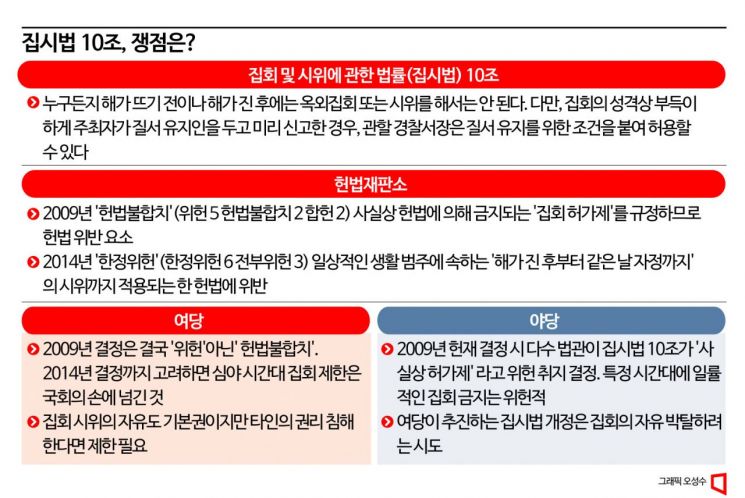
In 2014, the Constitutional Court issued a limited unconstitutionality ruling on Article 10 of the Assembly and Demonstration Act. Six justices supported limited unconstitutionality, and three supported full unconstitutionality. The purpose of limited unconstitutionality was that the provision violated the Constitution only when applied to assemblies during the commonly accepted nighttime daily life period, i.e., "demonstrations from sunset until midnight of the same day." The Court's majority opinion stated, "It is desirable to leave the decision on whether to ban demonstrations after midnight to the legislature." In other words, banning outdoor assemblies until evening hours, not late-night hours, was deemed excessive.
The opposition party opposes the amendment to the Assembly and Demonstration Act, citing the majority opinion of the 2009 Constitutional Court ruling. Song Ki-heon, Senior Deputy Floor Leader of the Democratic Party, emphasized at the National Assembly Steering Committee plenary meeting on the 24th, "If the National Assembly sets a principle that assemblies cannot be held at certain times and allows assemblies only in specific cases, that would be unconstitutional in light of the 2009 Constitutional Court ruling."
The ruling party argues for the amendment mainly based on the 2014 decision but explains that even considering the 2009 decision, there is no problem with legislation restricting assemblies after midnight. Jang Dong-hyuk, spokesperson for the People Power Party, told reporters at the National Assembly on the 25th, "The opinion that banning assemblies after midnight is effectively a permit system is the opinion of five justices in the 2009 decision," adding, "Just because five justices' opinions are the majority does not mean that the reasoning behind the constitutional incompatibility ruling is based on that logic." He continued, "The Democratic Party keeps twisting facts and legal principles as if the five justices' opinions were officially reflected in the Constitutional Court's opinion, but that is wrong."
Assembly 'permit system'? Concerns over fundamental rights restrictions
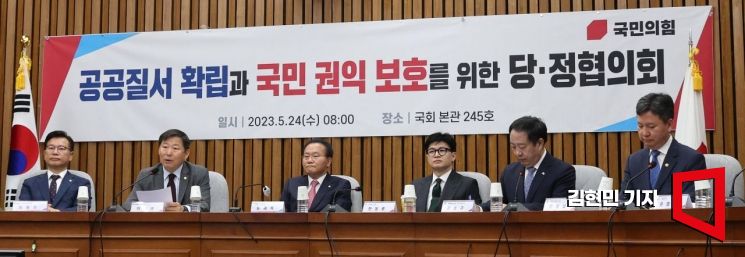 Lee Cheol-gyu, Secretary General of the People Power Party, is speaking at the Party-Government Council for Establishing Public Order and Protecting National Rights held at the National Assembly on the 24th. Photo by Kim Hyun-min kimhyun81@
The labor sector is actively opposing the amendment to Article 10 of the Assembly and Demonstration Act as a 'restriction on fundamental rights.' The Korean Confederation of Trade Unions criticized on the 25th, "What the government and ruling party are attempting now is a distorted notification system, that is, a 'permit system,'" and said, "It is not public authority that is collapsing miserably but citizens' fundamental rights." The People's Solidarity for Participatory Democracy also argued in a statement on the 19th, "Banning assemblies on the grounds of a history of illegal activities means that the notification system is being distorted into a de facto permit system that can be rejected based on the content of the notification or the identity of the notifier."
Experts showed differing opinions on the 'ban on late-night assemblies.' However, they viewed restricting assemblies at the reporting stage based on a history of illegal activities as having unconstitutional elements. Professor Han Sang-hee of Konkuk University Law School said, "The Constitutional Court said in its constitutional incompatibility ruling that assemblies can be restricted from midnight to dawn, but even if restricted, it should be 'principally allowed' and 'exceptionally restricted,'" adding, "What is being discussed now is the opposite direction, principally restricting and exceptionally allowing, which corresponds to a permit system."
Regarding restrictions on assemblies based on a history of illegal demonstrations, he said, "Whether there is a history of illegal assemblies is not important, but the government and ruling party are using unnecessary words," and added, "Regardless of whether there is a history of illegal assemblies, assemblies that pose a serious threat to public order should not be allowed, but saying that they will look at the history of illegal assemblies implies specific groups and is sowing discord among the people."
Professor Jang Young-soo of Korea University Law School said about the amendment to the Assembly and Demonstration Act, "I do not see it as a restriction on fundamental rights. Freedom of assembly and demonstration is an important fundamental right, but so is the freedom of residence of nearby residents." He interpreted that the Constitutional Court's decision cannot be interpreted focusing only on the 'majority opinion.' He said, "In the case of constitutional incompatibility, it should be understood as such. It means that it was not ruled unconstitutional," and added, "Since the Constitutional Court's decisions require the approval of six or more justices except for jurisdictional disputes, the phrase 'because it is a majority opinion' is meaningless."
However, Professor Jang advised that restricting assemblies of groups with a history of illegal demonstrations should be "very cautious." He said, "If this is expanded and excessively applied, constitutional problems will arise," and added, "Restrictions can be imposed if it is clear that an illegal demonstration will occur, but if it goes to the point of saying 'If there is a history of illegal demonstrations, you should never hold assemblies or demonstrations again,' that would be an excessive restriction."
© The Asia Business Daily(www.asiae.co.kr). All rights reserved.

![Clutching a Stolen Dior Bag, Saying "I Hate Being Poor but Real"... The Grotesque Con of a "Human Knockoff" [Slate]](https://cwcontent.asiae.co.kr/asiaresize/183/2026021902243444107_1771435474.jpg)
















