Next Year's Defense Budget to Increase by 3%
Bloomberg reported on the 25th (local time) that negotiations to raise the debt ceiling to prevent a default by the U.S. federal government are nearing an agreement.
According to sources familiar with the matter, President Joe Biden and Republican House Speaker Kevin McCarthy are narrowing their differences and approaching an agreement. The details are still tentative, and a final agreement has not yet been reached. The report also stated that the two sides have not yet agreed on the ceiling amount.
However, under the new agreement terms, the difference in the amounts claimed by both sides regarding 'discretionary spending,' which Congress has discretion over when budgeting, has narrowed to $70 billion (approximately 93 trillion won).
The U.S. budget is divided into discretionary and mandatory spending. Discretionary spending is the expenditure that the executive branch and Congress can budget and review at their discretion. Mandatory spending is budgeted and reviewed based on laws, so Congress does not have authority to control mandatory spending. Only discretionary spending is subject to increase or decrease each fiscal year according to congressional resolutions.
The Biden administration has advocated freezing discretionary spending this year, while the Republican side has pushed for a return to 2022 levels.
According to U.S. federal government statistics, discretionary spending in 2022 was $1.7 trillion, accounting for 27% of total spending of $6.27 trillion. About half of discretionary spending is defense spending.
Another source explained, "Negotiators agree on the total amount of discretionary spending, including defense, but will leave specific decisions on detailed items such as housing and education to Congress."
The agreement is expected to be a concise form including several key figures rather than a lengthy bill spanning hundreds of pages.
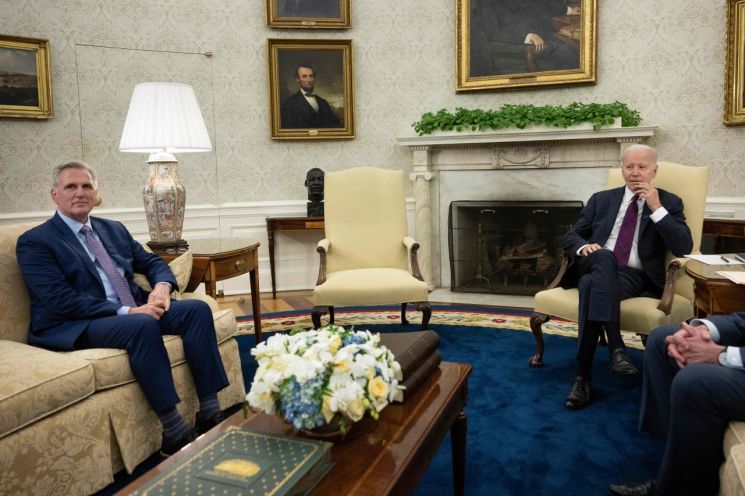 U.S. President Joe Biden (right) and Republican Speaker of the House Kevin McCarthy. [Image source=AFP Yonhap News]
The New York Times (NYT) also reported that there has been progress toward an agreement to raise the debt ceiling for two years while limiting all federal government spending except for defense and veterans affairs.
Meanwhile, the U.S. Treasury Department is preparing emergency measures in case an agreement is reached after the X-Day on July 1, when available cash is expected to be exhausted.
The Wall Street Journal (WSJ), citing sources, reported that the Treasury has pulled out emergency plans created after a similar situation in 2011.
According to the plan, after a default, decisions on whether to pay government bills will be made daily. This is part of preparations to delay some fund payments after June 1.
The plan does not include efforts to ensure specific bills are paid on time. However, Treasury officials and Federal Reserve (Fed) personnel have discussed prioritizing debt payments because U.S. Treasury securities are central to the global financial system.
Other federal government officials are also preparing for the possibility that Congress may not raise the $31.4 trillion debt ceiling in time.
© The Asia Business Daily(www.asiae.co.kr). All rights reserved.

















