Addition of Bio to Semiconductors, Displays, and Secondary Batteries
550 Trillion KRW+α Investment by 2027
What Are the Key Points of the National Advanced Strategic Industry Development and Protection Plan?
The government has newly added bio to the category of advanced strategic industries. It plans to designate 17 national advanced strategic technologies across four advanced industries?semiconductors, displays, secondary batteries, and bio?and actively foster these industries. If the private sector invests more than 550 trillion won in advanced industries over the next five years, the government will focus incentives through national project support.
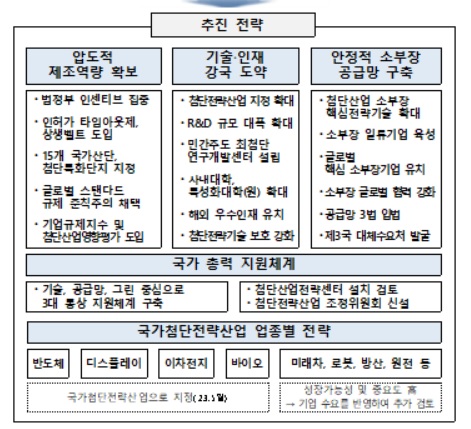
At the ‘2nd National Advanced Strategic Industry Committee’ chaired by Prime Minister Han Duck-soo on the 26th, bio was newly designated as a national advanced strategic industry following semiconductors, displays, and secondary batteries. The government plans to expand the scope of advanced strategic industries to include nuclear power, defense, and future mobility. It also designated 17 national advanced strategic technologies across the four advanced industries: 8 for semiconductors, 4 for displays, 3 for secondary batteries, and 2 for bio.
The finalized basic plan for fostering and protecting national advanced strategic industries (2023?2027) includes measures to ensure that private investment exceeding 550 trillion won in the four designated industries?semiconductors, displays, secondary batteries, and bio?is carried out smoothly through early establishment of new national industrial complexes, regulatory reforms, and industry-specific tailored support.
Currently, the private sector plans to invest a total of more than 550 trillion won by 2026: 340 trillion won in semiconductors, 62 trillion won in displays, 39 trillion won in secondary batteries, 13 trillion won in bio, 95 trillion won in future cars, and 2 trillion won in robotics. The government intends to maximize the investment effect of companies by establishing a new ‘leading project’ system, equivalent to Korea’s version of a ‘sector deal.’ When companies propose urgent and important national investment projects, the government will review and designate them as leading projects, then provide support equivalent to that of specialized complexes, including permits, tax credits, and financial assistance.
The government will also introduce a set of three regulatory reforms: the permit timeout system, the win-win belt, and the regulatory index and advanced industry impact assessment system. The permit timeout system is scheduled to be implemented on July 1. After review by the National Advanced Strategic Industry Committee, if a rapid permit request is made and the permit is not processed within a maximum of 60 days without special reasons, the permit will be deemed granted.
Additionally, the win-win belt is currently in the planning stage and will be promoted through future amendments to the National Advanced Strategic Industry Act. It is a method of sharing corporate investment profits among adjacent local governments to expedite permit processing across multiple jurisdictions. When companies apply for regulatory improvements related to national advanced industries, results will be notified within a maximum of 45 days. The government is also considering developing a corporate regulatory index and introducing an advanced industry impact assessment.
The government plans to provide more than 4.6 trillion won in research and development (R&D) support over 10 years until 2032 for the four major national advanced strategic industries, including 3.2 trillion won for semiconductors. To establish a stable supply chain for materials, parts, and equipment (MPE), the scope of core strategic technologies supported in key advanced industries will be expanded. The support targets will increase from 150 technologies in seven major fields?semiconductors, displays, automobiles, machinery and metals, electrical and electronics, basic chemicals, and bio?to 200 technologies across 10 fields including space, defense, and hydrogen by the second half of this year. A preliminary feasibility study for the MPE Alchemist Project will also be pursued to secure future advanced industry technologies.
To build a national full-scale support system, the current Technology Coordination Committee, which focuses on technology designation, will be reorganized into the ‘Advanced Strategic Industry Coordination Committee’ to comprehensively discuss technology, investment, and workforce. Separately, the establishment of an ‘Advanced Industry Strategy Center’ within the Korea Institute for Industrial Economics and Trade is under consideration as a think tank to analyze core information on advanced industries such as trade norms, global corporate trends, and environmental regulations.
© The Asia Business Daily(www.asiae.co.kr). All rights reserved.

















