Request for Launching Preferential and Exclusive Loan Products in Practice
Urging Shipping Companies to Establish Dedicated Teams to Support Exports
China's Ministry of Commerce has launched full-scale support for the rapid growth of automobile exports, urging financial institutions to actively back this trend. In particular, it emphasized that financial institutions should align with corporate demands, indirectly calling for preferential loans and the introduction of new financial products.
According to the Chinese economic media outlet Caijing on the 25th, the Ministry of Commerce stated at a press conference that it must cooperate with relevant departments to support the rapidly growing stage of automobile exports. The ministry said, "Automobile companies should collaborate with domestic and international financial institutions," and emphasized, "Financial institutions will be encouraged to innovate financial products and services within legal and regulatory frameworks and manageable risk levels to better meet corporate needs." Although it did not explicitly mention it, this is interpreted as a call for related companies to actively provide loans and launch dedicated products.
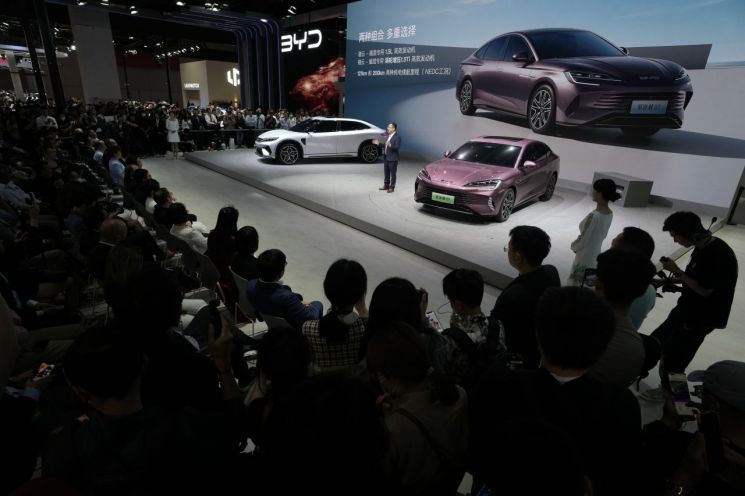
The Ministry of Commerce further urged, "To strengthen transportation security, strategic mid- to long-term cooperation with shipping companies must be promoted," adding, "Shipping companies should also establish dedicated teams to expand automobile export transportation capabilities." It also explained, "We will support improving international marketing and after-sales service (AS) systems, as well as enhancing capabilities for brand promotion, exhibitions, and sales services overseas."
The ministry particularly highlighted the recent rapid growth in China's automobile export volume and the diversification of trading partners. Despite the COVID-19 pandemic spreading in 2021 and 2022, the sector showed strong growth, and from January to April this year, 1.494 million vehicles were sold, a sharp increase of 76.5% compared to the previous year.
During the same period, the number of export destination countries reached 204, with exports to Belt and Road Initiative countries totaling $13.64 billion (approximately 18.1548 trillion KRW). Exports to developed countries increased by 41.8% to $12.41 billion. Notably, electric vehicles accounted for 42.9% of the total export volume during this period, contributing about 51.6% to the export growth.
Meanwhile, as sales have concentrated on specific companies such as BYD, a tense situation is unfolding within the Chinese automobile industry. According to multiple local media reports, Changcheng Automobile announced in a statement on the same day that it had reported to the Ministry of Ecology and Environment, the State Administration for Market Regulation, and the Ministry of Industry and Information Technology that BYD vehicles are suspected of emitting pollutants exceeding the standard limits. Changcheng Automobile, which mainly sells sport utility vehicles (SUVs), saw its sales drop sharply by 46.72% to 53,800 units from January to April compared to the previous year, while BYD sold 776,600 units during the same period, showing a growth rate of 96.91%.
© The Asia Business Daily(www.asiae.co.kr). All rights reserved.

















