Analysis of Telemedicine and Drug Delivery via Local Law Firms
"Most Primary and Follow-up Visits Have No Restrictions"
The Remote Medical Industry Council (Wonsanhyeop), composed of non-face-to-face medical platform companies, disclosed on the 26th an analysis of non-face-to-face medical treatment and pharmaceutical sales and delivery systems in major overseas countries. Excluding the United States, where detailed policies vary by state, local law firms surveyed G7 countries including Japan, France, Germany, the United Kingdom, Italy, and Canada, finding that a significant number of countries allow non-face-to-face initial consultations.
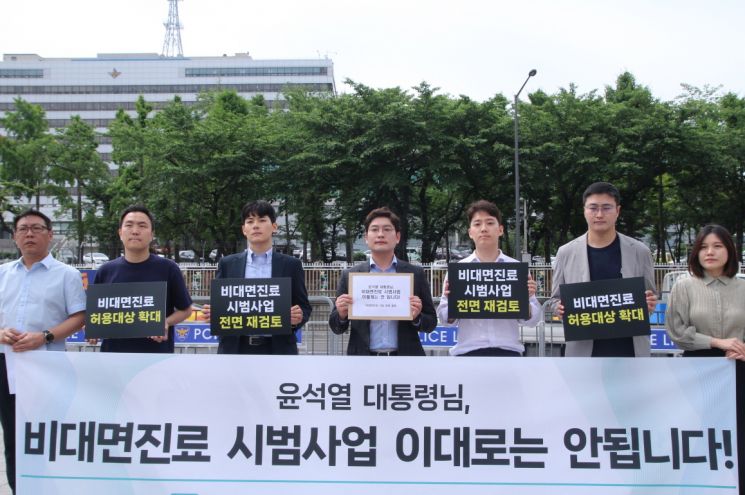 The Remote Medical Industry Council publicly released an "Appeal to the President" in front of the Presidential Office in Yongsan-gu, Seoul, urging a full reconsideration of the pilot project for non-face-to-face medical treatment currently being promoted by the Ministry of Health and Welfare.
 [Photo by Remote Medical Industry Council]
According to Wonsanhyeop, Japan revised the "Guidelines for the Proper Implementation of Online Medical Treatment" in January last year, maintaining the principle of non-face-to-face treatment through a regular doctor while allowing initial consultations by doctors other than the regular doctor through broad exceptions. Additionally, since September 2020, the delivery of prescribed medicines and remote medication guidance have also been permitted.
The United Kingdom allows remote medical treatment in the same way as face-to-face treatment without separate regulations. The "Good Practice Principles for Remote Consultation and Prescription" announced in 2019 by the British Medical Association and others permit initial remote consultations at the discretion of healthcare providers regardless of continuous treatment. France has allowed non-face-to-face medical treatment since 2018, and in April last year, the French National Health Insurance Fund issued "Good Practice Guidelines for Remote Consultation," explicitly stating that initial consultations are not a reason to exclude remote medical treatment.
Germany allowed remote medical treatment by revising the "Code of Conduct for Medical Professionals" in 2018, and through an additional revision in May 2021, permits "exclusively remote medical treatment" by doctors other than the primary care physician. Additional regulations were introduced, such as limiting the proportion of remote medical treatment to 30% of total consultations. Wonsanhyeop regarded Italy as the only G7 country allowing follow-up consultations. Italy has permitted remote medical treatment since 2014 under the "Telemedicine Guidelines," utilizing it as a monitoring concept for patients already officially diagnosed through face-to-face treatment.
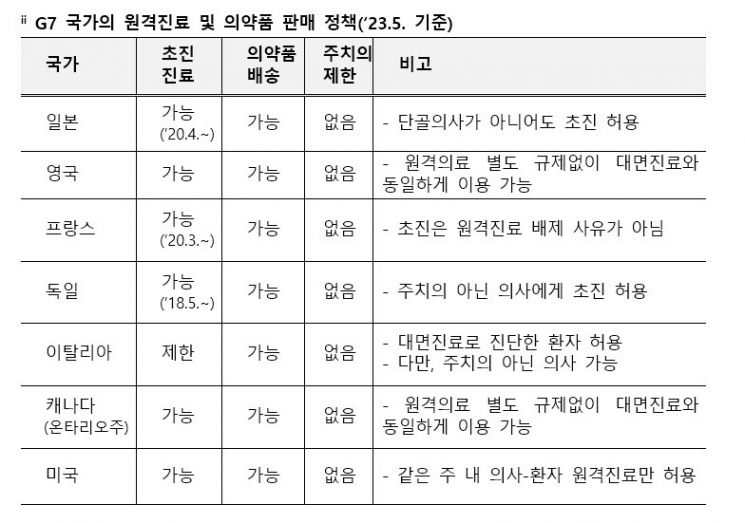
Wonsanhyeop analyzed, "As presented in the Ministry of Health and Welfare's pilot project plan for non-face-to-face medical treatment, there are no cases limiting the target by detailed provisions such as follow-up status, residence, or age," and "rather, it encourages medical professionals to make decisions based on their expert judgment in the medical field." They added, "Regarding the current contentious issues of initial and follow-up consultations, all countries except Japan did not define initial and follow-up consultations," and "although some medical associations recommend face-to-face first consultations, no government has enforced this through regulation."
Jang Ji-ho, co-chairman of Wonsanhyeop, emphasized, "Major global countries are already minimizing regulations and developing non-face-to-face medical treatment by prioritizing the professional capabilities of medical staff," and "Korea also operated a safe and effective medical service system as a result of frontline medical staff's judgment prioritizing patient benefits during the COVID-19 period." He added, "The Ministry of Health and Welfare should not be satisfied with showy discussions with medical associations for immediate benefits but should strive to build a healthcare system that truly benefits all citizens."
This survey was conducted by Wonsanhyeop commissioning local law firms in each country. Mori Hamada & Matsumoto Law Office participated for Japan; McDermott Will & Emery LLP for France, Germany, the United Kingdom, and Italy; and Blake, Cassel & Graydon LLP for Canada. Wonsanhyeop stated that if requested by the Ministry of Health and Welfare, it will disclose the original materials received from each country's law firms and engage in discussions.
© The Asia Business Daily(www.asiae.co.kr). All rights reserved.


















