Consumer Insight Analyzes Pre- and Post-COVID with TCI
Quarter Reduced to One-Quarter, 1.3 Times Increase Compared to Q1 2019
Amid the endemic phase (periodic outbreaks of infectious diseases) and increasing demand for overseas travel centered around nearby regions, interest among our citizens in traveling to Japan has risen by about 30% compared to before the occurrence of the 'Japan product boycott movement (No Japan)'.
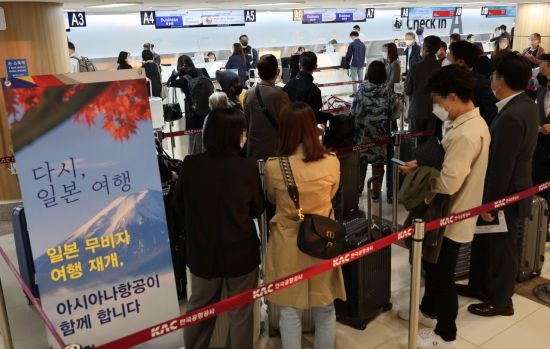 Due to the spread of COVID-19, visa-free (visa exemption) travel for Koreans to Japan, which had been suspended, resumed last October. Passengers are waiting at the Asiana Airlines international counter at Gimpo International Airport to check in for the Gimpo-Haneda flight.
 [Image source=Yonhap News]
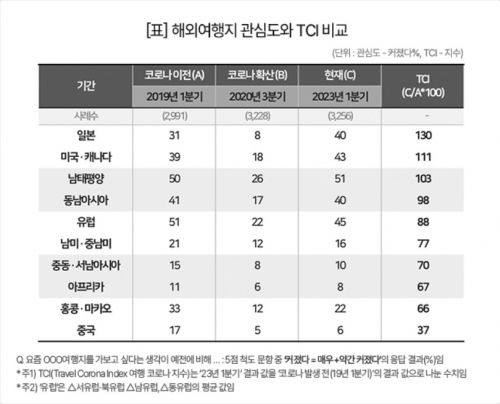
On the 26th, Consumer Insight, a specialized consumer research agency, announced the results of a survey on travel behavior and plans for the first quarter of this year, conducted with over 3,000 consumers. According to the results, interest in traveling to Japan increased by 9 percentage points compared to the first quarter of 2019 (31%), showing the largest growth. Consumer Insight applied its self-developed COVID-19 Travel Index (TCI) to this survey. The TCI quantifies the difference between 2019, before the COVID-19 outbreak, and the present, intuitively showing the degree of change during this period. With an index of 100 as the baseline, a higher number indicates an increase, while a lower number indicates a decrease.
The first quarter of 2019 was before the No Japan movement occurred. In July of that year, Japan unilaterally imposed export restrictions on South Korea, which led to the spread of the No Japan movement domestically. Reflecting the TCI, interest in traveling to Japan rose from 31% in the first quarter of 2019 to 40% in the first quarter of this year, recording 130, a 1.3 times (30%) increase. Compared to the TCI for the same period for the United States and Canada (111), South Pacific (103), Southeast Asia (98), and Europe (88), the rise in interest in traveling to Japan is particularly notable.
The region with low interest is the Greater China area. China’s TCI was the lowest at 37, indicating that interest in traveling to China has shrunk to about one-third compared to before COVID-19.
Consumer Insight explained this as a result of the THAAD (Terminal High Altitude Area Defense) conflict, the suppression of the Hong Kong democracy movement, and the perception that China was the origin of COVID-19. They added, "The No Japan movement cut interest in traveling to Japan to a quarter in a short period, but the recent sharp rebound shows that the boycott’s effect was temporary. Travel sentiment cannot be separated from historical issues between countries, diplomatic matters, or international situations, but ultimately, the consumer’s mindset is the most important."
Meanwhile, interest in most overseas travel destinations fell to less than half after the outbreak of COVID-19 in 2020, but as daily life recovers, there is a gradual upward trend after the dark period. Especially this year, the overall travel sector is clearly recovering to pre-COVID-19 levels. Interpark reported that as of this month, overseas travel package reservations increased by 43% compared to the same period in 2019, and during the same period, Chamjoeun Travel’s overseas travel package reservations recovered by more than 90%. However, the TCI remains low for regions with poor geographic accessibility and delayed travel infrastructure recovery, such as Latin America and Central and South America (77), the Middle East and Southwest Asia (70), and Africa (67).
© The Asia Business Daily(www.asiae.co.kr). All rights reserved.
![Clutching a Stolen Dior Bag, Saying "I Hate Being Poor but Real"... The Grotesque Con of a "Human Knockoff" [Slate]](https://cwcontent.asiae.co.kr/asiaresize/183/2026021902243444107_1771435474.jpg)

















