Discovered in a Painting Completed in 1652, Causing a Stir
Lacks Realism to Be Considered Actual Nike
Phenomenon of Interpreting Ambiguous Information as Desired
Interpretations that a Nike logo was hidden on the shoes of a boy in a portrait painted 400 years ago have been gaining popularity among museum visitors.
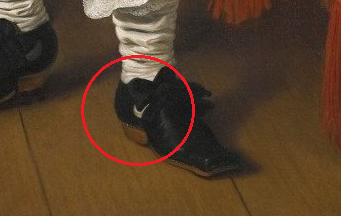
On the 24th (local time), the British daily Daily Mail reported that a Nike logo was discovered on the shoes of an 8-year-old boy in a painting created in 1652, sparking a sensation.
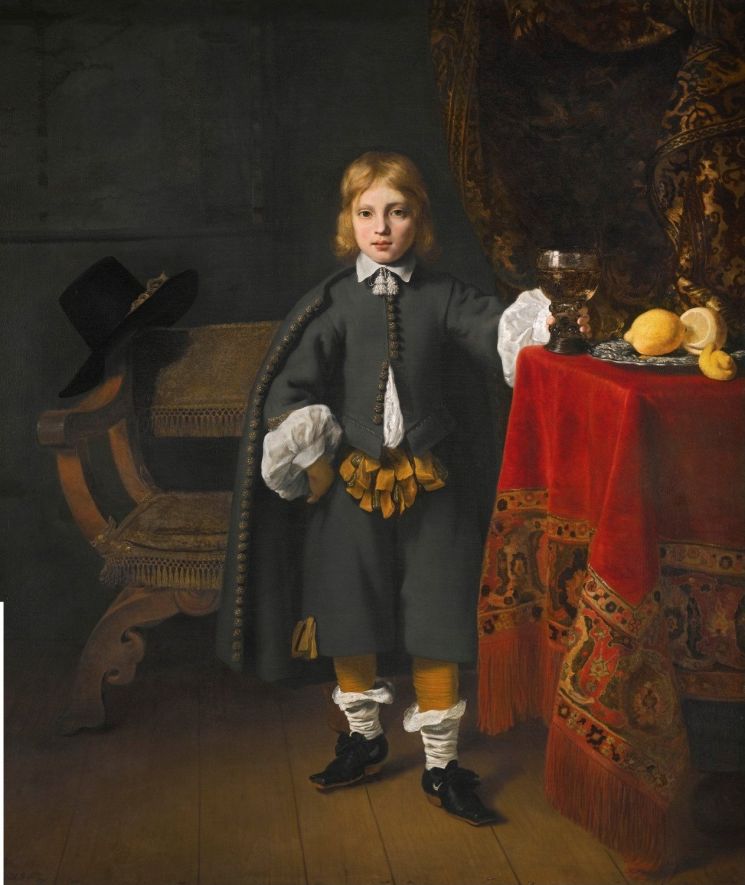
The artwork is titled "Portrait of a Boy," painted by Dutch artist Ferdinand Bol. It is currently held by the London Museum.
The subject of the painting is known to be Frederik Sluisken, the son of a wealthy wine merchant at the time.
The composition shows him holding a cup with his left hand on a table covered with a red cloth, wearing clothing that appears to be noble attire, including a lace-trimmed shirt and a black jacket.
Looking at the lower part of the painting, a pattern resembling the Nike logo is drawn on the black shoes the boy is wearing.
A visitor who saw the painting in person said, "I saw the Nike logo on the boy's shoes in the painting at the London Museum with my daughter," adding, "My daughter and I had a long conversation about how this painting is proof that time travelers exist."
As the painting became a hot topic, a representative of the London Museum said, "We are pleased that this painting has become popular among visitors," and added, "We shared this painting on social media, and many people said the design of the boy's shoes looks very modern and so stylish that they could believe it was a recently made product."
Ambiguous information is interpreted 'as I know it'... the 'Pareidolia Phenomenon'
 Cracked hills on Mars that look like a 'teddy bear.' Discovered by NASA's Mars Reconnaissance Orbiter (MRO). [Photo by NASA/JPL-Caltech/UArizona]
Nike is a brand established in January 1964 in Oregon, USA. It obviously did not exist when this artwork was completed. Realistically, there is no possibility that the boy in the painting was wearing Nike shoes.
So why do visitors cheer, claiming to see the Nike pattern in a 400-year-old artwork? This can be seen as a kind of 'pareidolia phenomenon.'
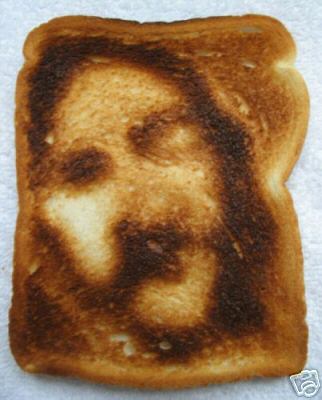 A photo known as the 'Jesus face shape appearing on toast' that became a hot topic on overseas social media.

Humans instinctively try to find order or meaningful patterns in chaotic shapes. When given ambiguous visual stimuli, humans tend to interpret them as other objects or people. The rabbit seen on the moon is a representative example.
Famous cases also include seeing the face of Jesus in stains on cloth or the face of a demon in flames.
Astronomer Carl Sagan explained the visual pareidolia phenomenon as an evolutionary trait of humans.
When infants can see with their eyes, they immediately recognize faces. If an infant cannot recognize their parents' faces and smile at them, it results in a lower chance of survival. If they do not recognize faces and smile, it is harder to win their parents' affection compared to other children, and they are less likely to receive proper care. According to Sagan, all infants can distinguish their parents' faces and smile, and humans have a tendency to seek out faces.
© The Asia Business Daily(www.asiae.co.kr). All rights reserved.



















