Driving Rise in Gangnam Area... Seoul Jeonse Prices Also Turn Upward
Seoul apartment prices have turned to an upward trend after more than a year. Recently, the atmosphere of rising transactions following the depletion of urgent sale properties in the Gangnam area seems to be spreading to various places.
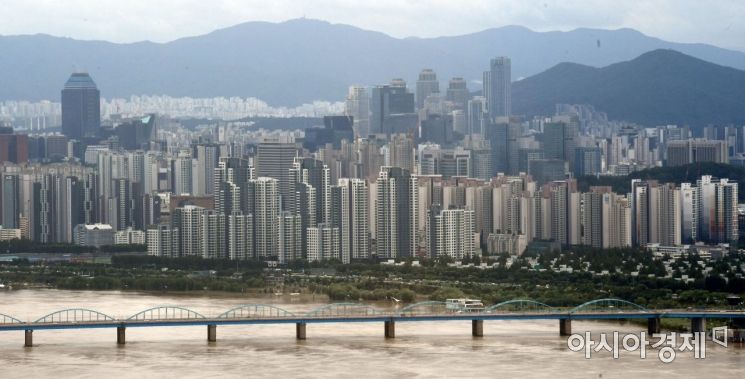 View of the apartment complexes along the Gangnam Han River as seen from the 63 Observatory in Yeouido, Seoul. / Photo by Hyunmin Kim kimhyun81@
According to the weekly apartment price trend announced by the Korea Real Estate Board on the 25th, Seoul apartment prices rose by 0.03% in the fourth week of May (as of the 22nd), marking an upward turn for the first time in over a year since the first week of May last year (0.01%).
Seoul apartment prices had continued to decline for 51 consecutive weeks due to interest rate hikes and a transaction freeze. However, following government policies such as the lifting of regulations in areas excluding the three Gangnam districts (Gangnam, Seocho, Songpa) and Yongsan-gu, as well as easing of loan and tax regulations earlier this year, low-priced properties have been sold off and asking prices have started to rise.
The upward trend was led by the Gangnam area. Seocho-gu (0.13%) and Gangnam-gu (0.19%) rose for six and five consecutive weeks respectively, and Songpa-gu saw its increase expand from 0.11% last week to 0.26%. For example, the Resence apartment in Jamsil-dong with an exclusive area of 84.99㎡ had urgent sale properties priced at 1.8 to 1.9 billion KRW sold out in January and February this year, and on the 18th and 24th of this month, it changed hands at 2.22 billion KRW and 2.23 billion KRW respectively. This means a rise of 200 to 300 million KRW in about three months. Gangdong-gu (0.05%) also continued its upward trend.
Dongjak-gu (0.05%) and Yongsan-gu (0.04%) rose for the third consecutive week. Mapo-gu (0.02%) also rose for two consecutive weeks, and Jung-gu turned to an increase from -0.01% to 0.03%. Yangcheon-gu (0.00%), centered on the redevelopment projects in the Mokdong new town complex, stopped its decline that had continued since the second week of June last year and recorded a flat trend for the first time in about 11 months.
Incheon (0.02%) rose for two consecutive weeks. However, there were differences by region. Seo-gu (0.11%) rose due to new complexes in Dangha, Gajeong, and Cheongna-dong, while Gyeyang-gu (-0.21%) and Michuhol-gu (-0.20%) declined due to the supply of older complexes.
Gyeonggi Province (-0.06%) saw a larger decline compared to the previous week (-0.02%). Cheoin-gu in Yongin-si (0.32%), benefiting from the development of national industrial complexes, rose for nine consecutive weeks, and Yongin-si (0.03%), Hwaseong-si (0.15%), and Gwangmyeong-si (0.08%) also showed strength. However, Pyeongtaek-si (-0.04%), which reversed its four-week consecutive rise, as well as Yangju-si (-0.97%), Gwangju-si (-0.48%), and Anseong-si (-0.38%) were weak.
Jeonse prices nationwide narrowed their decline from -0.10% to -0.08%. In particular, Seoul (-0.06% to 0.01%) rose for the first time in one year and four months since the third week of January last year (0.01%). The Real Estate Board explained, "With concerns about further declines in Jeonse prices decreasing, urgent sale properties in large complexes with locally favorable residential conditions have been sold off, leading to successful rising transactions."
The decline in the metropolitan area (-0.06% to -0.04%) and local areas (-0.15% to -0.12%) also narrowed. Among them, Sejong rose by 0.05%, continuing its upward trend for eight consecutive weeks since turning to an increase in the last week of March.
© The Asia Business Daily(www.asiae.co.kr). All rights reserved.

















