There is a warning that the more companies strengthen global ESG (Environmental, Social, and Governance) risk management at the supply chain level, the higher the possibility of conflicts with regulations against unfair management interference.
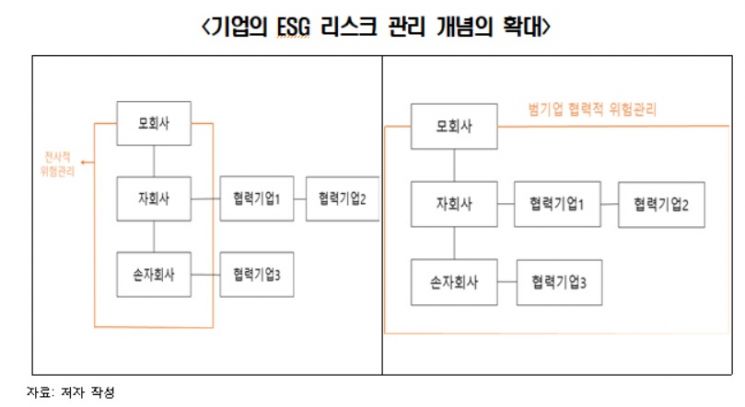
On the 26th, the Korea Economic Research Institute (hereinafter KERI) stated in its report titled 'Implications of Overseas ESG Litigation and Corporate Risk Management' that even if companies faithfully comply with supply chain due diligence guidelines, it is impossible to completely prevent ESG risks from occurring.
If damage occurs, the company in question must bear liability for violating the 'duty of care.' Of course, the parent company that exercises management and supervision over the company is not exempt from responsibility. This is because the parent company's management and supervision of its subsidiaries and partners can itself serve as a strong legal basis for liability.
This creates an ironic situation where the more companies comply with global ESG regulations, the greater their legal liability becomes when damage occurs. However, companies cannot simply choose not to comply with global ESG regulations, as access to overseas markets could become impossible.
The only thing companies can do is actively manage ESG-related risks. In this case, it is necessary to establish a strong ‘collaborative’ relationship with partner companies. The success or failure of ESG risk management depends on how effectively risk management can be enforced even on partner companies without equity relationships.
However, as companies’ legal liability for ESG risks increases, the intensity of risk management and supervision over partner companies inevitably becomes stronger, which partner companies may perceive as ‘unfair management interference.’ This is why regulatory authorities need to provide guidelines to prevent conflicts between ESG risk management and prohibitions on management interference in advance, thereby reducing uncertainty.
Lee Taegyu, a senior researcher at KERI, said, “Major large corporations have established ESG codes of conduct for their partners and are practicing ESG risk management at the supply chain level, but if partner companies feel that the cost of complying with these codes is too high, they will try to evade the codes.” He explained, “In this process, if large corporations intensify ESG risk management over their partners, there is a possibility of conflict with domestic regulations (such as the Subcontracting Act and the Fair Trade Act) that prohibit ‘unfair management interference.’”
© The Asia Business Daily(www.asiae.co.kr). All rights reserved.
![User Who Sold Erroneously Deposited Bitcoins to Repay Debt and Fund Entertainment... What Did the Supreme Court Decide in 2021? [Legal Issue Check]](https://cwcontent.asiae.co.kr/asiaresize/183/2026020910431234020_1770601391.png)















