Government to Begin Full Discussions in 'Legislative Consultation'
Civil Society Groups like Kyungsilryeon Also Call for "Expansion of Quotas"
Discussions Expected to Accelerate on PA Nurse Issues and More
The increase in medical school quotas, considered one of the biggest issues in the healthcare sector alongside the Nursing Act and telemedicine, is heating up in earnest. Although the medical community is being praised for a complete victory after the veto (reconsideration request) of the Nursing Act bill and the incorporation of doctors' groups' opinions into the telemedicine pilot project plan, it appears to be under all-around pressure regarding the increase in medical school quotas.
According to the Ministry of Health and Welfare on the 25th, while some quarters are discussing a specific increase in medical school quotas in the range of 300 to 500, the government still maintains the position that "nothing has been finalized." However, it has clearly expressed its intention to discuss the increase in medical school quotas through the ongoing 'Medical Issues Consultative Body' (Uijeong Consultative Body) with the medical community, including the Korea Medical Association. At the full meeting of the National Assembly's Health and Welfare Committee last month, Minister of Health and Welfare Cho Kyu-hong said, "We are consulting with the medical community according to the Uijeong Consultative Body, but we cannot keep being dragged along just because discussions are being avoided," adding, "There are many demands for new medical schools in regions, and there is also an urgent opinion that people should be able to live and work in those regions. We will find the optimal alternative and use it to rebuild essential medical care." This is interpreted as a declaration that the government will no longer be swayed by the opposition of the medical community.
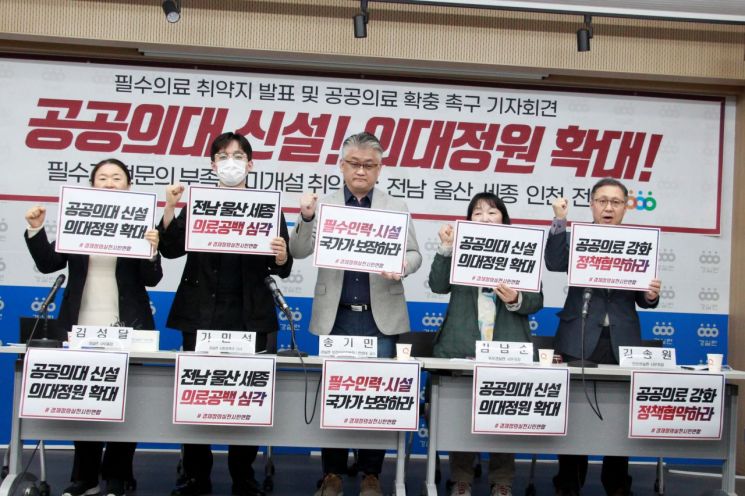 The Citizens' Coalition for Economic Justice held a press conference on the 11th of last month, demanding the establishment of a public medical school and the expansion of medical school quotas.
 [Photo by Kyungsilryeon]
Not only the government but also civil society has stepped up pressure to increase medical school quotas. The Citizens' Coalition for Economic Justice (CCEJ) argues that to resolve the current medical vacuum, the medical school quota must be increased by at least 1,000, assuming the establishment of public medical schools. At 11 a.m. on the same day, they plan to hold a 'National CCEJ Press Conference Urging the Yoon Seok-yeol Government to Expand Medical School Quotas' in front of the Presidential Office in Yongsan-gu, Seoul, calling on President Yoon Seok-yeol to directly address the medical school quota issue. The CCEJ emphasized, "The core of Korea's medical vacuum is the absolute shortage of doctors to treat patients and the concentration of the limited number of doctors in popular specialties and specific regions," adding, "To solve this, the medical school quota, which has been fixed at 3,058 for 18 years, must be significantly expanded, and a basis must be established to allocate doctors to essential specialties and medically underserved areas."
In particular, following the veto of the Nursing Act, the controversy over the scope of work of so-called 'PA (physician assistant) nurses' has further highlighted the need to increase medical school quotas. The nursing community has entered a 'lawful struggle,' bringing the PA nurse issue to the surface, and the background to their illegal medical practices is the shortage of medical personnel. The Nursing Act incident has thus become linked to the increase in medical school quotas.
On the other hand, the medical community points out that the problem lies not in the number of medical school quotas but in the current medical system. The Korea Medical Association stated, "The shortage of personnel in essential and public medical fields is not due to a lack of total doctors but stems from structural problems such as the government's lack of proper doctor workforce supply policies and poor medical environments in regions and medically underserved areas," adding, "The argument that simply increasing the total number of doctors or establishing public medical schools because there is a shortage of doctors in certain fields or regions is a fragmentary and irresponsible measure that cannot be a fundamental solution." The Korean Intern Resident Association also suggested solutions such as hiring additional skilled doctors like in-house full-time doctors and contract doctors and establishing personnel standards per hospital bed.
Despite such opposition from the medical community, the government's determination is firm, and with pressure from civil society and high public support for increasing medical school quotas, discussions are expected to accelerate. There are also prospects that the government and the medical community will find a compromise in the Uijeong Consultative Body. In a public opinion poll commissioned by the National Health and Medical Industry Labor Union to the polling agency Southern Post in March, surveying 1,000 adults aged 19 and over nationwide, 66.7% of respondents supported expanding medical school quotas. Additionally, 58.4% answered that there is a shortage of doctors. The Health and Medical Labor Union urged, "The government should not delay any longer and must take action to eradicate illegal medical practices, expand medical school quotas, and establish appropriate medical personnel standards."
© The Asia Business Daily(www.asiae.co.kr). All rights reserved.
!["The Woman Who Threw Herself into the Water Clutching a Stolen Dior Bag"...A Grotesque Success Story That Shakes the Korean Psyche [Slate]](https://cwcontent.asiae.co.kr/asiaresize/183/2026021902243444107_1771435474.jpg)
















