Jeon Hae-cheol "Legislature Must Respond to Confusion in Labor Field"
"More Discussion and Efforts to Prepare Alternatives Needed Before Plenary Session"
"I acknowledge the shortcomings."
Jeon Hae-cheol, Chairman of the National Assembly Environment and Labor Committee (member of the Democratic Party of Korea), expressed this sentiment on the 24th during the process of answering questions while handling the agenda for the request to refer the partial amendment bill of the Labor Union and Labor Relations Adjustment Act, known as the Yellow Envelope Act, to the plenary session.
Earlier, Im Eui-ja, the senior member of the People Power Party in the Environment and Labor Committee, raised responsibility issues against Chairman Jeon, saying, "The Yellow Envelope Act only increases confusion on the ground and causes conflicts. Why do you want to do this (direct referral to the plenary session)?" and added, "You are a lawyer, so you should know better."
In response, Chairman Jeon said, "The Environment and Labor Committee has discussed this bill for more than six months," and explained, "This bill was not decided from scratch regarding the scope of the employer or the extent of damages, but rather aimed to legislatively resolve 'how to deal with the current Supreme Court precedents.'" He continued, "As you well know, according to the Supreme Court precedents, there have been countless trial and error situations on the ground about whether to interpret these precedents one way or another," and criticized the National Assembly and government for shirking responsibility by saying, "If so, the legislature should provide answers and come up with solutions, whether narrow or broad, right or wrong. However, no solutions were provided, leaving labor-management relations on the ground to fight, compromise, or cause endless conflicts."
He acknowledged, "This law did not fully reflect the government's opinions, and there were parts where the ruling party's opinions were not reflected," but explained, "At least if there are Supreme Court precedents, the legislature should have reached some conclusion in any way." He added, "We could not delay the procedural discussion in the Environment and Labor Committee, and if there is agreement on changing the agenda, a judgment should be made accordingly."
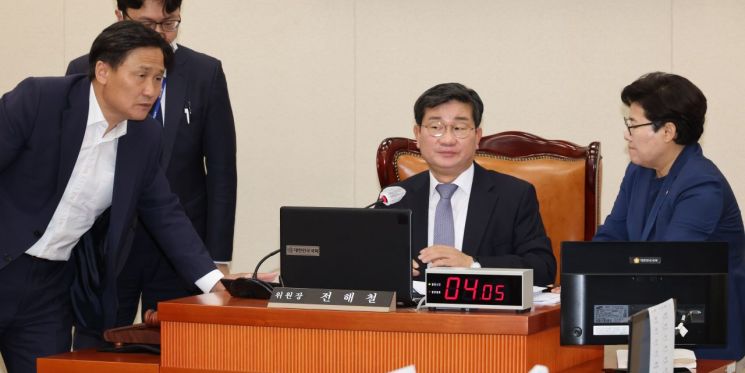
On that day, the Environment and Labor Committee, led solely by the opposition party, directly referred the Yellow Envelope Act to the plenary session. The Yellow Envelope Act was passed solely by the opposition in the Environment and Labor Committee on February 21 and then moved to the Legislation and Judiciary Committee. Subsequently, it was submitted to the Legislation and Judiciary Committee on March 27 for systematic and legal review, but the review has not been completed even after 90 days since referral. Accordingly, opposition members of the Environment and Labor Committee, based on Article 86 of the National Assembly Act, which allows the standing committee to decide on direct referral to the plenary session if the review is not conducted for more than 60 days without reason, resolved to change the agenda and submit the direct referral agenda. The justification was that the Legislation and Judiciary Committee was deliberately delaying the bill review to block the bill's passage.
The Yellow Envelope Act includes provisions that allow parties who are not signatories to the employment contract but have a substantial and concrete position to control and decide the working conditions of workers, such as the original contractor, to be considered employers, and limits claims for damages related to labor disputes. The Yellow Envelope Act was proposed in the 21st National Assembly following the trial of the subcontractor union strike at Daewoo Shipbuilding & Marine Engineering. Last August, Daewoo Shipbuilding & Marine Engineering filed a damage claim worth 47 billion KRW against five executives of the subcontractor union.
Although there were precedents from the Supreme Court and administrative courts related to this law, criticism continued that each case had to be concluded through trials because it was not legislatively settled. At a forum held in the National Assembly last February, Park Soo-geun, a professor at Hanyang University Law School and former chairman of the Central Labor Relations Commission, expressed concern, saying, "If there is no legislation on the Yellow Envelope Act, conflicts between companies and unions will occur, and labor-management relations could intensify." The legal community also worried that even with established precedents, if legislation is not enacted, both labor and management would have to knock on the court's door and wait 5 to 6 years for Supreme Court rulings.
For Chairman Jeon, the more the legislature neglects its duties, the less it can leave matters solely to the judiciary and litigants. He also urged both ruling and opposition parties and the government to engage in more responsible discussions before the plenary vote regarding the bill proceeding solely by the opposition. Chairman Jeon said, "When a conclusion is reached in the Environment and Labor Committee, it should not be considered final; it should be discussed and debated in the plenary session, and it is our role to prepare more discussions and alternatives outside the chamber."
© The Asia Business Daily(www.asiae.co.kr). All rights reserved.
![Clutching a Stolen Dior Bag, Saying "I Hate Being Poor but Real"... The Grotesque Con of a "Human Knockoff" [Slate]](https://cwcontent.asiae.co.kr/asiaresize/183/2026021902243444107_1771435474.jpg)
















