Dong-A University held an awards ceremony for excellent certification targeting programs proven to have qualitative excellence in the pilot evaluation of non-curricular program certification.
The Dong-A University Institute for Educational Innovation has been conducting a pilot evaluation since last year while carrying out the "Development of Non-Curricular Education Program Certification Indicators and Research on the Introduction of Certification System" to enhance the qualitative level of non-curricular education, strengthen program substance, and spread the achievements of excellent programs.
As a result of this excellent certification pilot evaluation, a total of five programs were finally selected as excellent programs.
The grand prize was awarded to "Dong-A Muse (Seokdang Museum Curatorial Research Department)".
The excellence awards were given to the programs "Dong-A UT Mentoring (Student Counseling Center)", "Career Peer Mentoring (Career Development Center)", "JUMP-UP Major Mentoring (Teaching and Learning Development Center)", and "Dong-A Talent Donation Volunteer Group (Student Welfare Department)".
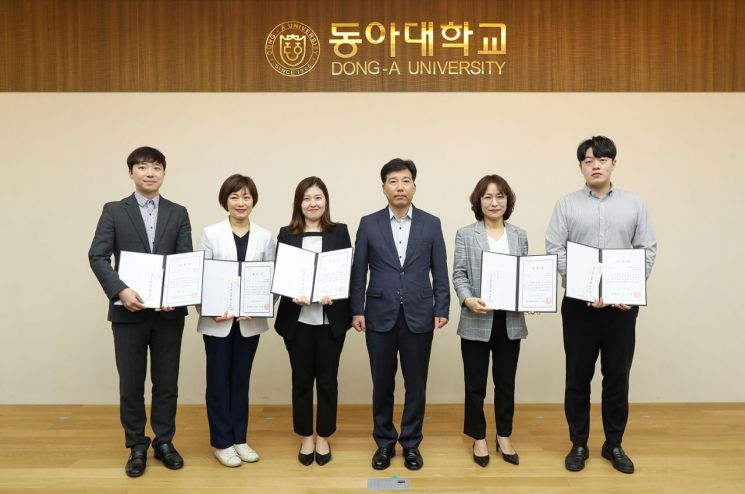 (From left) Nam Seung-deok, curator at Dong-A University, Kang Jin, research professor at the Center for Teaching and Learning Development, Bang Hee-won, research professor at the Career Development Center, Lee Hae-woo, president, Yoon Mi, research professor at the Student Counseling Center, Song Myung-geun, staff at the Student Welfare Department, and others are posing for a commemorative photo at the 'Non-Curricular Education Program Certification Pilot Evaluation Awards Ceremony.'
"Dong-A Muse," operated by the Seokdang Museum, is a program where enrolled students complete various training courses as prospective curators and directly plan museum exhibitions based on this training.
The program received the grand prize for realizing cultural sharing with socially vulnerable groups by producing Braille guides and translations for the visually impaired, and contributing to the cultural development of the local community.
This program was highly evaluated from various perspectives, including its purpose of culturally contributing to the local community, solid program structure and educational content, high educational value, student satisfaction, and strong quantitative outcomes.
The non-curricular education program certification system consists of two stages of evaluation. The first stage, basic certification evaluation, is a quantitative assessment of basic requirements such as satisfaction scores and completion rates. The second stage, excellent certification evaluation, is a qualitative assessment conducted separately by judges on the achievements of programs that have obtained basic certification.
Programs selected for excellent certification receive double non-curricular points, separate promotional support, an excellent certification badge, and a modest prize for the operating department. The validity period is two years.
Kang Young-jo, Director of the Institute for Educational Innovation, said, "During the pilot evaluation process of the non-curricular certification system, many excellent non-curricular programs and educational achievements within the university were shared and empathized with by members," adding, "Starting this year, we will fully operate the non-curricular certification system to continuously improve the qualitative level of non-curricular education within the university."
© The Asia Business Daily(www.asiae.co.kr). All rights reserved.

















