"Possible to Sink US Carrier Strike Group with 24 Missiles"
"Low Data Reliability May Lead to Inaccurate Conclusions"
Chinese researchers claimed that wargame results showed the Chinese military sinking the United States' most advanced aircraft carrier strike group in the South China Sea using hypersonic missiles. They demonstrated military power by asserting that it is entirely possible to sink U.S. carriers with the hypersonic anti-ship missiles China possesses. However, some military experts within China questioned the accuracy of the data on these missiles and raised doubts about the reliability of the results.
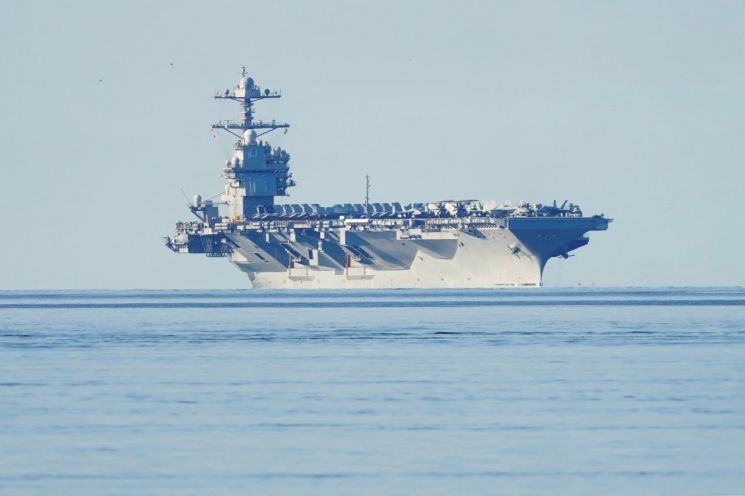
According to the Hong Kong South China Morning Post (SCMP) on the 24th, this month, the Chinese journal Ceshi Jishu Xuebao (測試技術學報) published the contents of a wargame conducted by researchers from Zhongbei University in Shanxi Province, China, set in the South China Sea. The university is known for having a large number of graduates working in China's aerospace and defense industries and maintaining close ties with the People's Liberation Army.
The researchers stated that in 20 combat simulations conducted on the mainstream wargame software platform used by the Chinese military, the aircraft carrier strike group centered on the U.S. Navy's most advanced carrier, the Gerald R. Ford (CVN-78), was sunk by 24 hypersonic anti-ship missiles.
The scenario of the wargame involved U.S. naval vessels continuing to approach islands claimed by China in the South China Sea despite repeated warnings from the Chinese military, resulting in attacks. According to the researchers, almost all U.S. naval vessels in the wargame were eventually sunk by Chinese military attacks.
The U.S. naval vessels featured in the simulation included the Gerald R. Ford, the Ticonderoga-class missile cruiser USS San Jacinto, and four Arleigh Burke-class Flight IIA missile destroyers, totaling six ships. The nuclear-powered aircraft carrier Gerald R. Ford, commissioned in 2017, has a displacement of 101,600 tons, making it the largest and most modern carrier in the U.S. Navy. It is classified as a powerful strategic asset equipped with state-of-the-art radar and electronic warfare systems.
The researchers claimed that the two types of anti-ship missiles used by the Chinese military cruise at high altitudes, can reach a top speed of Mach 11, and can sink an aircraft carrier or large warship with two strikes. However, they warned that the missile performance shown in the wargame could differ in actual combat due to terrain, weather, and other unpredictable factors, so caution is necessary.
The announcement of these wargame results has attracted significant attention as it comes amid escalating hegemonic conflicts between the U.S. and China over the Taiwan Strait and the South China Sea. SCMP pointed out that "this is the first time China has disclosed wargame results involving hypersonic attacks against a U.S. carrier strike group," adding that "the reason China made this disclosure is unknown."
However, some military experts expressed skepticism about the performance of the hypersonic missiles featured in the wargame. An aerospace defense industry engineer in Beijing, who requested anonymity, told SCMP, "If the data on the Chinese hypersonic missiles used in this wargame are detached from reality, it could affect the quality of the simulation and lead to inaccurate results."
© The Asia Business Daily(www.asiae.co.kr). All rights reserved.

















