From May Next Year, CCyB Raised from 0% to 1%
Enhancing Banks' Loss Absorption Capacity Amid Economic Uncertainty
Last Year's Banking Sector Net Profit 18.5 Trillion Won... "Sufficient Capacity"
The financial authorities have decided to impose a countercyclical capital buffer (CCyB) on banks and bank holding companies. This is to strengthen banks' loss-absorbing capacity amid increasing economic uncertainties domestically and internationally and expanding risks in the financial markets.
On the 24th, the Financial Services Commission held a regular meeting and resolved to raise the CCyB accumulation level for banks and bank holding companies to 1%. This is a follow-up measure to the direction for improving the banking sector's soundness system discussed at the third working group meeting of the Banking Sector Management, Business Practices, and System Improvement Task Force (TF) held in March.
The CCyB is a system that imposes an additional capital accumulation obligation on banks within the range of 0 to 2.5% of risk-weighted assets, considering the impact of credit supply-related economic fluctuations on the financial system and the real economy. Since its introduction in 2016, it has been maintained at 0%.
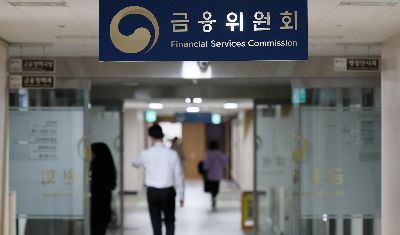 On the 9th, officials were busy moving in the corridor of the Financial Services Commission at the Government Seoul Office in Jongno-gu, Seoul, where financial authorities decided to include mortgage loans (Judaemdae) in the 'debt refinancing' infrastructure scheduled to be launched in May by the end of the year. Financial authorities explained that they aim to reduce the interest burden on mortgage loans by building a debt refinancing platform that allows users to compare financial sector loan interest rates at a glance and switch loans easily. Photo by Dongju Yoon doso7@
The authorities' decision to impose the CCyB is based on a comprehensive consideration of related indicators and the current soundness status of domestic banks. Although the increase in household credit has slowed due to the continuous base rate hikes since last year, corporate credit continues to grow at a high rate. Accordingly, high accumulation signals have appeared in the main indicator for CCyB accumulation, the 'total credit/domestic gross domestic product (GDP) gap,' and the supplementary indicator, the 'total credit gap.' The total credit/GDP gap is an indicator showing how quickly credit supply has increased relative to the speed of economic growth.
Furthermore, at the end of last year, the common equity tier 1 capital ratio of domestic banks was 13.50% (12.57% including holding companies), exceeding the regulatory ratio (7.0?8.0%), but it slightly declined compared to the end of 2021 (13.99%) due to last year's interest rate hikes and sharp exchange rate fluctuations. In particular, domestic banks are evaluated to have additional capital accumulation capacity, having generated approximately KRW 18.5 trillion in net income last year, an increase of KRW 1.6 trillion compared to the previous year.
The Financial Services Commission stated, "Along with this, the authorities judge that it is necessary to enhance banks' loss-absorbing capacity through proactive capital expansion in preparation for domestic and international macroeconomic uncertainties, increased financial sector risks, and the possibility of realizing latent losses," adding, "Major foreign countries are also actively utilizing the CCyB to respond to increased liquidity during the COVID-19 pandemic."
According to this decision, domestic banks and bank holding companies will have a preparation period of about one year starting today and must accumulate a CCyB of 1% from May 1 next year. Based on an analysis of the impact as of the end of last year, all banks and bank holding companies are expected to maintain capital ratios above regulatory levels even after the CCyB is imposed, so the authorities expect banks and bank holding companies to make additional capital expansion efforts to maintain a certain buffer level.
The Financial Services Commission said, "Through the imposition of the CCyB, the loss-absorbing capacity against major risks that may arise in the future will be improved, enhancing domestic and international trust in the soundness of domestic banks," and added, "The Financial Services Commission and the Financial Supervisory Service will continue to monitor the market impact of the CCyB imposition and respond promptly by adjusting the level and timing of imposition if necessary."
© The Asia Business Daily(www.asiae.co.kr). All rights reserved.

















