The performance of major full-service carriers (FSC) and low-cost carriers (LCC) in the second quarter is expected to diverge. FSCs are projected to see an increase in revenue due to a rise in passengers on routes to the Americas and Europe. In contrast, LCCs are expected to post weak results as the number of passengers on routes to Japan and Southeast Asia declines.
On the 24th, financial information firm FnGuide forecasted that Korean Air's second-quarter standalone revenue and operating profit would be 3.3473 trillion KRW and 302.6 billion KRW, respectively. Revenue is expected to increase by 4.74% compared to the previous quarter, but operating profit is projected to decrease by 27.08%.
Meanwhile, LCCs are expected to record poorer performance compared to FSCs. Jeju Air is forecasted to have revenue of 353.3 billion KRW and operating profit of 18.3 billion KRW, representing decreases of 16.34% and 74.16%, respectively, compared to the previous quarter. T'way Air is also expected to see revenue drop by 23.84% to 273.2 billion KRW and operating profit fall by 62.66% to 30.8 billion KRW compared to the previous quarter.
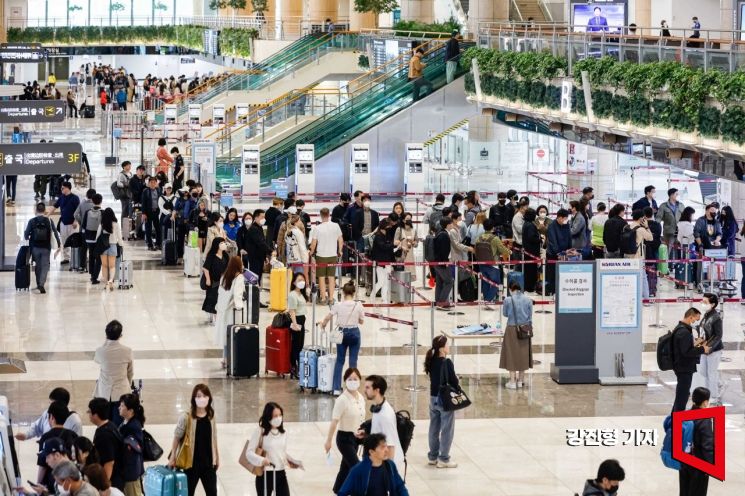
Passenger numbers in the second quarter continue to rise following the first quarter. The number of international passengers using Incheon International Airport steadily increased from 3.83 million in January, 3.72 million in February, to 3.89 million in March. In April, the second quarter, it rose further to 4.02 million. The upward trend continued this month as well. From the 1st to the 21st, 2.91 million international passengers were recorded, a 6.13% increase compared to 2.74 million during the same period last month.
However, differences by route are causing the performance gap between FSCs and LCCs. At airports nationwide, including Incheon and Gimpo International Airports, the number of passengers traveling to and from the Americas and Europe last month was 446,554 and 333,882, respectively, marking increases of 5.4% and 20.88% compared to the previous month.
Conversely, passengers to Japan and Southeast Asia numbered 1.34 million and 1.72 million, respectively, decreasing by 6.45% and 3.91% over the same period. While passengers on the Americas and Europe routes, which are FSCs' main focus, increased, those on Japan and Southeast Asia routes, key for LCCs, declined. Medium- to long-haul routes increased, but short- to medium-haul routes decreased. This difference is expected to cause a performance gap in the second quarter results.
Park Soo-young, a researcher at Hanwha Investment & Securities, said, "The number of international passengers in April increased compared to the previous month. Although the number of passengers on short-haul routes such as Japan and Southeast Asia, which had been strong, decreased, long-haul routes like the Americas and Europe increased." He added, "Even on short-haul routes, FSCs relatively succeeded better than LCCs in defending against the decline in passenger numbers."
© The Asia Business Daily(www.asiae.co.kr). All rights reserved.
![User Who Sold Erroneously Deposited Bitcoins to Repay Debt and Fund Entertainment... What Did the Supreme Court Decide in 2021? [Legal Issue Check]](https://cwcontent.asiae.co.kr/asiaresize/183/2026020910431234020_1770601391.png)















