Expansion of Mechanization Rate by Work Stage to Reduce Labor
Achieving 77.5% Mechanization Rate for Field Crops by 2026
The Rural Development Administration (RDA) announced on the 24th that it will accelerate the expansion of mechanization in garlic and onion cultivation by increasing mechanization at each stage of field crop operations. This policy is linked to the government's national agenda, "Industrialization of Agriculture for Future Growth," aiming to address labor shortages and improve the convenience of farming operations in field crop cultivation.
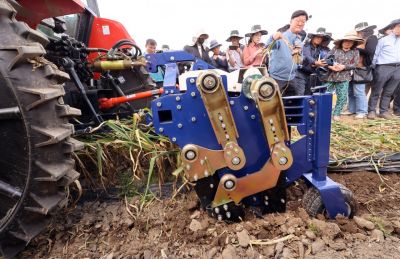
The RDA has developed and distributed agricultural machinery for garlic and onion, such as seeders, transplanting machines, stem cutters, diggers, and collectors. However, the mechanization rate at each operation stage remains sluggish. An RDA official stated, "As of 2022, the mechanization rate for seeding and transplanting operations is only 15-16%, while the harvesting mechanization rate is 44% for garlic and 26% for onions," adding, "The rapid expansion of mechanized cultivation models is urgently needed." (Seeding refers to sowing seeds, and transplanting means planting seedlings grown in a nursery bed into the field.)
The low mechanization rate is problematic because labor in rural areas is increasingly scarce. According to the 2022 Agricultural, Forestry, and Fisheries Survey conducted by Statistics Korea, the farming population has decreased by 25.6% over the past decade, and the aging rate has risen to 49.8%. An RDA official explained, "A large proportion of agricultural workers are elderly, and there are limits to their ability to farm manually," emphasizing, "The widespread adoption of machinery to replace manual labor is necessary." According to the Ministry of Agriculture, Food and Rural Affairs' 9th Basic Plan for Agricultural Mechanization (2022-2026), the mechanization rate in paddy farming was 98.6% as of 2020, with most farming operations performed using machinery except for some pest control tasks. In contrast, the mechanization rate in field farming was only about 61.9% in the same year.
Accordingly, the government has set a policy goal to increase the mechanization rate of field crops to 77.5% by 2026. To achieve this in a short period, the RDA has been implementing the "Jonghyeong Mujin Project," an innovative convergence collaboration project that sequentially promotes research and development, field verification, and technology dissemination since the 26th of last month. One of the five tasks selected under the Jonghyeong Mujin Project is "Development and Field Expansion of Smart Mechanized Cultivation Models for Field Crops."
Among field crops, this year's core objective is the field expansion of mechanization for garlic and onions centered on major production areas. An RDA official explained, "To this end, the Ministry of Agriculture, Food and Rural Affairs, RDA, provincial agricultural research institutes, city and county agricultural technology centers, regional agricultural cooperatives, and agricultural machinery associations are collaborating across central and local governments and public and private sectors to verify improvement technologies addressing mechanization barriers in 20 regions across 13 cities and counties nationwide and disseminate these technologies."
The key tasks include establishing and advancing mechanized cultivation models for garlic and onions and promoting these models centered on major production areas. For garlic, eight standard models linked to cultivation technologies such as seeding, precision cultivation, harvesting, and storage will be established; for onions, models related to seedling raising and transplanting, precision cultivation, harvesting, and storage will be developed. Plans also include developing management analysis and standard manuals for mechanized cultivation models. This year, the "Excellent Mechanization Model Development Project" will support 1,134 hectares, and new technology demonstration projects will be conducted in Buan, Uiseong, Hapcheon, and Namhae. Additionally, field verification of mechanized standard cultivation models will be carried out at 10 sites, including Muan, Sinan, Hapcheon, Hampyeong, and Haenam.
An RDA official emphasized, "Through this project, we will not focus solely on machinery development but will have experts in breeding, cultivation, and environment collaborate to demonstrate and disseminate packaged cultivation models in the field. These models will include varieties and cultivation methods for mechanization expansion and machinery application methods tailored to regional soil characteristics."
© The Asia Business Daily(www.asiae.co.kr). All rights reserved.

















