Unclear Plan for Annual 3 Trillion Yen Funding
Business and Medical Sectors Oppose Funding Methods
The Kishida Cabinet in Japan has announced a pledge to double the child allowance paid from the third child onward in multi-child households as a support measure. However, with the policy expected to cost an annual 1.2 trillion yen (11.3 trillion won), criticism over funding measures is growing. This has deepened the concerns of Prime Minister Fumio Kishida, who is aiming for re-election.
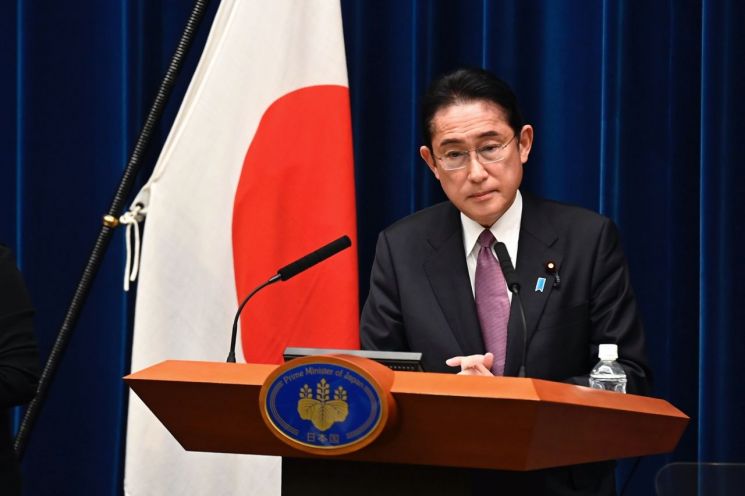
On the 23rd, Asahi Shimbun reported that the Japanese government is considering increasing the monthly child allowance for the third child from 15,000 yen to 30,000 yen, paid from age 3 until elementary school. This plan is expected to be included in the Basic Policy on Economic and Fiscal Management (骨太の方針) to be finalized next month. Asahi Shimbun analyzed that "this is influenced by the recent decline over about 20 years in households with three or more children in Japan."
Currently, Japan’s child allowance is set at 15,000 yen per month for children aged 0 to under 3, and 10,000 yen per month until junior high school. However, from the third child onward, an additional 5,000 yen is paid as a multi-child support measure, making it 15,000 yen per month. The proposal is to double this amount to 30,000 yen per month. The ruling Liberal Democratic Party (LDP) also proposed increasing the allowance from the second child onward, but this plan has been put on hold. Additionally, the Japanese government aims to abolish income limits on child allowances and extend payments until age 18 starting next year.
The problem lies in funding. Expanding the child allowance alone will cost 1.2 trillion yen, and the proactive low birthrate countermeasures planned over three years will cost 3 trillion yen. Although the government wants to raise taxes to secure funds, it has already announced a tax increase policy last year due to increased defense spending. Additional tax hikes would burden the administration’s re-election prospects. According to Yomiuri Shimbun, there is strong caution within the LDP that "additional tax increases will be difficult for the public to accept," which has influenced the decision to postpone tax hikes.
For now, the Japanese government plans to cover the necessary funds for child allowance payments through additional social insurance premium collections and cuts in social security expenditures. The first area where the government will increase the burden is health insurance. Medical insurance premiums for those aged 60 and over will be raised, and corporate contributions will also be significantly increased.
However, the media points out that even securing funds through these methods will not meet Prime Minister Kishida’s declared goal of "doubling the future budget." Asahi criticized, "Ultimately, reviewing new burden increases including taxes will be inevitable."
Above all, as the government touches the social security system such as health insurance, opposition is growing among labor and experts. At the Children’s Future Strategy Meeting held on the 3rd to discuss funding measures for the low birthrate, Prime Minister Kishida stated, "We are not considering new tax increases including consumption tax," but added, "We will aim to secure funds through thorough expenditure reforms to minimize the actual burden on the public."
This immediately met opposition. Especially notable was the business community’s backlash; at the meeting, Ken Kobayashi, Chairman of the Japan Chamber of Commerce and Industry, reportedly criticized, "If burdens increase, it could dampen companies’ efforts to promote investment and wage increases."
Following the increase in insurance premiums, the government is considering cuts in social security expenditures. This means reducing spending in medical, nursing care, and welfare sectors. However, these industries, which were hit hard by COVID-19 and inflation, are instead demanding additional spending, making persuasion difficult. Former Minister of Health, Labour and Welfare Norihisa Tamura met with nursing care workers and Prime Minister Kishida on the 3rd to request wage increases for industry workers next year. This is because services such as nursing care and welfare for the disabled have government-set fair prices.
Furthermore, the Japan Medical Association, Japan Dental Association, and Japan Pharmaceutical Association jointly issued a statement on the 5th demanding inflation countermeasures and wage increases. At a press conference, they raised their voices saying, "While low birthrate countermeasure allowances are necessary, cutting social security expenses is not right." The medical community has already reduced costs through measures such as lowering drug prices considering inflation. A senior official at the Ministry of Health, Labour and Welfare told Asahi Shimbun, "It feels like bleeding every year. There is not much remaining capacity."
Ultimately, although measures have been laid out, Prime Minister Kishida’s concerns are growing as no funding sources have been found. Debates over the amount of cuts and other issues are expected to continue until the end of the year.
© The Asia Business Daily(www.asiae.co.kr). All rights reserved.
![From Bar Hostess to Organ Seller to High Society... The Grotesque Con of a "Human Counterfeit" [Slate]](https://cwcontent.asiae.co.kr/asiaresize/183/2026021902243444107_1771435474.jpg)
















