Self-reporting relying on lawmakers' conscience lacks effectiveness
Even with consent forms for personal data use, money laundering at overseas exchanges cannot be uncovered
As controversy over independent lawmaker Kim Nam-guk's cryptocurrency holdings erupts, the political sphere is once again mentioning a full survey of National Assembly members. However, experts have expressed critical opinions, saying it is "close to covering one's eyes and pretending not to see."
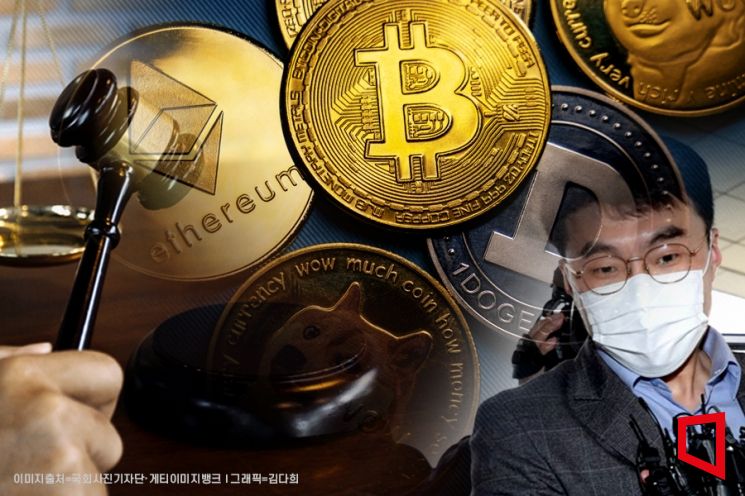
On the 22nd, Bae Jin-kyo, floor leader of the Justice Party, said at the executive committee meeting held at the National Assembly, "Legislative discussions related to cryptocurrency should not become rushed legislation to avoid the storm caused by the Kim Nam-guk coin incident," adding, "All ruling and opposition parties must immediately respond to the full survey of National Assembly members' cryptocurrency holdings."
Both ruling and opposition parties are showing positive responses to the full survey of cryptocurrency holdings. On the 17th, at the plenary meeting of the National Assembly's Political Affairs Committee, both sides adopted a resolution on "Voluntary Reporting and Investigation of Virtual Assets by National Assembly Members." Lee Yang-su, the ruling party's secretary from the People Power Party, and Song Ki-heon, the opposition party's secretary from the Democratic Party of Korea, also expressed agreement with the cryptocurrency full survey. Academia is also calling for a full survey of National Assembly members' cryptocurrency holdings. The Korea Game Society stated in a press release on the 11th, "There have been rampant rumors for several years that Play to Earn (P2E) companies have been lobbying the National Assembly," and added, "A full survey of not only National Assembly members but also their aides is necessary."
However, experts point out that at this stage, the full survey is unlikely to produce practical effects because it is merely a voluntary reporting format. Professor Hong Ki-hoon of the Department of Business Administration at Hongik University said, "If it is a voluntary reporting format, only those without problems will submit their cryptocurrency transaction details," adding, "In the end, it will be close to a form of covering one's eyes and pretending not to see."
There is a solution. It can be done by having National Assembly members submit consent forms for the use of personal information to the Anti-Corruption and Civil Rights Commission, which investigates corruption and conflicts of interest among public officials. During the 2021 Korea Land and Housing Corporation (LH) speculation scandal, both ruling and opposition parties submitted consent forms for the use of personal information when requesting a full survey of lawmakers and their families' real estate holdings. Through this, the Anti-Corruption Commission confirmed that 12 members and their families from the Democratic Party of Korea and 12 from the People Power Party were involved in the LH speculation scandal.
Once the consent forms for personal information use are submitted, cryptocurrency transaction details stored at domestic exchanges such as Upbit, Bithumb, Coinone, Korbit, and GOPAX can be secured. This is because domestic exchanges record investors' transaction details on central servers. Currently, only the Justice Party has submitted consent forms for personal information use to the Anti-Corruption Commission regarding the cryptocurrency full survey. Professor Hong said, "A full survey of cryptocurrency through domestic exchanges is sufficiently meaningful," adding, "Such actions like a full survey are necessary to restore trust in the National Assembly members caught up in lobbying rumors."
However, this also has limitations. Cryptocurrency transaction details through overseas exchanges cannot be identified unless the survey subjects voluntarily report them. Overseas exchanges, which advocate decentralization, do not store transaction details on their servers. Moreover, unlike domestic exchanges that have contracts with banks for real-name verified deposit and withdrawal accounts, overseas exchanges require transactions through anonymous personal cryptocurrency wallets. This leaves ample room for sending cryptocurrency overseas to increase assets or launder money.
Professor Lee Byung-wook of Seoul School of Integrated Sciences and Technologies pointed out, "It is impossible to identify not only overseas exchange transactions but also cryptocurrencies not listed on domestic exchanges," adding, "The reality is that we have to rely on the conscience of the lawmakers."
© The Asia Business Daily(www.asiae.co.kr). All rights reserved.

















