Nurses opposing the exercise of the veto power on the Nursing Act have launched a 'law-abiding struggle,' bringing the issue of the scope of work between healthcare professions to the forefront. Both the nursing and medical communities agree on the need to normalize the scope of work, but subtle differences exist in their approaches to solutions.
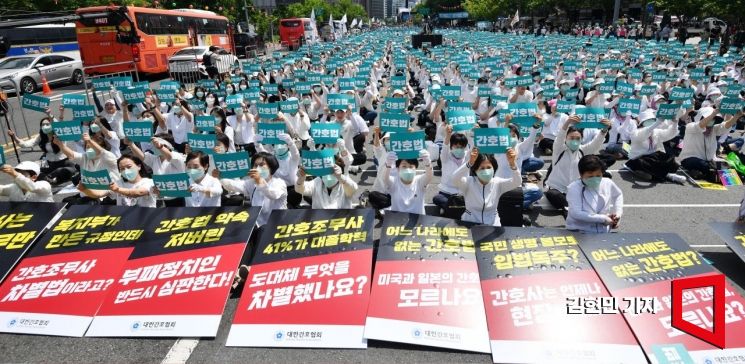 Nurses affiliated with the Korean Nurses Association and related personnel held a general rally on the 19th around Sejong-daero, Seoul, condemning President Yoon Seok-yeol's veto of the Nursing Act. Photo by Hyunmin Kim kimhyun81@
According to the healthcare sector on the 22nd, after President Yoon Seok-yeol exercised his veto power on the Nursing Act bill at the Cabinet meeting on the 16th, the Korean Nurses Association declared a law-abiding struggle refusing illegal work orders. The intention is to reject instructions beyond the scope of nursing duties and perform only legally defined tasks. The association emphasized, “We refuse doctors' work orders related to illegal medical practices,” and “In particular, we will refuse doctors' orders concerning licensed duties of other healthcare professionals such as clinical pathologists.” In fact, the 'Illegal Medical Practice Reporting Center' opened by the association on the 18th was overwhelmed with reports, making it inaccessible due to traffic overload on the first day.
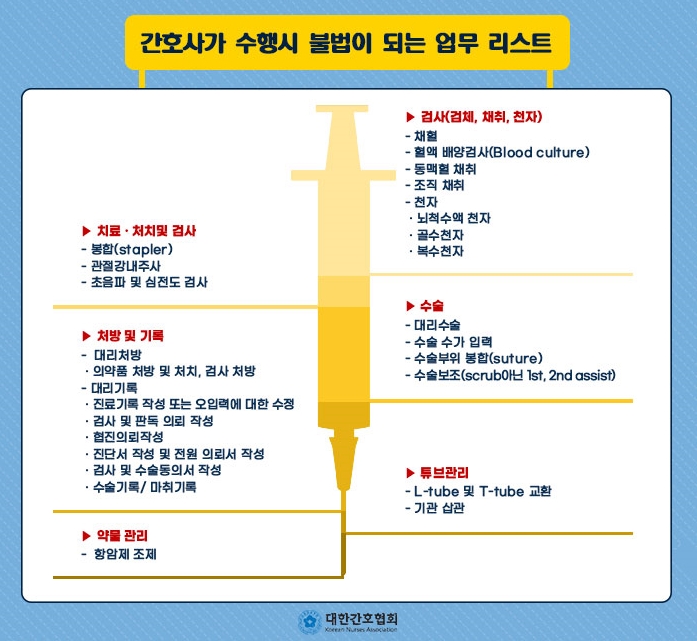
The illegal scope of work presented by the association covers all medical activities including testing, treatment and procedures, surgery, prescriptions and records, and drug management. Specifically, proxy prescriptions, proxy surgeries, proxy records, preparation of test and surgery consent forms, blood collection, puncture, suturing, chemotherapy preparation, and intubation were listed as illegal tasks by the association. These have been practiced as a matter of course despite being illegal, citing reasons such as a shortage of doctors. Sharing doctors' IDs and passwords for nurses to enter prescriptions is one of the covertly known practices.
At the center of this law-abiding struggle is the physician assistant nurse, known as 'PA (physician assistant) nurse.' Although a nurse, PA nurses participate in some surgeries or substitute some prescriptions on behalf of doctors, which is potentially illegal under current medical law. However, due to manpower shortages, most university hospitals have PA nurses in reality. The Ministry of Health and Welfare announced a 'Comprehensive Support Plan for Nursing Personnel' last month, stating, “We plan to listen carefully to the difficulties of PA nurses and prepare improvement measures through social discussions,” bringing the issue back into public discourse. The ministry also released a statement the day before, mentioning a specific schedule: “We plan to operate a consultative body from June to devise improvement measures to resolve the PA issue.” Experts, field workers, and related organizations will participate in the consultative body to discuss overall issues such as hospital staffing structures and the scope of work between professions.
The Korean Nurses Association encourages participation in the law-abiding struggle, stating, “We have the right to firmly refuse illegal acts,” and “Through this, we will regain our justification and legitimacy to perform only nursing duties under the Nursing Act.” The nursing community’s law-abiding struggle is expected to establish the legitimate scope of nursing duties and also serve as leverage to pressure for an increase in medical school quotas. The nursing sector cites a shortage of doctors as the reason for illegal work orders to nurses. The government also shares the position that increasing medical school quotas is somewhat inevitable.
The medical community agrees that some medical acts performed by PA nurses beyond the scope of nursing duties should be prohibited. The Korean Intern Resident Association welcomed the nursing association’s law-abiding struggle, stating, “Proxy prescriptions and proxy surgeries are not the fault of nurses but structural problems of hospitals.” However, the association views the issue as arising not from a shortage of residents but from insufficient hiring of adequate replacement personnel. While agreeing on the need to increase medical personnel, they differ on solutions. The Intern Resident Association argued, “The fundamental cause of the widespread proxy surgeries and proxy prescriptions is the failure to hire sufficient substitute medical personnel (such as attending physicians and contract doctors),” and “To solve this, hospitals must ultimately hire more doctors and nurses.”
© The Asia Business Daily(www.asiae.co.kr). All rights reserved.
![Clutching a Stolen Dior Bag, Saying "I Hate Being Poor but Real"... The Grotesque Con of a "Human Knockoff" [Slate]](https://cwcontent.asiae.co.kr/asiaresize/183/2026021902243444107_1771435474.jpg)

















