"Election Law Reform Must Not Be Delayed...
All Negotiations Must Be Completed in the First Half of This Year"
Speaker of the National Assembly Kim Jin-pyo emphasized that the election system reform must be finalized by the end of June, stating, "The more deeply we discuss and deliberate, the more consensus is reached on the direction of the election system reform. What remains is the time for negotiation to make choices."
On the 22nd, Speaker Kim attended the "Public Debate on the Election System Reform Deliberative Poll," hosted by the bipartisan Political Reform Parliamentary Group at the National Assembly Members' Office Building in Yeouido, Seoul. He said, "They say you strike the iron while it is hot. Now is exactly the time to strike."
The debate was organized based on the results of a deliberative poll conducted by the Special Committee on Political Reform, which involved 500 citizen participants who deliberated on key issues of election system reform on the 6th and 13th of this month, followed by a public opinion survey to confirm changes.
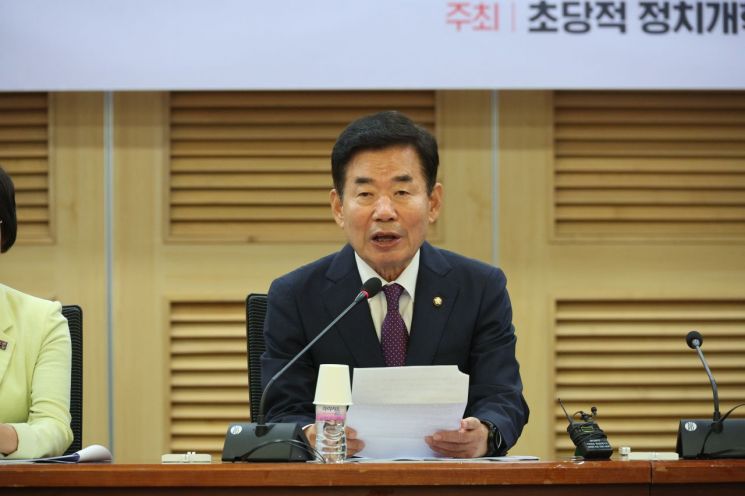
Speaker Kim mentioned that in the Special Committee's deliberative poll, 59% of the citizen participants supported the mixed urban-rural electoral district system. He said, "I believe the mixed urban-rural electoral district system could serve as an important compromise point in negotiations between the ruling and opposition parties."
Regarding the expansion of proportional representation, he explained, "Surprisingly, the support rate changed from 27% before the deliberation process to 70% after," adding, "This shows agreement that the proportional representation system should fulfill its original purpose." He interpreted this as a declaration of intent that the original purpose of proportional representation?to include political minorities such as women, youth, and persons with disabilities, as well as experts in culture, arts, and science and technology?must be fully realized.
On the introduction of an open-list proportional representation system, he said, "The preference rate was 72%. This is due to distrust that if the right to elect proportional representatives is fully entrusted to parties as it is now, satellite parties will inevitably be created," adding, "Voters should be able to choose directly to hold parties accountable for their nominations."
He emphasized that considering the limited time, negotiations on the revision of the election law must be completed before the regular session of the National Assembly.
Speaker Kim said, "The election law negotiations must be completed in the first half of the year so that the framework can be approved by the plenary session and sent to the Special Committee on Political Reform. Then, in consultation with the National Election Commission, the actual electoral district delineation must be carried out," adding, "It is challenging to reflect specific issues in the election law within just two months."
He added, "Negotiations should be conducted within a set timeframe," and said, "I have repeatedly told the recently elected floor leaders of both major parties that all negotiations must be completed in the first half of this year."
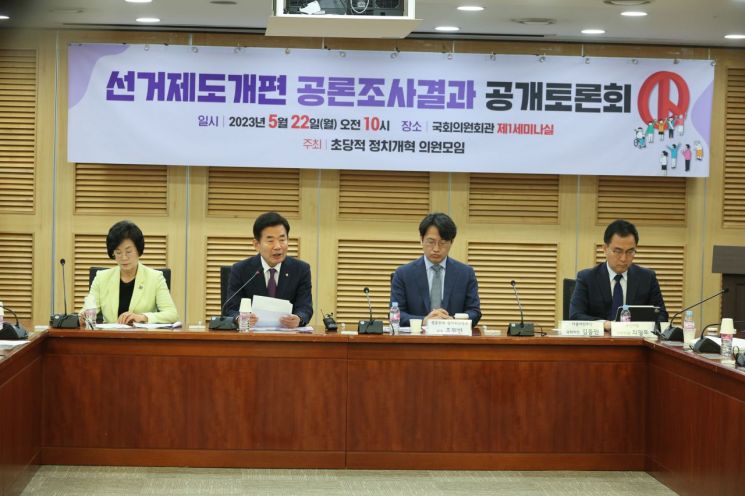
Professor Cho Won-bin of the Department of Political Science and International Relations at Sungkyunkwan University, who attended as an expert, analyzed, "The results of the deliberative poll on the 13th ultimately converge on the reform direction of 'strengthening voters' political efficacy.'"
He mentioned that the opinion supporting the expansion of proportional representatives increased by 43 percentage points after deliberation, and support for increasing the number of assembly members also rose by 20 percentage points after deliberation. He explained, "Understanding the mechanism of the proportional representation system shows that the direction of the National Assembly's election system should move toward expansion."
He also said, "The fact that there is support for increasing the number of assembly members after considering the influence and scale of lawmakers suggests that even if public opinion polls are not favorable, it is very important to persuade the public, which this public deliberation has demonstrated."
Professor Cho summarized the main issues to be discussed going forward as the proportional representation system, mixed urban-rural electoral districts, and the expansion of the number of National Assembly members. However, he emphasized the need to discuss the election system thoroughly so that voters can understand and make informed choices, rather than frequently reforming the election system.
He said, "Transparency must be strengthened alongside election system reform," adding, "At the same time, election system reforms do not always achieve the expected outcomes."
Professor Cho stressed, "Because institutional changes affect and are affected by participating parties, candidates, and voters, frequent changes to the election system are undesirable," and added, "It is also important for voters to understand the election system. Introducing specific elections in a limited way can rather provoke debates about the intent, so caution is necessary."
© The Asia Business Daily(www.asiae.co.kr). All rights reserved.
![Clutching a Stolen Dior Bag, Saying "I Hate Being Poor but Real"... The Grotesque Con of a "Human Knockoff" [Slate]](https://cwcontent.asiae.co.kr/asiaresize/183/2026021902243444107_1771435474.jpg)

















