WSJ 'Impact Analysis by 3 Different Scenarios'
The tentative deadline for the deadlocked U.S. federal government's debt ceiling negotiations is now just 11 days away. As the so-called 'X-Day,' the date identified by U.S. Treasury Secretary Janet Yellen when available funds will be exhausted, approaches, the risk of uncertainty due to a potential default is increasing. If the negotiations end in a 'no deal,' experts predict a multi-crisis scenario more severe than the 2008 global financial crisis, including a bank run in the banking sector and rising mortgage rates.
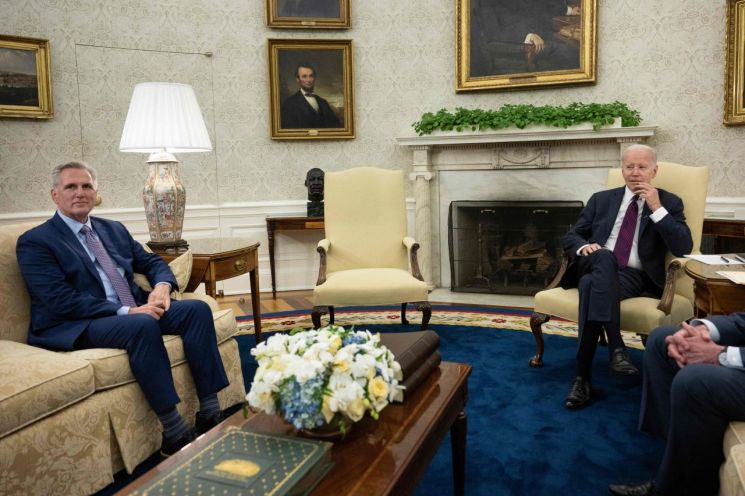
On the 21st (local time), The Wall Street Journal (WSJ) analyzed that the debt ceiling negotiations could face three scenarios just before X-Day: a 'Last-Minute Deal,' a 'Deal After Deadline,' or a 'No Deal.'
If a dramatic agreement is reached just before X-Day, the market is expected to be hit by a crisis stemming from the uncertainty surrounding the debt ceiling negotiations. With the high-intensity tightening that began last year and the cascading collapse of regional banks, the likelihood of the U.S. entering a recession this year is increasing, and the uncertainty of the debt ceiling negotiations will add fuel to the market's troubles.
Joel Prakken, Chief U.S. Economist at S&P Global Market Intelligence, pointed out, "While negotiations between President Joe Biden and Congress remain sluggish, 'debt ceiling uncertainty' is simultaneously suppressing consumption, investment, and corporate activity," adding, "This uncertainty tightens fiscal conditions and increases the likelihood of a U.S. recession." He emphasized, "Even if a dramatic agreement is reached before X-Day when available cash runs out, it will leave irreversible side effects such as a slowdown in economic growth for that quarter." S&P Global Market Intelligence forecasts financial turmoil similar to 2011, when delayed negotiations led to a downgrade of the national credit rating and raised default risks, potentially causing the U.S. quarterly GDP to contract by 0.1% year-over-year.
At least a last-minute deal is expected to have less economic impact than a 'Deal After Deadline' occurring after next month’s 1st. If the negotiations are delayed beyond X-Day as Secretary Yellen warned, government employee salaries and Social Security benefits will not be paid. This could lead to a sharp drop in consumption, the lifeblood of the U.S. economy. More than 66 million Americans rely on Social Security, and millions of veterans and military families are also affected. As the government prioritizes debt repayment over salaries and Social Security payments, the U.S. GDP is expected to shrink by 2% year-over-year in the third quarter and contract even more sharply in the fourth quarter. Gregory Daco, Chief Economist at global consulting firm Ernst & Young (EY), said, "As the risk of default becomes a reality due to negotiation delays, market shocks will spread rapidly."
The White House Council of Economic Advisers (CEA) previously warned in a report that "if a default state prolongs, more than 8 million Americans could lose their jobs," adding, "Unlike during the COVID-19 pandemic when trillions of dollars in stimulus were injected, the government will be powerless."
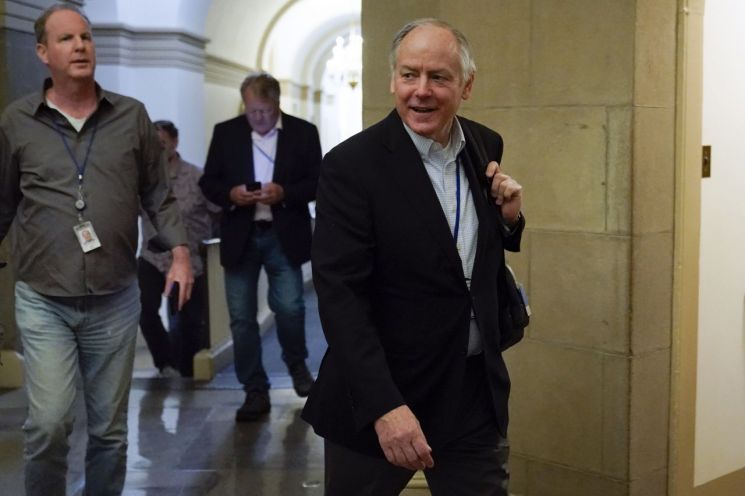 Senior Advisor Steve Ricchetti leading the White House negotiation team.
 [Image source=AP Yonhap News]
The worst-case scenario is a 'No Deal' where negotiations collapse. Following a breakdown, global investors would rush to sell large volumes of U.S. Treasury bonds, causing Treasury prices to plummet. The financial conditions of global companies, banks, and fund products tied to Treasury price trends would suffer mounting asset losses. WSJ warned that the resulting sharp rise in borrowing costs?linked to Treasury yields and affecting credit card rates, mortgages, and auto loans?would have a tremendous impact on the everyday economy.
WSJ particularly noted that if a default actually occurs, the steep drop in U.S. Treasury prices could trigger a repeat of the bank run crisis among regional banks. In March, Silicon Valley Bank (SVB) experienced a bank run after losses from Treasury sales became known, with depositors rushing to withdraw funds via smartphones, leading to a chain reaction of regional bank failures.
Investor risk aversion is also expected to cause a stock market crash. The White House CEA projected that within a month of a default, 45% of the market value of the New York Stock Exchange could disappear. Economist Daco predicted, "A default would trigger a recession more severe than the 2008 global financial crisis."
Meanwhile, during the weekend, working-level negotiations between the White House and Congress stalled and were temporarily suspended due to deadlock. President Biden and House Speaker Kevin McCarthy are scheduled to meet again on the 22nd based on the results of their teams' discussions.
© The Asia Business Daily(www.asiae.co.kr). All rights reserved.


















