Changing Supply Chains to Reduce China Risks
Opposition to Changes by Force or Coercion
Unified Voice on Preventing North Korean Nuclear Proliferation
On the 20th, the Group of Seven (G7) issued a joint statement targeting China, Russia, and North Korea across various fields including economy, human rights, and security. They delivered a strong message condemning Russia, pledging to support Ukraine and unite against Russia. They also expressed their intention to actively respond to China's weaponization of raw materials and pressure over the Taiwan issue. Additionally, they united in urging North Korea to halt its nuclear weapons tests and prevent nuclear proliferation.
◆Strengthening Strategic Material Supply Chains... Targeting Economic Retaliation by Russia and China
At the G7 summit that concluded on the 21st, the core message adopted by the leaders of major countries was strong containment of China and Russia through unity.
The G7 leaders clearly expressed their intention to reduce China-related risks by changing supply chains.
The statement mentioned, "We are ready to build constructive and stable relations with China," emphasizing that cooperation with China is essential. However, in detailed sections on economy and security, provisions to pressure China were meticulously specified.
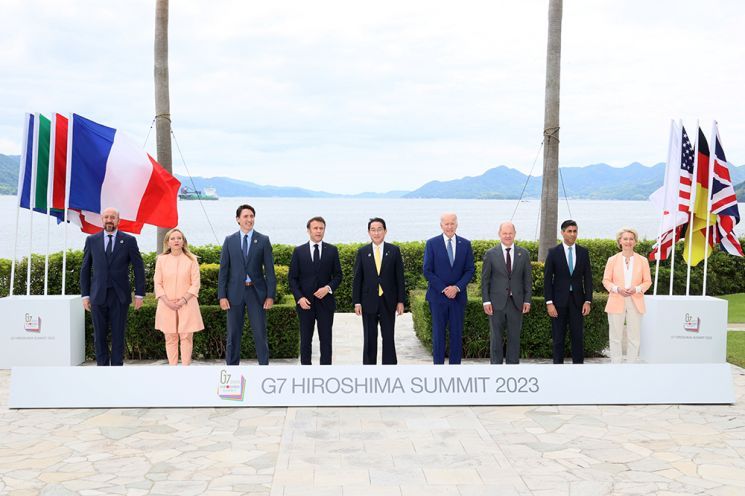
In particular, they agreed to strengthen supply chains for key minerals and strategic materials among G7 countries in opposition to China and Russia. The G7 stated, "Transparency, diversity, security, and sustainability are essential principles in building and strengthening resilient supply chains among the Group of Seven and trusted partner countries," and added, "We will strengthen resilient supply chains for critical minerals, semiconductors, batteries, and other essential materials through global partnerships."
This means reducing dependence on strategic materials from China and Russia and expanding cooperation with allies such as South Korea to mitigate supply chain risks. China and Russia have previously used economic retaliation tools such as restricting rare earth and crude oil exports to pressure other countries' foreign policies.
The G7's determination is expected to lead to strengthening semiconductor alliances. The Nihon Keizai Shimbun explained that through the statement, G7 countries indicated their intention to attract countries with semiconductor production technologies such as South Korea and Europe to reinforce a Western-centered semiconductor supply chain. Recently, as conflicts between the United States and China have intensified, the possibility of China forcibly invading Taiwan has emerged, which could lead to a global disruption in semiconductor supply.
◆Strong Condemnation of Military Provocations by North Korea, China, and Russia
Regarding security issues, the G7 strongly condemned Russia's invasion of Ukraine as well as potential military provocations by China and North Korea. The statement said, "Claims by China to expand maritime rights in the South China Sea have no legal basis," and strongly opposed "any unilateral attempts to change the status quo by force or coercion."
It further reaffirmed "the importance of peace and stability in the Taiwan Strait as indispensable for the security and prosperity of the international community," and expressed opposition to China's attempts at forcible unification by demanding a peaceful resolution to the Taiwan issue.
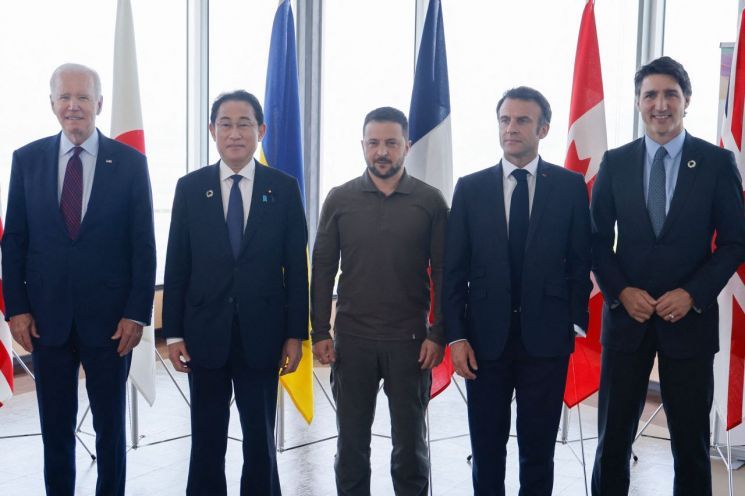
The G7 also sharply criticized Russia's invasion of Ukraine as a "serious violation of international law" and pledged continued solidarity with Ukraine. U.S. President Joe Biden reportedly promised during the summit to support Ukraine in acquiring F-16 fighter jets. The F-16 is a high-performance fighter equipped with radar capable of detecting targets hundreds of miles away and the latest missiles, called a "game changer" that could alter the course of the war.
Additionally, the G7 urged North Korea to stop military provocations such as ballistic missile launches and nuclear weapons development and to respond to the international community's proposals for dialogue.
◆Immediate Backlash from China and Russia... "G7's Goal is Dual Containment"
As the G7 sharpened its stance against authoritarian regimes, China and Russia immediately pushed back. On the 20th, China lodged a diplomatic protest called "stern negotiations" with the host country Japan and others, criticizing the G7 for violently interfering in China's internal affairs.
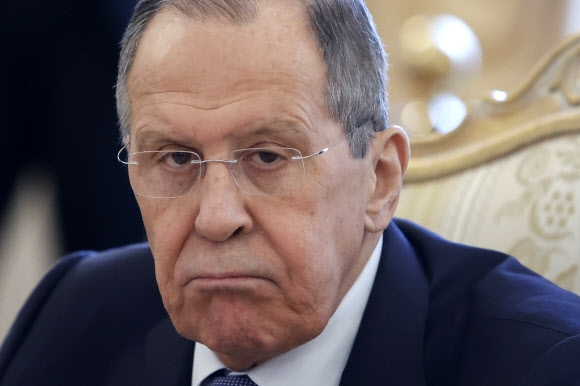
Russia also strongly protested the G7 statement, claiming its purpose was to impose dual containment on Russia and China. Russian Foreign Minister Sergey Lavrov attended the 31st Foreign and Defense Policy Council meeting held in Russia on the 21st and said, "We have begun the most dramatic confrontation with an aggressive bloc composed of the United States, the European Union (EU), and the North Atlantic Treaty Organization (NATO)." He added that the G7 has openly revealed its intention not only to defeat Russia on the battlefield but later to eliminate it as a geopolitical competitor.
© The Asia Business Daily(www.asiae.co.kr). All rights reserved.
![Clutching a Stolen Dior Bag, Saying "I Hate Being Poor but Real"... The Grotesque Con of a "Human Knockoff" [Slate]](https://cwcontent.asiae.co.kr/asiaresize/183/2026021902243444107_1771435474.jpg)


















