The first 'Quarantine Management Basic Plan' to respond to new infectious diseases after the 'endemic' (periodic outbreak of infectious diseases) and COVID-19 has been finalized. The plan focuses on gradually expanding the infectious diseases monitored at airports and ports, establishing a sewage-based surveillance system, and preparing measures to prevent and block the inflow of infectious diseases from abroad.
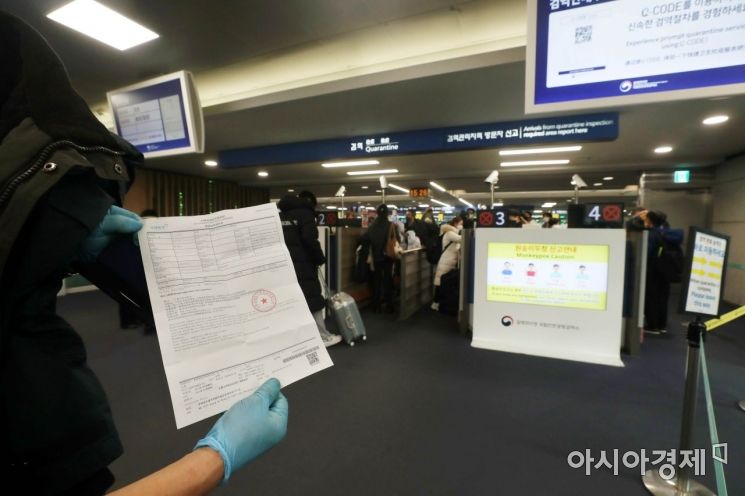 An airport official is checking the QR code at the arrival hall of Incheon International Airport Terminal 1. / Yeongjongdo - Photo by Kang Jin-hyung aymsdream@
On the 22nd, the Korea Disease Control and Prevention Agency (KDCA) announced that it had finalized the '1st Quarantine Management Basic Plan (2023?2027)' through the Quarantine Expert Committee. This plan was prepared to further systematically strengthen quarantine, an important measure to prevent the inflow and spread of diseases from overseas and to protect public health and prevent social and economic damage.
The basic quarantine plan consists of four major strategies and 15 detailed strategies. First, to establish a 'Next Pandemic Response System,' the number of quarantine infectious diseases will be expanded from the current 11 to 20, and quarantine facility infrastructure will be expanded to stably observe suspected infectious disease patients identified at the quarantine stage. Additionally, a sewage-based infectious disease surveillance system will be established at airports and ports to secure indirect indicators of infectious diseases that could not be detected during the incubation period at entry, thereby building a quarantine system prepared for future infectious diseases. An online overseas infectious disease reporting center will be established, and the quarantine information pre-entry system (Q-CODE) will be expanded to ports to improve quarantine efficiency.
Transportation and cargo quarantine will also be advanced. A reporting and emergency response system will be established in case of infectious disease patients on board aircraft, and support for repatriation in case of confirmed overseas cases will be institutionalized. Procedures for responding to emergency patients on ships will be prepared, and a permanent land quarantine system foundation will be established. Furthermore, to strengthen organizational and personnel expertise, quarantine officer training will be revamped, and regular training for overseas infectious disease preparedness at airports and ports will be promoted.
Infrastructure to strengthen domestic and international cooperation will also be established. Provisions for international cooperation will be included in the Quarantine Act, and cooperation regarding transportation means for entrants and cargo hygiene quarantine cooperation will be strengthened to prepare for public health crises. Based on the experience of responding to COVID-19, an emergency response system will be established, and research and development (R&D) on cargo quarantine inspection technologies will be promoted to foster the development of the quarantine industry. Director General Ji Young-mi of the KDCA stated, "With the establishment of the Quarantine Management Basic Plan, we plan to continuously implement policies over the next five years to realize a safe and healthy society by blocking the inflow and spread of overseas diseases," adding, "We hope to lead international quarantine standards through proactive and systematic policy implementation."
© The Asia Business Daily(www.asiae.co.kr). All rights reserved.
!["I'd Rather Live as a Glamorous Fake Than as a Poor Real Me"...A Grotesque Success Story Shaking the Korean Psyche [Slate]](https://cwcontent.asiae.co.kr/asiaresize/183/2026021902243444107_1771435474.jpg)
















