Yellow dust originating from the Gobi Desert and the Inner Mongolian Plateau began to be observed in South Korea on the morning of the 21st.
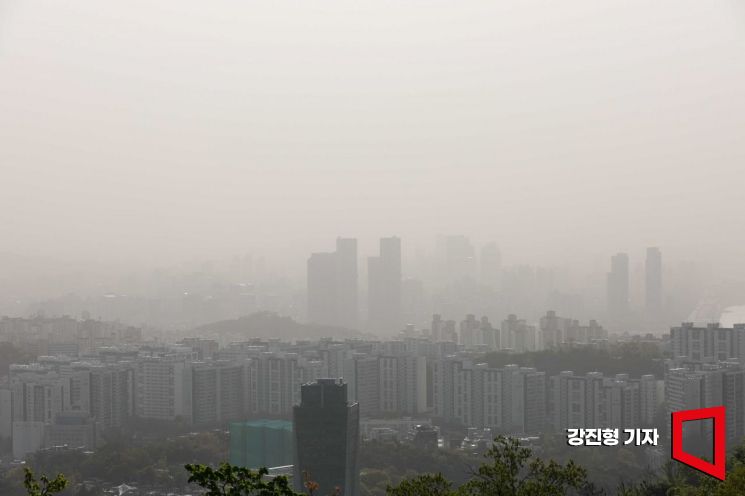
The Korea Meteorological Administration stated, "As of 11 a.m., yellow dust is being observed in the West Sea Five Islands, including Baengnyeongdo, and the concentration of particulate matter (PM10) in northern Gyeonggi and northern Gangwon is gradually increasing to over 100㎍/㎥."
As of 11 a.m., the one-hour average particulate matter concentrations at major locations are Baengnyeongdo 214㎍/㎥, Yeonpyeongdo 145㎍/㎥, Daegwallyeong 154㎍/㎥, Gwangdeoksan 118㎍/㎥, Bukchuncheon 114㎍/㎥, Sokcho 109㎍/㎥, and Seoul 81㎍/㎥.
The yellow dust is expected to be carried southeastward by northwesterly winds, covering the entire country. The National Institute of Environmental Research forecasted that particulate matter levels in the Seoul metropolitan area, Gangwon, and Chungcheong regions will be 'bad,' especially reaching 'very bad' levels from the afternoon. At night, particulate matter in Jeonbuk Province is also expected to reach very bad levels.
Yellow dust originated from the Gobi Desert and the Inner Mongolian Plateau starting from the night of the 18th.
© The Asia Business Daily(www.asiae.co.kr). All rights reserved.

















