Domestic Researchers Suppress Gene Expression and Alleviate Cartilage Destruction
Domestic researchers have developed a new treatment method for osteoarthritis, which has relied on joint injections.

The Korea Research Foundation announced on the 21st that the research team led by Professors Yang Si-young of Sungkyunkwan University and Yoon Sung-il of Chung-Ang University identified a new receptor that causes osteoarthritis and successfully developed an antibody therapy that effectively inhibits it. They proposed a treatment technology for osteoarthritis that suppresses the arthritis-related gene Activin A and alleviates cartilage destruction.
Osteoarthritis is a representative disease of the aging era, but so far, there is no fundamental treatment other than temporary pain relief treatments such as surgical operations or cartilage injections, making the development of effective antibody therapies urgent.
The research team focused on the fact that osteoarthritis is promoted by the interaction between pathogenic cytokines and growth factors secreted by joint tissue cells and their receptors. They embarked on developing receptor blockers that prevent the binding of these proteins and receptors to establish fundamental prevention and treatment methods.
The team analyzed tissues from arthritis patients and selected a new pathogenic receptor ACVR2B that causes osteoarthritis, confirming increased expression of ACVR2B in joint tissues of arthritis patients and arthritis animal models. Using supercomputer-based disease model simulations, they elucidated the mechanism by which the arthritis-related gene Activin A binds to receptors ACVR2B and Nox4 on the cell membrane, increasing the expression of catabolic factors that mediate cartilage destruction, thereby accelerating the onset of osteoarthritis. They also confirmed that inhibiting ACVR2B, which binds to Activin A, suppressed various forms of osteoarthritis.
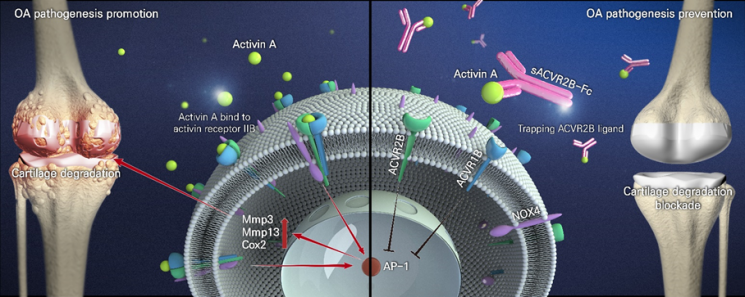 Increased Activin A in degenerative arthritis binds to ACVR2B and Nox4, accelerating the onset of degenerative arthritis by increasing the expression of catabolic factors that mediate cartilage destruction. However, injecting the receptor type ACVR2B-Fc into the cartilage inhibits the Activin A-ACVR2B-NOX4 signaling pathway, thereby suppressing the progression of degenerative arthritis. Image provided by Professor Si-Young Yang, Sungkyunkwan University; Dr. Ji-Min Jeon, Sungkyunkwan University; and Sung-Il Yoon, Chung-Ang University.
The research team produced a receptor-type ACVR2B-Fc that inhibits the Activin A-ACVR2B-Nox4 signaling pathway and injected it into the knee cartilage of osteoarthritis animal models, confirming that the degree of cartilage destruction was alleviated. The targeted antibody therapy using ACVR2B-Fc can be locally injected, offering advantages over general antibody therapies administered through blood vessels by causing no side effects and affecting only the joints.
Professor Yang said, “We identified the intercellular signaling pathway centered on the pathogenic receptor ACVR2B that causes osteoarthritis and discovered an antibody therapy that inhibits it, finding a clue to overcoming osteoarthritis.” He added, “We will establish a foundation for practical application and industrialization through follow-up studies such as preclinical research using medium and large animals and toxicity evaluations.”
The results of this study were published online on March 22 in the international journal 'Advanced Science.'
© The Asia Business Daily(www.asiae.co.kr). All rights reserved.
!["The Woman Who Threw Herself into the Water Clutching a Stolen Dior Bag"...A Grotesque Success Story That Shakes the Korean Psyche [Slate]](https://cwcontent.asiae.co.kr/asiaresize/183/2026021902243444107_1771435474.jpg)

















