Starting from the 1st of next month, as the COVID-19 crisis level is lowered from 'Severe' to 'Alert,' the temporarily permitted telemedicine services will be discontinued and transitioned into a pilot project. The People Power Party and the Ministry of Health and Welfare recently discussed the direction of the pilot project through party-government consultations and announced a plan that includes principles such as focusing on follow-up visits and prohibiting medication delivery. Although the party and government intend to finalize the plan before actual implementation, a significant regression compared to the previously temporarily allowed telemedicine is expected at this point.
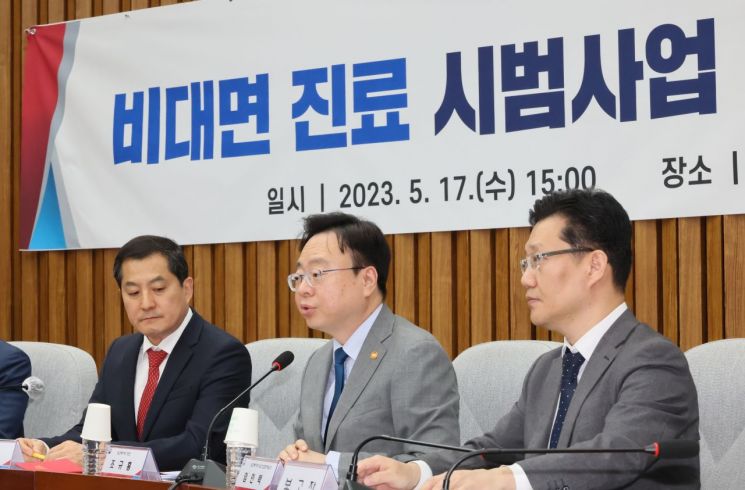 Minister of Health and Welfare Cho Kyu-hong is giving a greeting at the government-party consultation meeting on the pilot project for non-face-to-face medical treatment held at the National Assembly on the afternoon of the 17th. [Image source=Yonhap News]
Limited Initial Consultations... Will Pediatric Telemedicine Be Allowed on Weekends and Holidays?
The key issues remain the limited scope of initial consultations and medication delivery. According to the plan presented by the party and government, initial consultations will be allowed only in limited cases such as infectious disease confirmed patients who find it difficult to visit medical institutions directly, elderly and disabled individuals with mobility difficulties, and patients in island and mountainous areas. There was also discussion about allowing pediatric consultations for children and adolescents under 18 years old during holidays and nighttime, but this was initially excluded due to opposition from medical associations. The Korean Medical Association and other medical groups strongly oppose allowing initial telemedicine consultations for pediatric patients, arguing that "children and adolescents, who often have difficulty expressing themselves and exhibit atypical symptoms, must receive face-to-face consultations prioritizing patient safety."
However, in light of recent pediatric care crises and the inconvenience caused to working parents raising children, voices have emerged advocating for at least minimal initial consultations on days when medical institutions are closed. The consumer group 'Consumer Watch' stated in a press release, "If a child falls ill during nighttime or weekends when their usual clinic is closed, parents have no choice but to visit the emergency room again, effectively returning to the desperate situation before telemedicine was allowed," and criticized the decision by saying, "It completely disregards how much telephone consultations with doctors and urgent prescriptions can support parents when their child is sick late at night."
Claims that telemedicine increases the risk of medical accidents are less convincing when looking at the data so far. According to the telemedicine status and performance report released by the Ministry of Health and Welfare in March, 13.79 million people used telemedicine over three years without any significant medical accidents. This indicates that most users utilized telemedicine for mild symptoms. From 2020 to 2022, the Korea Medical Dispute Mediation and Arbitration Agency did not receive any consumer damage cases due to medical negligence. Prioritizing the value of 'patient safety' and adhering to the principle of 'follow-up visits first,' there are calls for a compromise that realistically supports those who face difficulties accessing medical institutions.
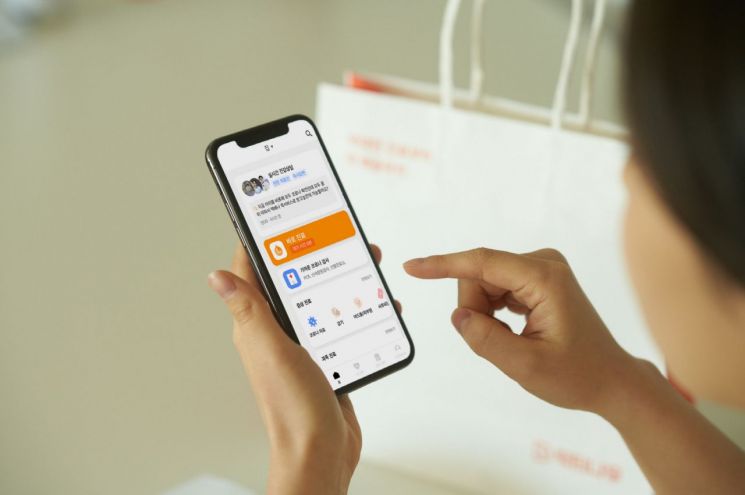
Medication Delivery Prohibited Even for Mobility-Impaired Elderly Living Alone... Future Improvements?
Another contentious issue in the telemedicine pilot project is 'medication delivery.' During the COVID-19 pandemic, telemedicine temporarily allowed platforms to provide medication delivery services. However, under the Pharmaceutical Affairs Act, selling medicines outside pharmacies is prohibited, which has been a continuous point of controversy. The pharmaceutical community, led by the Korean Pharmaceutical Association, has opposed amendments to the Pharmaceutical Affairs Act that would allow medication delivery. The association has also demanded, prior to the implementation of telemedicine, ▲activation of dispensing identical ingredients ▲guarantee of patient-centered pharmacy choice ▲legal medication delivery led by pharmacists without platform intervention ▲establishment of a supervisory body to manage illegal activities by telemedicine platform companies.
Nonetheless, there are arguments for allowing some limited medication delivery. Infectious disease confirmed patients, elderly and disabled individuals with mobility difficulties, and residents of island and mountainous areas are representative vulnerable groups. Since these largely overlap with the groups allowed initial consultations, permitting medication delivery only for those eligible for initial consultations seems reasonable. Despite this, the party and government have fundamentally prohibited medication delivery. They plan to devise supplementary measures for the elderly, disabled, and infectious disease patients, but it remains uncertain how much these will be reflected given the opposition from the pharmaceutical association.
The telemedicine platform industry, which was somewhat willing to accept limited allowances, has strongly opposed the significantly regressive pilot project plan. Until just before the party-government consultations, the Korea Telemedicine Industry Association (Wonsanhyeop) had pledged to "take responsibility to ensure a stable telemedicine pilot project operation," but upon the announcement of the pilot project plan, they called it "a death sentence for telemedicine in Korea" and demanded a full reconsideration. Wonsanhyeop criticized, "The Ministry of Health and Welfare only listened to the voices of medical organizations and the lawmakers representing them, completely ignoring the majority of citizens who have been living their daily lives diligently and simply wanted to manage their health through telemedicine," and emphasized, "The pilot project plan must be reestablished to redefine follow-up visits in telemedicine, expand the scope of initial consultations, and guarantee citizens' choice of medical care and improve medical accessibility even at this stage."
© The Asia Business Daily(www.asiae.co.kr). All rights reserved.
!["The Woman Who Threw Herself into the Water Clutching a Stolen Dior Bag"...A Grotesque Success Story That Shakes the Korean Psyche [Slate]](https://cwcontent.asiae.co.kr/asiaresize/183/2026021902243444107_1771435474.jpg)

















