Adults Searching for Animation, Games, and Comics
Sales Soar for Products Chosen by 'Deokhu' Fans
# Mr. Kim, a man in his 40s who works in an office, visits toy stores on weekends to buy newly released Lego sets or toys. Mr. Kim said, "Many people think it's strange for someone my age to collect toys, but it's a healthy hobby." He added, "Products chosen by 'deokhu' like me sell like crazy."
The purchasing power of 'deokhu,' a term that collectively refers to enthusiasts deeply immersed in a particular field such as games or comics, is increasing. 'Deokhu' is a shortened form of 'odeokhu,' which is the Korean pronunciation of the Japanese word 'otaku,' meaning a person who is obsessed with one area. The term 'otaku' first appeared in Japan in the 1970s and originally meant 'house' or a polite form of 'you.' Over time, it came to describe people who stayed indoors and pursued hobbies, often implying a lack of social skills, which gave it a negative connotation.
However, nowadays, it is used positively to describe people who are passionate and interested in a particular field. Especially, products that attract the attention of 'deokhu' generate significant sales, leading to the emergence of the term 'deokhu-nomics.' 'Deokhu-nomics' is a neologism that first appeared in Japan, referring to industries growing thanks to the support of deokhu.
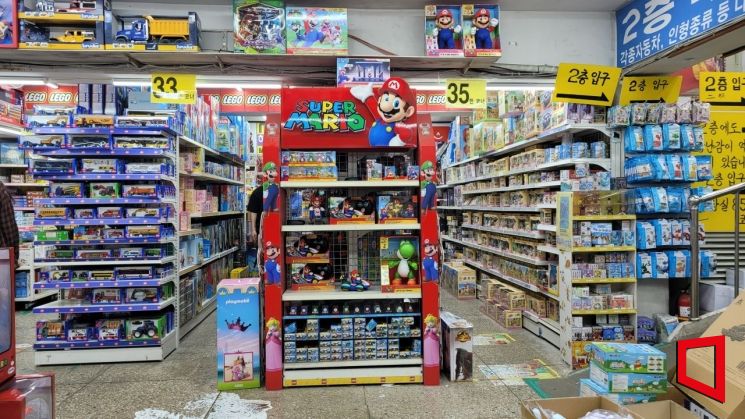 A toy store located in Changsin-dong, Seoul. According to a store official, 'Lego' enthusiasts, 'Super Mario' fans, and adults often visit the toy store. Photo by Han Seung-gon
A representative example of sales growth driven by deokhu is the Pok?mon bread released by SPC Samlip. This bread includes Pok?mon stickers, which became wildly popular among Pok?mon deokhu. According to SPC, the Pok?mon bread launched in February last year sold 1.5 million units within a week of release. By December of the same year, over 100 million units had been sold.
Pok?mon bread, priced at 1,500 won per bag, was sold for over 10,000 won?more than six times the original price?on secondhand trading sites, and the stickers (ttibuttibussil) were traded among deokhu for 40,000 to 50,000 won. The Pok?mon steamed buns (Sobulgogi steamed bun and Walnut red bean steamed bun) released in December last year sold 3 million units within three weeks, and the Sanrio bread based on 'Sanrio Characters,' released last month, recorded cumulative sales of 1 million units within a week.
Additionally, AK Plaza Hongdae shopping mall became a hotspot for deokhu when it opened stores like 'Daewon Media,' which features a figure shop themed around the Japanese animation 'One Piece' and a gamer specialty shop in May last year. Among deokhu, an 'open run' even took place. As many as 14,000 people visited the store during the first weekend after opening.
The public's reaction to this is also not negative. Mr. Lee, a man in his 30s who is a Gundam enthusiast and works in an office, said, "I like Gundam, so I wasn't particularly moved, but the store was a big topic among 'One Piece' fans." He added, "If a pop-up store themed around Gundam opens, I would definitely go."
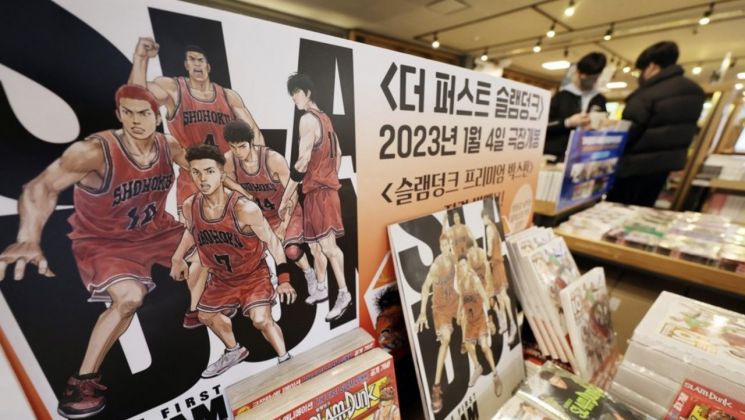 Thanks to the success of the Japanese animation 'The First Slam Dunk,' the 'Slam Dunk' manga volumes also gained great popularity. The photo shows Slam Dunk manga books displayed at Kyobo Bookstore Gwanghwamun branch in Jongno-gu, Seoul, last February. [Image source=Yonhap News]
Regarding this 'deokhu-nomics' phenomenon, the Korea Trade-Investment Promotion Agency (KOTRA) Tokyo Trade Center analyzed in a 2021 trend report that the annual consumption scale of the top three Japanese otaku markets?animation, games, and comics?would reach 4 trillion yen (approximately 40 trillion won). The report also noted that changing times played a role. It stated, "In the 1980s, the term 'otaku' was used to describe peculiar people with heterogeneous hobbies such as animation, games, and comics, but 40 years later, it has become a positive image representing individuals who deeply pursue their personal tastes regardless of generation or gender."
Experts emphasize that deokhu-nomics has already established itself in the market, and 'fandom consumption' is emerging as a powerful consumer base. Cultural critic Jung Deok-hyun said, "'Deokhu-nomics' and 'fandom consumption' are phenomena that have entered the settlement stage rather than being just trends." He added, "For example, even looking at movie theaters, it is a kind of fandom consumption. Recent box office successes like Slam Dunk and the Marvel movie 'Guardians of the Galaxy Vol. 3 (Gaogael 3)' have strong fan bases. In the case of Gaogael 3, the 'Marvel fandom' played a significant role in its success." He continued, "When fandom consumption occurs, it can spread to other fields and lead to further consumption, making this type of consumption very important from an industrial perspective."
© The Asia Business Daily(www.asiae.co.kr). All rights reserved.


















