"Current Situation Similar to Pre-World War I"
"Unyielding US and China, World's Greatest Threat"
"Humanity's Fate Depends on Bilateral Relations"
Henry Kissinger (99), a veteran American diplomat active during the Cold War and former U.S. Secretary of State, warned that a 'Third World War' could break out within the next 5 to 10 years amid escalating U.S.-China tensions.
In an interview with the British weekly magazine The Economist on the 17th (local time), former Secretary Kissinger asserted, "The two greatest immediate threats to peace, given their capability to destroy humanity, are the United States and China."
He said, "We are in a situation similar to that before World War I," adding, "Neither side has political room to concede, and any event that disrupts the balance could lead to catastrophic consequences."
He further emphasized, "The fate of humanity depends on whether the United States and China get along," and urged, "We must find a way to avoid war within 5 to 10 years."
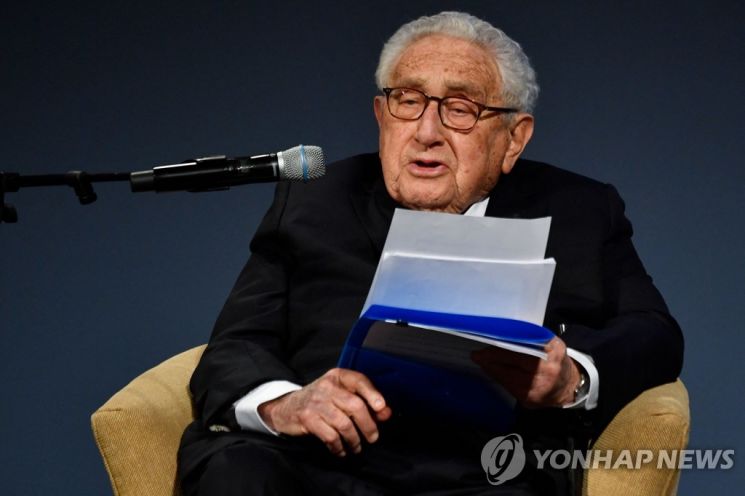
Former Secretary Kissinger also warned about the impact of artificial intelligence (AI) development on warfare. "Historically, no one has ever had the capability to completely annihilate the enemy due to geographical and accuracy limitations," he said, "but now, thanks to AI, those limitations will disappear."
He suggested that since it is impossible to revert AI technology to its original state, both countries should engage in dialogue to establish deterrence regarding military AI, similar to the post-Cold War nuclear arms reduction talks among nuclear powers.
Kissinger proposed a realistic solution for coexistence between the U.S. and China. He said that while both countries should fundamentally maintain their respective positions on Taiwan, the U.S. must handle troop deployments in the Pacific region cautiously and avoid giving the impression that it supports Taiwan's independence.
He also warned that if a war breaks out in Taiwan, the global economy would suffer enormous damage, and China would inevitably have to retreat.
Kissinger was active on the front lines of U.S. diplomacy during the height of the Cold War in the 1970s. As National Security Advisor under the Nixon administration, he secretly visited China in 1971 to discuss improving U.S.-China relations with then Chinese Premier Zhou Enlai, laying the groundwork for the establishment of diplomatic relations between the two countries in 1979.
Through this, he contributed to easing the extreme confrontation between the West and the Communist bloc and became a key figure in designing the so-called "d?tente" that lasted for a decade from the early 1970s.
Meanwhile, Kissinger has repeatedly urged easing tensions between the U.S. and China, warning of the possibility of conflict for several years.
In 2021, at a forum hosted by the McCain Institute for International Leadership under Arizona State University, he warned, "The tension between the U.S. and China is the biggest problem not only for the United States but for the entire world," adding, "If this is not resolved, it will affect the whole world."
© The Asia Business Daily(www.asiae.co.kr). All rights reserved.
![Clutching a Stolen Dior Bag, Saying "I Hate Being Poor but Real"... The Grotesque Con of a "Human Knockoff" [Slate]](https://cwcontent.asiae.co.kr/asiaresize/183/2026021902243444107_1771435474.jpg)











