Seoul Metropolitan Police Agency Had Plans for Forced Dispersal
Considered Late-Night Unexpected Variables and Legal Interpretations of the Assembly and Demonstration Act
Police Call for "Swift Investigation and Amendment of the Assembly and Demonstration Act"
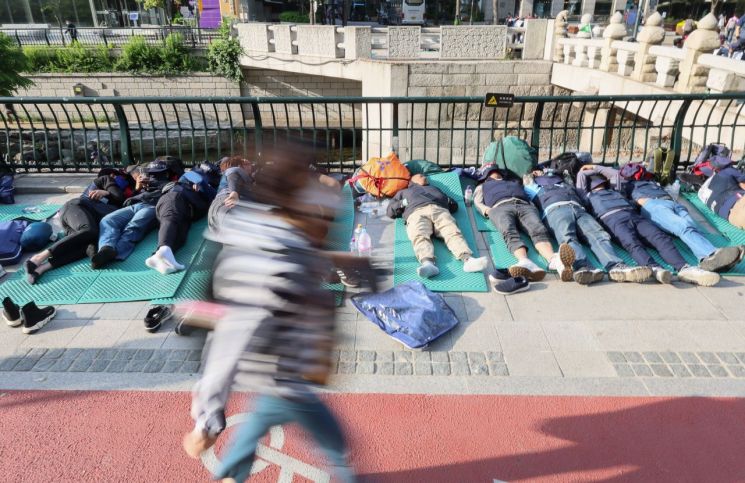
The 1-night, 2-day overnight protest held by the Korean Confederation of Trade Unions (KCTU) Construction Union in downtown Seoul on the 16th and 17th was confirmed to have been possible due to the combined factors of the police's reluctance to forcibly disperse and the exclusion of the Assembly and Demonstration Act (ADA) application.
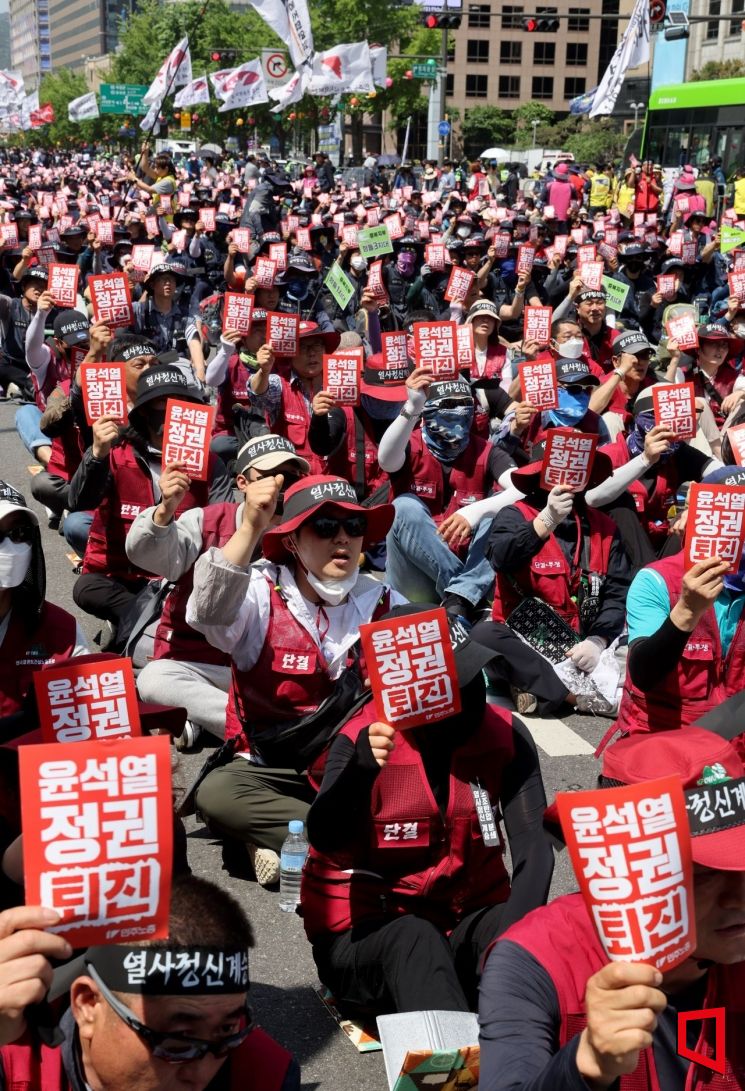 Members of the Korean Confederation of Trade Unions held a rally on the 17th around Sejong-daero in Seoul, shouting slogans calling for the resignation of the Yoon Seok-yeol administration. Photo by Heo Young-han younghan@
Consideration of Unexpected Variables During Late Night Hours and Legal Interpretation of Forced Dispersal
According to the National Police Agency, the Seoul Metropolitan Police Agency issued three dispersal orders on both the 16th and 17th. The police have the authority to forcibly disperse illegal assemblies if the order to disperse is ignored three or more times, but they did not actually carry out the dispersal.
On the 19th, a Seoul Metropolitan Police Agency official stated, "We do not pre-judge illegality, but we reviewed forced dispersal the day before," adding, "However, even if a plan was established, the conditions on site must be considered, and the possibility of accidents due to unexpected situations during late-night hours was taken into account."
It was also a burden that the union abused Article 15 of the ADA, claiming that the event was not an illegal assembly but a cultural event or similar. The current ADA prohibits the application of assembly bans or restrictions to assemblies related to academic, artistic, athletic, religious, ceremonial, or national events.
The police also appear to have considered legal interpretations such as Supreme Court precedents. In 2013, the Supreme Court ruled that even unreported assemblies cannot be forcibly dispersed by the police unconditionally.
At that time, the Supreme Court's full bench overturned the original sentence that fined four former senior members of the Democratic Labor Party, including Lee Su-ho, and sent the case back to the Seoul Central District Court. Although it was acknowledged that the assembly was unreported and illegal, the court judged that a dispersal order could only be issued if the assembly or demonstration clearly posed a direct threat to others' legal interests or public peace and order. It was considered unreasonable to view the union's overnight protest as posing a direct threat. The fact that there was no physical confrontation or violent behavior was also taken into account.
Recent policies on responding to assemblies and demonstrations were also reflected. Due to concerns about physical clashes, investigations are being conducted after the fact through evidence collection. Considering that only 5,500 experienced officers were deployed on site, forcibly dispersing and arresting participants was practically impossible. A police official stated, "The Construction Union and KCTU each reported assemblies with 30,000 and 55,000 participants, respectively, but to forcibly disperse these, at least four times that number, 200,000 officers, would be needed."
Police Plan Swift Investigation... Controversy Over Reviewing Illegal Assembly Records
On the previous day, Police Commissioner Yoon Hee-geun stated, "We will investigate illegal assemblies swiftly and firmly," adding, "We have requested the attendance of five executive members, including the Construction Union chairman, by the 25th, and if they fail to appear, arrest warrants will be issued for their apprehension." Namdaemun Police Station is investigating two individuals, including the Construction Union chairman, on charges of violating the ADA, while Jungbu Police Station is investigating three individuals, including the KCTU Organizational Dispute Director, on charges of violating the ADA and obstructing general traffic.
The police also plan to strengthen crackdowns on various assemblies. The National Police Agency announced that it will prohibit or restrict similar assemblies by groups with a history of illegal assemblies like the Construction Union. Under the current ADA, assemblies and demonstrations operate under a notification system, not a permit system. However, a National Police Agency official stated, "If a group that has committed illegal violence files an assembly notification, it is predictable," and said they would prohibit assemblies and demonstrations by anticipating future risks.
© The Asia Business Daily(www.asiae.co.kr). All rights reserved.


















