End of 'Cardboard Shortage' Benefiting from COVID Era
Paper Industry Earnings Decline Due to Manufacturing Slump and Reduced Parcel Demand
Hansol and Moorim See Mixed Results Amid Rising Pulp Prices
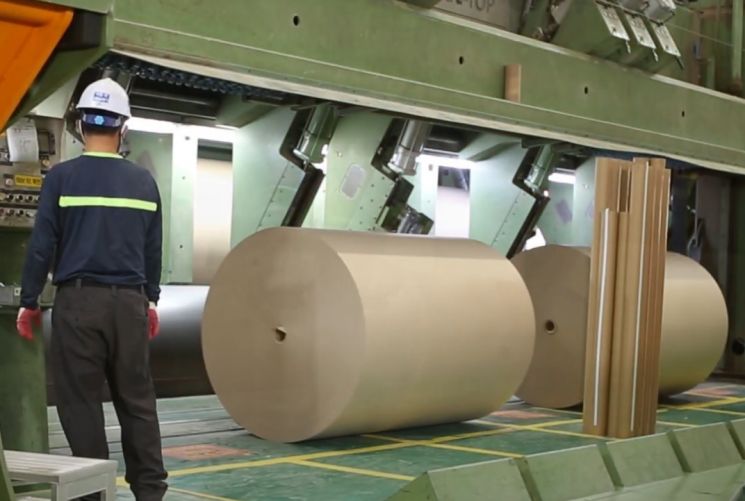
Dark clouds have gathered over the paper industry’s performance in the first quarter of this year. The demand for paper has been steadily declining due to the spread of the digital economy, and the worsening manufacturing sector has led to a sharp drop in demand for packaging materials. The decrease in parcel volumes following the COVID-19 endemic phase has also reduced the demand for cardboard used in packaging boxes, further worsening the performance of related companies.
On the 19th, Asia Economy compiled the first-quarter results of 14 paper companies listed on the domestic stock market. The total sales amounted to 2.231 trillion KRW, and operating profit was 96.1 billion KRW. Compared to the same quarter last year, sales increased by 1.1%, but operating profit fell by 24.8%. Although product sales remained at a similar level to last year, margins decreased by a quarter.
Paper is broadly categorized into printing paper (records), industrial paper (packaging), sanitary paper (toilet paper), and specialty paper. Industrial paper is divided into corrugated cardboard used for delivery boxes and white cardboard used for packaging confectionery, pharmaceuticals, and cosmetics. In the first quarter of this year, companies primarily producing industrial paper saw a notable decline in performance.
Youngpoong Paper, which mainly produces linerboard (one of the corrugated cardboard raw materials) and paper tubes (cylindrical paper forms), recorded an operating profit of 2.1 billion KRW in the first quarter of last year but posted an operating loss of 700 million KRW in the first quarter of this year. Sales also plunged 32% from 28.2 billion KRW to 19.1 billion KRW. Asia Paper, which mainly produces corrugated cardboard raw materials and corrugated boxes, saw sales decrease by 10.7% and operating profit by 33%. Taerim Packaging, the top domestic producer of corrugated cardboard box packaging materials, also experienced a 7.1% drop in sales and a 15.6% decline in operating profit. A representative from a corrugated cardboard manufacturer said, "During the COVID-19 pandemic, corrugated cardboard was in such high demand it was called ‘gold cardboard,’ but recently, inventories have piled up significantly." He added, "The reduction in parcel volumes due to decreased consumer sentiment amid the economic downturn is also a negative factor."
Hansol Paper, the number one paper company in Korea, also struggled. Hansol’s sales in the first quarter of this year were 561 billion KRW, with an operating profit of 7.8 billion KRW. Compared to the same quarter last year, sales increased by 2.4%, but operating profit decreased by 68.3%. Based on separate financial statements excluding affiliate performance, the company posted an operating loss of 2.7 billion KRW, turning to a deficit. Despite three price hikes in paper last year, it was insufficient to defend performance.
Hansol is facing difficulties due to the decline in manufacturing activity and rising costs of pulp, the raw material for paper, and energy. According to the Ministry of Trade, Industry and Energy’s raw material price information, as of April 24, the price of Southern US mixed hardwood pulp (SBHK) was $770 per ton (approximately 1.03 million KRW). After peaking at $1,030 per ton in August last year and maintaining high prices until the end of the year, prices have gradually declined this year. Another factor behind the performance deterioration was the suspension of operations at the Janghang plant in Seocheon-gun, Chungnam Province, due to heavy snowfall at the end of last year. The Janghang plant is one of Hansol Paper’s key factories, producing 600,000 tons annually of printing and specialty paper. A Hansol representative said, "The Janghang plant is currently being restored with the goal of resuming operations within the second quarter."
Among domestic paper companies, the Murim Group, which is the only one to produce pulp directly, performed well. Murim subsidiaries Murim Paper and Murim SP manufacture eco-friendly paper and specialty paper using pulp produced by Murim P&P at its Ulsan plant. The burden of rising pulp prices is relatively lower compared to other companies. Murim Paper’s sales in the first quarter of this year were 344.8 billion KRW, and operating profit was 21.6 billion KRW, representing increases of 21.2% and 219.6%, respectively, compared to the first quarter of last year. During the same period, Murim P&P’s sales rose by 23.8%, and operating profit increased by 36%.
© The Asia Business Daily(www.asiae.co.kr). All rights reserved.
![Clutching a Stolen Dior Bag, Saying "I Hate Being Poor but Real"... The Grotesque Con of a "Human Knockoff" [Slate]](https://cwcontent.asiae.co.kr/asiaresize/183/2026021902243444107_1771435474.jpg)















