Early Heat Drives Stores to Run Air Conditioners at Full Blast
Despite Electricity Price Hikes, Doors Wide Open
Merchants Say "No Choice If We Want to Attract Customers"
"Rather than saving on air conditioning costs, it's better to raise the price of goods and sell even one more item. If you close the door while doing business, customers think you've gone out of business and won't come in. Don't close the door, just go out."
On the 17th, under hot weather with daytime temperatures exceeding 30 degrees Celsius, self-employed business owner A, who runs a clothing store in downtown Myeongdong with the air conditioner running at full capacity and both doors wide open, shouted loudly at customers who were about to leave after closing the door.
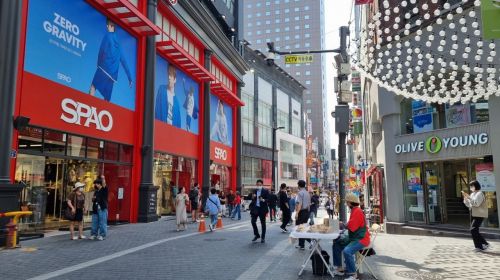 On the afternoon of the 17th, shops with air conditioning turned on are open wide for business on the streets of Myeongdong, Jung-gu, Seoul. Photo by Moon Hyewon
As the government raised electricity rates by 8 won per kWh and gas rates by 1.04 won per MJ, the cooling cost burden on self-employed business owners has increased further, but the practice of 'open-door cooling' business in major downtown commercial districts still prevailed.
Open-door cooling is a major cause of power waste. According to the Korea Energy Agency, open-door cooling can result in electricity bills up to three times higher than when the door is closed and the air conditioner is running, due to significantly reduced energy efficiency.
However, on this day, 9 out of 10 stores including cosmetics, shoe, clothing stores, restaurants, and cafes on the streets of Myeongdong operated with their doors wide open even while running air conditioning. Although energy efficiency drops significantly when operating with doors open, merchants commonly agree that it is unavoidable to keep the doors open to welcome customers.
Merchant B, who runs a bag store near Myeongdong Station, said, "The hotter the weather gets, the cooler the store needs to be for more customers to come in. We only close the door when employees are eating or attending to urgent matters; if the door is closed, customers think we are not operating. We have to keep it wide open to get even one more customer."
Self-employed business owner C, who runs a clothing store in an alley near a large shopping mall, said, "Before COVID-19, the average monthly electricity bill in summer was about 1 million won. Even if electricity rates have increased, if we close the door to save this cost or because we fear a fine of about 500,000 won, all customers will leave and the business will fail. It's better to just raise the price of goods and sell them," he said.
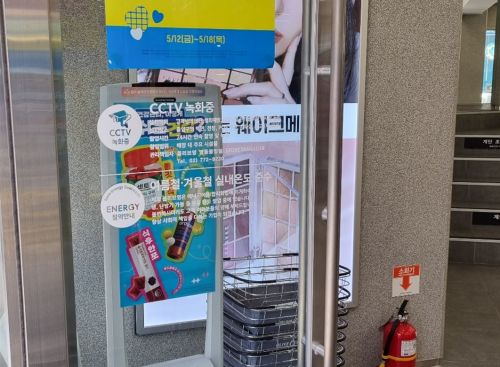 On the afternoon of the 17th, despite the notice "Observe indoor temperatures in summer and winter" being clearly displayed on the entrance door of Olive Young Myeongdong Central Branch in Seoul, all doors were wide open during operation. Photo by Moon Hyewon
Olive Young Myeongdong Central Branch had a notice on the entrance door stating, "Compliance with indoor temperature during summer and winter ? Olive Young operates with doors closed while running cooling and heating devices in accordance with the Energy Use Rationalization Act. We ask for customers' understanding despite any inconvenience. We will always strive to be a socially responsible company," yet all doors were wide open during operation.
If open-door cooling business practices are recognized to cause or potentially cause serious disruptions in energy supply due to domestic or international energy conditions, the government may designate a specific period to announce and inspect these practices and impose fines. Violations can result in fines ranging from 1.5 million to 3 million won depending on the number of offenses.
The Ministry of Trade, Industry and Energy used to conduct annual crackdowns before COVID-19 but postponed enforcement during the pandemic citing the need for ventilation. For now, Seoul City plans to recruit the 'Energy Seoul Companion Team' and conduct an energy-saving campaign from next month through August in major commercial districts such as Myeongdong to discourage open-door cooling.
© The Asia Business Daily(www.asiae.co.kr). All rights reserved.


















