If Population Decreases by 1%, GDP Drops by 0.59%
Hankyung Research Institute 'Impact of Population Structure Changes on GDP'
A study found that if the working-age population decreases by 1%, the gross domestic product (GDP) decreases by about 0.59%, and if the dependent population increases by 1%, GDP decreases by about 0.17%. To mitigate the economic shock caused by changes in the population structure, multifaceted policies such as increasing employment rates in the labor market, deregulation, utilization of foreign workers, and improvement of labor productivity are necessary.
On the 18th, the Korea Economic Research Institute (KERI) announced in its report titled "Estimation of the Impact of Population Structure Changes on GDP and Implications" that the deepening low birthrate and aging population could negatively affect South Korea's economy in the future due to changes in the population structure.
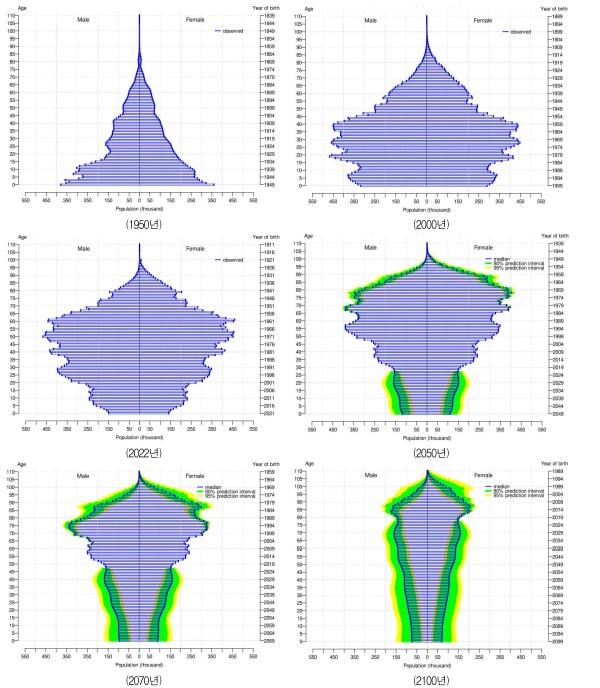
According to United Nations (UN) population data, South Korea's total population is expected to decrease by about 11.67% from 51.81 million last year to 45.77 million in 2050. Among them, the working-age population in 2050 is projected to be 23.98 million, a decrease of about 34.75% compared to 36.75 million in 2022. The dependent population is estimated to increase by about 44.67%, from 15.05 million in 2022 to 21.78 million in 2050.
South Korea's population pyramid has changed from a triangular shape in the past to a pot-shaped structure in 2022, with a thickened population aged 40 to 60. By 2050, due to the intensification of low birthrate and aging, the shape is expected to change from a pot shape to an inverted pyramid with a larger elderly population. By 2100, the population will decrease further, resulting in a stick shape with a narrower population area across all age groups.
KERI conducted an empirical analysis using panel data from the Organisation for Economic Co-operation and Development (OECD) countries and found that if the working-age population decreases by 1%, GDP decreases by about 0.59%, and if the dependent population increases by 1%, GDP decreases by about 0.17%. Based on this, assuming other factors remain constant, South Korea's population structure changes are expected to reduce GDP by 28.38% in 2050 compared to 2022. Converted to an average annual rate from 2022 to 2050, GDP is projected to decrease by about 1.18% per year. As the working-age population, which plays a central role in the economy, decreases and the dependent population increases, the resulting increase in fiscal burden and decrease in future investment dampen economic vitality, negatively impacting GDP.
Senior Research Fellow Yoo Jin-seong of KERI advised, “Since an increase in the employment rate positively affects GDP, it is necessary to expand employment opportunities by easing labor regulations such as labor market rigidity and to explore ways to enhance women's economic participation by expanding flexible working hours policies.” He added, “It is also necessary to improve the employment efficiency of the elderly by promoting wage peak systems and wage structure reforms, while increasing companies’ capacity to employ and expanding employment opportunities for young people.”
© The Asia Business Daily(www.asiae.co.kr). All rights reserved.
![Clutching a Stolen Dior Bag, Saying "I Hate Being Poor but Real"... The Grotesque Con of a "Human Knockoff" [Slate]](https://cwcontent.asiae.co.kr/asiaresize/183/2026021902243444107_1771435474.jpg)
















