Legislative Attempts Since 2018
Failures Due to Inadequate Virtual Asset Regulations
Growing Political Momentum for Virtual Asset Disclosure
Legislation to include virtual assets in the disclosure requirements for public officials' property has gained momentum following the 'cryptocurrency investment suspicion' involving Kim Nam-guk, a lawmaker who left the Democratic Party of Korea. Although similar amendments to the Public Officials Ethics Act have been proposed in the past, they failed to pass the National Assembly for over five years. Discussions in the National Assembly to establish a legal basis for virtual assets are also expected to accelerate.
According to the National Assembly on the 18th, the Administrative Safety Committee plans to discuss the amendment to the Public Officials Ethics Act at a subcommittee meeting on the 22nd. The amendment includes virtual assets in the property registration requirements for public officials and candidates. Nine related amendment bills have been submitted this month. If the ruling and opposition parties reach an agreement in the subcommittee, the bill is likely to be approved at the full Administrative Safety Committee meeting on the 24th and then processed at the plenary session scheduled for the 25th.
The Public Officials Ethics Act Amendment Triggered by Kim Nam-guk
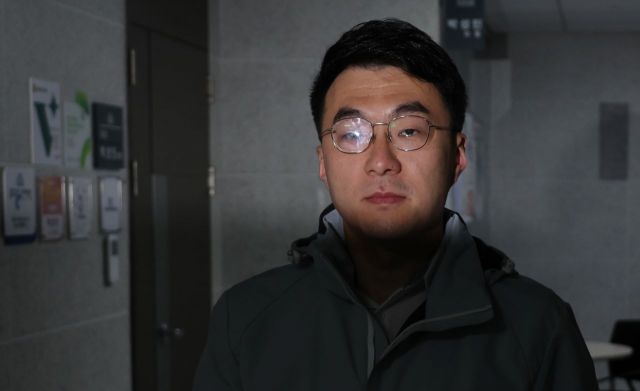
The National Assembly's move to amend the Public Officials Ethics Act was prompted by the spread of suspicions regarding Kim Nam-guk's cryptocurrency investments worth around 10 billion KRW. Allegations surfaced that Kim held and traded cryptocurrencies worth up to 10 billion KRW from January to March last year, just before the presidential election. However, Kim did not report these virtual assets during the disclosure of his property as a lawmaker last year. As a result, the political circles quickly proposed the 'Public Officials Ethics Act amendment' to include virtual assets in the list of publicly registered properties for high-ranking officials. With less than a year remaining until the general election, 'cryptocurrency' has emerged as the biggest political issue.
Kim Ki-hyun, leader of the People Power Party, said at the party's supreme council meeting on the 11th, after the controversy over Kim Nam-guk's cryptocurrency investments arose, "The 'Kim Nam-guk Prevention Act,' which mandates the inclusion of virtual asset holdings of public officials in property registration and requires transparent disclosure of transaction details, must be urgently introduced." Park Kwang-on, floor leader of the Democratic Party, also pledged at the policy coordination meeting on the same day, "We will include virtual assets in property registration and reporting, incorporate conflict of interest details, and address legal gaps and system loopholes." The floor leaders of both parties recently met under the chairmanship of National Assembly Speaker Kim Jin-pyo and agreed to process the amendment to the Public Officials Ethics Act during the May extraordinary session.
The current Public Officials Ethics Act requires high-ranking officials to disclose registered properties such as land, buildings, real estate, cash, deposits, stocks, jewelry, artworks, antiques, and intellectual property rights. Virtual assets are not subject to disclosure. Therefore, Kim reported 1.53 billion KRW in assets this year, but virtual assets worth tens of billions of KRW were excluded from the property details. However, concerns have been raised about potential conflicts of interest, including the use of undisclosed information, as he traded virtual assets worth tens of billions of KRW.
Efforts to Legislate Disclosure of Virtual Assets by Public Officials... Why They Failed to Pass the National Assembly
The legislation to mandate disclosure of virtual assets by public officials is not a new discussion. During the 20th National Assembly in 2018, Democratic Party lawmakers Jeong Dong-young, Noh Woong-rae, and Ki Dong-min each introduced amendments to the Public Officials Ethics Act to include virtual assets in the disclosure requirements. This was during the period of a cryptocurrency investment boom driven by the rapid rise in Bitcoin prices. Jeong Dong-young's bill defined 'cryptocurrency worth over 10 million KRW,' Noh Woong-rae's bill defined 'virtual currencies and other assets designated by the president,' and Ki Dong-min's bill defined 'virtual currencies worth over 10 million KRW' as subject to registration.
At the time, the Administrative Safety Committee's review opinion stated, "Considering that cryptocurrencies held for investment purposes have recently increased and that regulating them like stocks and bonds could prevent property concealment through cryptocurrencies, there is legislative validity." However, it also pointed out the need for further review, citing "the absence of a legal framework for cryptocurrencies." There were concerns that treating cryptocurrencies the same as stocks and other financial assets at the national level could cause misunderstandings, which hindered the passage of the amendment. Subsequently, the amendment failed to pass the standing committee and was discarded with the expiration of the 20th National Assembly.
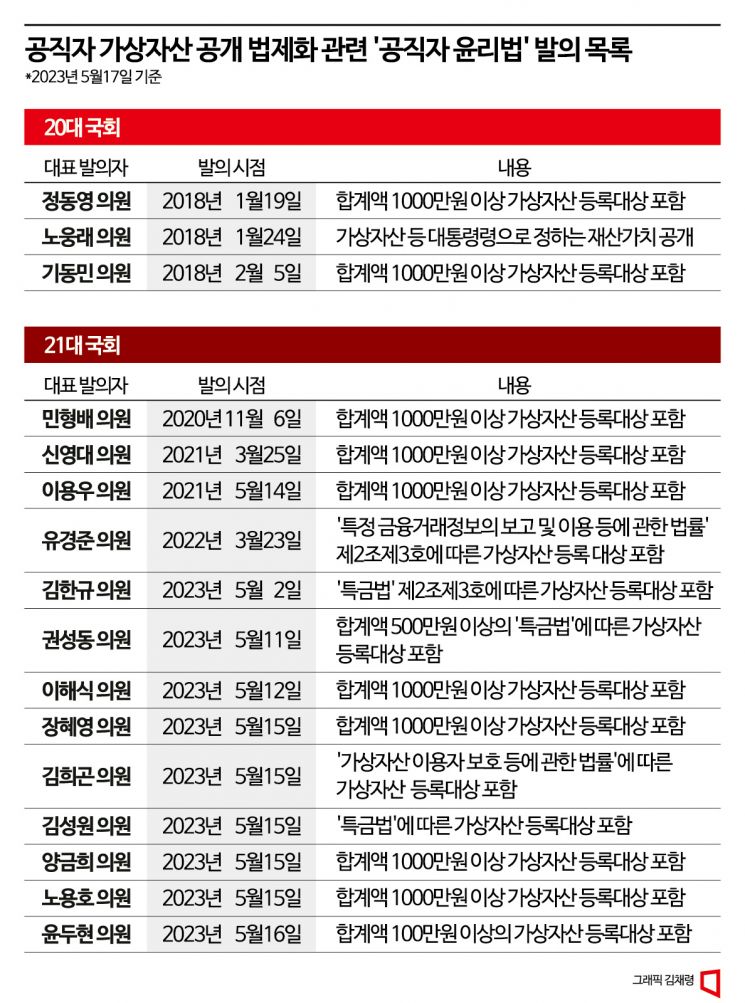
In the 21st National Assembly, People Power Party lawmaker Yoo Kyung-joon and Democratic Party lawmakers Kim Han-gyu, Min Hyung-bae, Shin Young-dae, and Lee Yong-woo have introduced similar bills. These bills have remained pending in the Administrative Safety Committee subcommittee due to review opinions stating that there are no regulations on the method of valuation in related laws and that discussions should proceed after related regulations are revised. The consensus is that legislation to disclose virtual assets by public officials should follow the enactment of so-called 'industry-specific laws' that formally include virtual assets within the regulatory framework.
Virtual Assets Regulated by the Act on Reporting and Using Specified Financial Transaction Information (Special Financial Transactions Act)... Will Industry-Specific Laws Also Pass the National Assembly?
Currently, virtual assets are regulated under the 'Act on Reporting and Using Specified Financial Transaction Information (Special Financial Transactions Act, or Special Financial Act),' which passed the National Assembly plenary session in March 2020. The Special Financial Act requires reporting of suspicious transactions involving virtual assets to prevent money laundering. However, it does not include legal provisions to protect virtual asset investors or prevent unfair practices.
Accordingly, the National Assembly's Political Affairs Committee is promoting phased legislation of the Virtual Asset User Protection Act. This bill defines virtual assets as tokens representing value or rights that can be stored and transferred based on distributed ledger technology, and focuses on protecting users by safeguarding their deposits. The Political Affairs Committee passed the Virtual Asset User Protection Act at a subcommittee meeting on the 11th. Additionally, at the full committee meeting the day before, all members of the Political Affairs Committee adopted a resolution to voluntarily report their virtual asset holdings.
Experts in politics and law have stated that virtual assets should be recognized as assets and included in the disclosure requirements for public officials' properties. Professor Kim Sang-gyeom of Dongguk University's Department of Law said, "Virtual assets currently have economic value and should naturally be included in property disclosures and managed accordingly." He added, "It is also problematic that a lawmaker, who is both an elected official and a public servant, treats virtual assets as a means of profit."
Lee Kwang-jae, Secretary-General of the Korea Manifesto Practice Headquarters, said, "This problem arose because the National Assembly has been slow to act. Our current legal system does not include elements of the digital society. This is an opportunity for our society to engage in in-depth discussions and move toward disclosure of digital assets as well." Professor Park Sang-byeong of Inha University's Graduate School of Policy also argued, "The issue of lawmakers' assets is not merely a legal matter but relates to the public's expectations and standards. The ruling and opposition parties should quickly reach an agreement and conduct a full investigation of lawmakers' virtual asset holdings."
However, some academics express caution, arguing that virtual assets cannot yet be equated with currencies or stocks. Professor Kim Seung-joo of Korea University's Graduate School of Information Security said, "Including virtual assets in public officials' property registration means recognizing them as equivalent to cash or securities, which could have other repercussions. This is a contentious issue in academia and industry and cannot be easily advanced."
© The Asia Business Daily(www.asiae.co.kr). All rights reserved.


















