Hanwha Life Requests Public Health Insurance Medical Data
Scrapped Amid Concerns Over 'Denial of Vulnerable Groups'
Consumers, Providers, Experts Express Unified Concerns
"Public Interest Must Come First... Private Sector Should Build Data Directly"
"Even Pseudonymized Data Can Identify Individuals"
"Concerns Over Exclusion of Vulnerable Groups"
Insurance Industry Calls Concerns 'Excessive'... Difficult to Deny Enrollment
How many men in their 40s are diagnosed with chronic diseases through the National Health Insurance Service (NHIS) health checkups, and what kind of people are diagnosed with cancer through cancer screenings? The NHIS is planning to provide its public medical data, which includes such information, to insurance companies so they can develop products. However, concerns have been raised that without prior public consensus, realizing this plan could lead to numerous side effects.
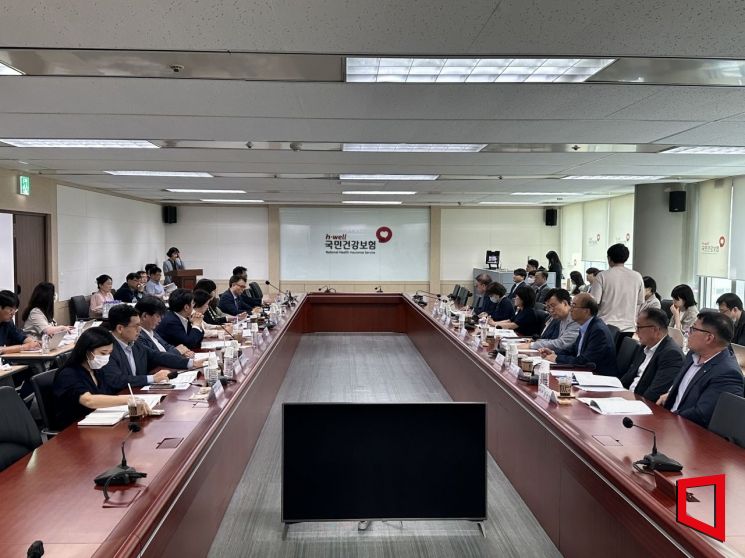 On the afternoon of the 17th, the 'Health Insurance Data Provision Guidelines Forum' is being held in Yeouido, Yeongdeungpo-gu, Seoul.
 [Photo by Lee Chunhee]
On the afternoon of the 17th, a "Health Insurance Data Provision Guideline Forum" was held in Yeouido, Yeongdeungpo-gu, Seoul, to discuss this issue. The main point of contention at the forum was whether the NHIS should provide the public medical data it holds to private insurance companies for the development of insurance products.
The NHIS currently holds big data encompassing social and economic information and citizens' medical records, including subscriber and dependent qualifications directly related to health insurance, insurance premium imposition details, medical treatment histories from hospitals and clinics, health checkups, long-term care insurance, and automobile insurance, all in accordance with the National Health Insurance Act and other laws. It currently provides data to academia and public institutions through various national approved statistics, major statistics, and the Public Data Portal. Park Jong-heon, head of the NHIS Big Data Operations Office, explained, "Most of the data provided to private companies have been for academic research, totaling about 30 cases."
Since the enactment of the Data 3 Laws (Personal Information Protection Act, Information and Communications Network Act, and Credit Information Act) in 2020, the private insurance industry has requested these data since 2021, stating they would use them for "scientific research" after pseudonymization. However, the NHIS rejected these requests citing concerns such as ▲ exclusion of vulnerable groups ▲ difficulty in considering it as scientific research ▲ violation of minimizing data provision. Nevertheless, as Hanwha Life Insurance reapplied for related requests and controversy continued, the NHIS has been seeking a compromise through stakeholder consultations since last year.
Through this process, in October last year, the "Guidelines for Data Opening to Private Insurance Companies" were derived. Reflecting concerns significantly, the guidelines include provisions such as ▲ refusal to provide data for research that disadvantages specific groups or citizens ▲ joint research participation by the NHIS and academia ▲ obtaining prior consent from the NHIS when utilizing research results.
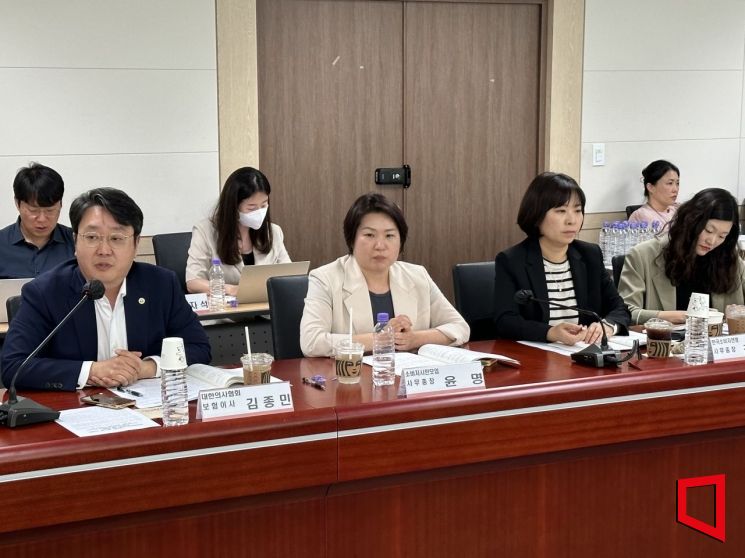 On the afternoon of the 17th, at the "Health Insurance Data Provision Guidelines Forum" held in Yeouido, Yeongdeungpo-gu, Seoul, Kim Jong-min, Insurance Director of the Korean Medical Association, attended as a panelist representing providers, and Yoon Myung, Secretary General of the Citizens' Coalition for Consumer Rights, and Jung Ji-yeon, Secretary General of the Korea Consumer Federation, attended as panelists representing consumer groups (from left)
 Photo by Lee Chun-hee
However, at the forum, fundamental objections to the term "guidelines" emerged, with concerns that the drawbacks might outweigh the benefits. Kim Jong-min, insurance director of the Korean Medical Association, said, "I decided to attend thinking this would be a debate on the pros and cons of establishing guidelines," adding, "If the guidelines have already been decided to be provided, then the discussion is meaningless." Kim also expressed concerns about the possibility of personal identification despite pseudonymized information. He stated, "They say pseudonymization can cover everything, but when combined with financial information, individuals can be identified," emphasizing, "Pseudonymized data is essentially information that requires individual consent, yet it is being sent as pseudonymized."
Yoon Ah-ri, secretary general of the Korean Data Law and Policy Association, also explained, "In the case of pseudonymized information, individuals cannot be identified without the use or combination of additional information," but added, "Regarding the health insurance data managed by the NHIS, the volume is vast and contains many sensitive details, so concerns about providing it to the private sector are also valid." Yoon said, "It is encouraging that considerations such as re-identification risk, use beyond the intended purpose, and third-party provision are included," and added, "Post-monitoring will also serve as a foundation for safe utilization once data provision is decided."
Jung Ji-yeon, secretary general of the Korea Consumer Federation, who participated as a consumer group representative, said, "From the consumer's perspective, there are concerns about the use of sensitive health information, and insurance companies have yet to present clear improvement measures," emphasizing, "I hope the system is implemented with sufficient countermeasures and preparations, even if it takes a little longer." Jung explained, "Currently, failure to disclose disease or morbidity status is a major reason for insurance claim denials," and added, "If private insurers have access to extensive information and use it for product development, there is a significant concern that consumers could be selected and discriminated against."
 On the afternoon of the 17th, Kim Myung-hee, Director of the Policy and Statistics Support Center at the National Medical Center, and Jung Sung-hee, Director of Research Coordination at the Korea Insurance Research Institute, attended as expert panelists at the "Health Insurance Data Provision Guidelines Discussion" held in Yeouido, Yeongdeungpo-gu, Seoul (from left)
 Photo by Lee Chun-hee
Experts also expressed concerns. Kim Myung-hee, director of the Policy and Statistics Support Center at the National Medical Center, criticized the private insurance companies' requests for public medical data as "free-riding." Kim emphasized that "public interest" should be the core, stating, "Health insurance big data is generated using medical system infrastructure funded by public resources," and added, "If such information is truly necessary for the advancement of insurance products, private insurers should invest resources to build cohorts or conduct periodic surveys themselves to directly collect and analyze data." She further noted that unlike the UK, where over one million people opted out of national health insurance and switched to private insurance following the introduction of medical information sharing systems, Korea lacks such rights, increasing the risk of consumer rights violations.
Regarding the public's cost-benefit aspect, she said, "Discounts on insurance premiums for low-risk groups are, on the other hand, the flip side of excluding high-risk subscribers or raising premiums differentially," and warned, "Claims that incentive programs encourage and promote healthy behaviors are more likely to impose punitive burdens for past performance rather than incentives for future health improvement," expressing concerns that this could harm patients' interests.
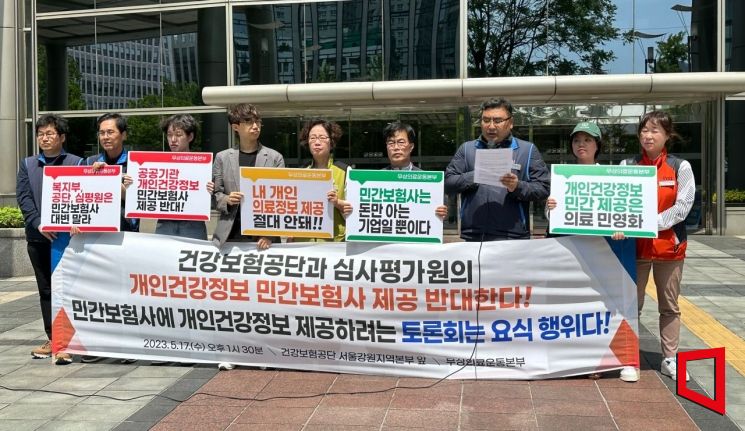 On the afternoon of the 17th, prior to the 'Health Insurance Data Provision Guidelines Forum' held in Yeouido, Yeongdeungpo-gu, Seoul, the Free Medical Movement Headquarters held a press conference opposing the forum.
 [Photo by Lee Chunhee]
Labor and civil society groups also issued strong criticism, demanding the cancellation of the forum. The Movement Headquarters for Blocking Medical Privatization and Realizing Universal Healthcare (Universal Healthcare Movement Headquarters) held a press conference before the forum, expressing opposition to providing public medical data. The Universal Healthcare Movement Headquarters stated, "Providing public data to private insurance companies itself violates public interest," and opposed "the provision of pseudonymized information without individual consent, which is not only risky but also conflicts with the National Health Insurance Act." They also criticized the recent amendment to the Medical Service Act, which passed the National Assembly's standing committee the day before and simplifies claims for indemnity insurance, saying, "They are trying to give all public institution information to private insurers," and warned, "This will jeopardize the health insurance system itself." After the press conference, they went to the forum venue, held a picket protest, reiterated their stance, and demanded the cancellation of the forum, causing the forum to start about 40 minutes late.
Insurance Industry: 'Excessive Concerns'... Difficult to Exclude Subscribers
The insurance industry argues that such concerns are excessive and that utilizing public medical data to develop insurance products for the elderly and those with pre-existing conditions could increase social utility. Moon Byung-jun, manager at Hanwha Life Insurance, which formed a joint research group with academia and the medical community and reapplied for the use of pseudonymized data from the NHIS, explained, "We are working for customers who need insurance but cannot enroll due to existing medical history, but there are many difficulties in developing products for those with pre-existing conditions with the information insurance companies currently have," adding, "We aim to develop new products by calculating new risk rates through precise analysis using public medical data." Regarding the possibility of excluding vulnerable groups from enrollment, he emphasized, "Public medical data is pseudonymized data, and statistical results derived from analysis are allowed to be taken out only under the review and approval of the provider," stressing, "It is impossible for insurance companies to identify individuals and block insurance enrollment."
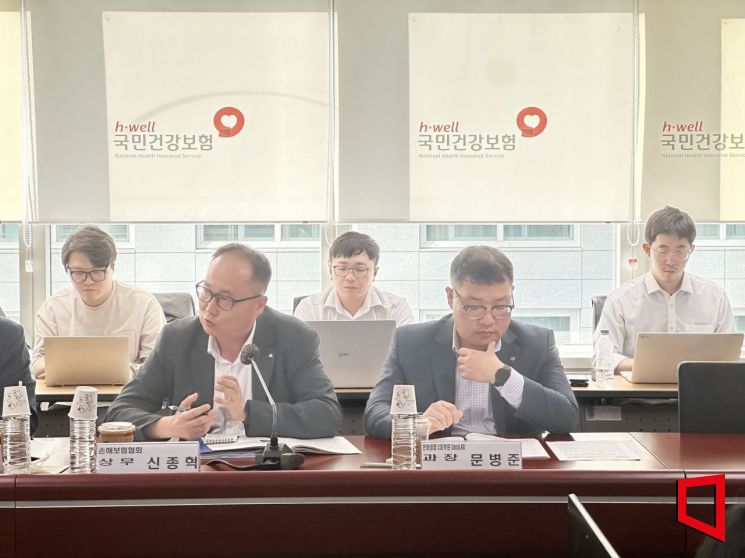 On the afternoon of the 17th, Shin Jong-hyuk, Executive Director of the General Insurance Association, and Moon Byung-jun, Manager at Hanwha Life Insurance (from left), attended the "Health Insurance Data Provision Guidelines Forum" held in Yeouido, Yeongdeungpo-gu, Seoul, representing the insurance industry.
 Photo by Lee Chun-hee
Jung Sung-hee, research coordination director at the Korea Insurance Research Institute, said, "Insurance companies cannot develop biased products that may cause consumer harm under relevant laws," and added, "Active government support is needed to help improve the quality of life of the people." Jung also proposed, "To ensure healthy discussions on sound data opening and utilization continue, a public-private insurance data council (data control tower) should be formed and operated, and a 'Special Data Committee' under the Prime Minister should be established to act as a promoter of data opening."
© The Asia Business Daily(www.asiae.co.kr). All rights reserved.



















