The last group of conscripted police officers (Uigyeong), who assisted in police security duties, will be discharged on the 17th. With their discharge, Uigyeong will disappear into history after 41 years since its establishment.
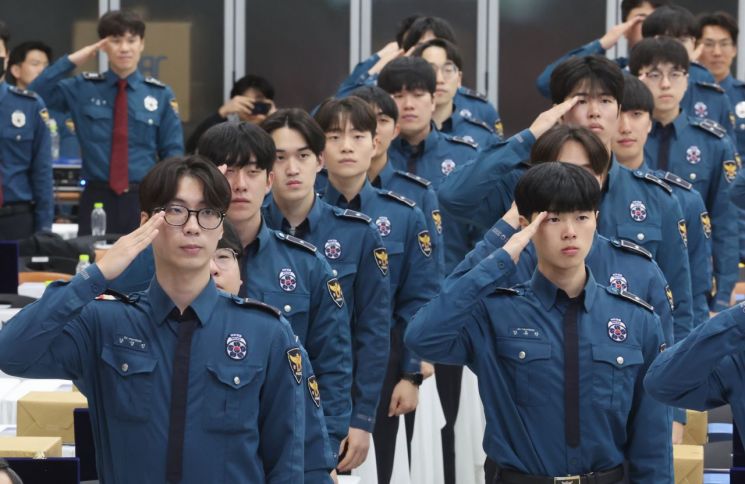 The last conscripted police officers of the 1142nd class of the Republic of Korea are saluting at the joint discharge ceremony held on the 14th of last month at the National Police Agency in Seodaemun-gu, Seoul. [Image source=Yonhap News]
Uigyeong was newly established in 1982 following the revision of the Combat Police Unit Installation Act, which divided combat police into operational police and Uigyeong. The first Uigyeong cohort enlisted in January 1983, and with the discharge of the last operational police in December 2013, security assistance duties were unified under Uigyeong.
During the Moon Jae-in administration, the abolition of Uigyeong, which was responsible for security assistance duties, was confirmed. In line with former President Moon’s pledge to create 810,000 public jobs, the "Plan for the Gradual Reduction of Uigyeong and Increase of Police Personnel" was announced in July 2017. The intention was to abolish Uigyeong and increase the number of police officers to contribute to public job creation. The plan also considered responding to the decrease in military service resources due to the demographic cliff. Accordingly, Uigyeong personnel were reduced by 20% annually starting in 2018, and with the discharge of the last cohort of Uigyeong members on this day, the abolition process is complete.
Uigyeong served as an alternative to military service by assisting police security duties instead of enlisting in the military. Their main duties included managing assemblies and demonstrations, crime prevention patrols, traffic control, and guarding facilities such as the National Assembly and diplomatic missions. Uigyeong held a rank just below patrol officer, wearing a rank insignia with one Mugunghwa (Rose of Sharon) flower bud.
The popularity of Uigyeong varied dramatically over time. Before the 2010s, Uigyeong had a strong image of being chosen by young men who wanted to enlist quickly for unavoidable reasons. It was notorious for various abuses and violent protests. The National Human Rights Commission recommended institutional improvements consecutively in 2007 and 2008, and when the malpractices were not eradicated, it even recommended abolishing the Uigyeong system at one point.
However, after Cho Hyun-oh, the former Commissioner of the National Police Agency, took office in 2010 and successfully led reforms of Uigyeong culture, its popularity surged. With abuses eliminated, and the advantages of more freedom for outings and overnight stays than soldiers, as well as working in urban areas, becoming prominent, the competition rate for Uigyeong selection exams exceeded 20 to 1 after the 2010s. Some candidates took the exam multiple times until they passed or traveled to regions with lower competition rates to take the exam. The competition rate for the last cohort of Uigyeong members reached 31.4 to 1.
Current police officers and discharged Uigyeong members who worked alongside Uigyeong expressed regret over the abolition of the system. Park, a police lieutenant (30) and former Uigyeong platoon leader, said, "It is truly regrettable that the Uigyeong, who endured hardships together to maintain security across the country, are marking the end of a 41-year history. I am grateful to all discharged members and wish them success."
Heo (29), who completed his Uigyeong service in 2016, said, "Even after discharge, I always looked when I met junior Uigyeong members on the street. I believe Uigyeong had clear roles such as embassy security and assembly management, so it is regrettable that the system was abolished entirely rather than reduced."
Meanwhile, concerns have been raised about the weakening of security response capabilities following the abolition of Uigyeong. The Seoul Metropolitan Police Agency expanded the riot police units from the 5th Riot Police Unit to the 6th and 7th in January 2021, and currently up to the 8th Riot Police Unit. However, compared to 2018, the number of Uigyeong units decreased by 74, while police riot units increased by only 37.
A security section chief at a frontline police station expressed difficulties, saying, "Three Uigyeong members were removed, and only one police officer was added." He added, "Violent protests have decreased, and even before, the capabilities of three Uigyeong members and one police officer were considered similar, so there is no immediate major gap in assembly management. However, it is true that planning assembly management is difficult due to the absolute decrease in experienced personnel."
© The Asia Business Daily(www.asiae.co.kr). All rights reserved.

















