A Time of Complex Great Transition, Considering South Korea's Vulnerabilities
Relying Solely on US-China Clash Could Increase Burdens
To realize a global pivotal state, it was suggested that the trilateral system of Korea, the United States, and Japan should be strengthened, while a hedging strategy is necessary given the era of complex great transitions. The analysis emphasized that instead of choosing between the U.S. and China, a framework of mutual respect and cooperation with China, which holds significant strategic interests, should also be kept open.
This means considering the risks involved when pursuing foreign policy solely focused on the U.S.-China confrontation. In other words, there is a possibility that U.S. Secretary of State Antony Blinken’s rescheduled visit to China could take place within this year. Secretary Blinken had initially planned his first visit to China in February, but it was unilaterally canceled as a protest over the Chinese surveillance balloon incident. Recently, there have been repeated mentions of resuming the visit.
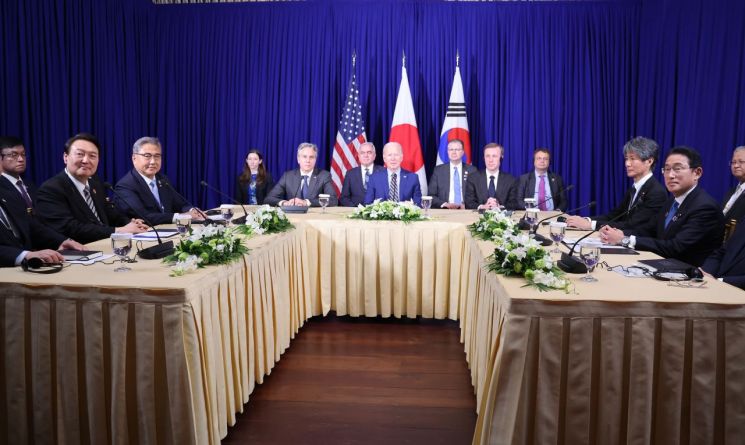 The trilateral summit between South Korea, the United States, and Japan held in Phnom Penh, Cambodia on November 13 last year. [Image source=Yonhap News]
At the academic conference titled "Trilateral Cooperation among Korea, the U.S., and Japan and the Realization of a Global Pivotal State" (Session 2: Trilateral Cooperation among Korea, the U.S., and Japan and the Realization of a Global Pivotal State) held by the Korea National Diplomatic Academy on the 16th, such recommendations were made.
Shin Gak-su, former ambassador to Japan and former first and second vice foreign minister, stated, “In an era of so-called complex great transitions such as liberalism, deepening protectionism, North Korea’s nuclear armament advancement, climate change, and digital transformation, it is necessary to establish an operational plan for a global pivotal state that takes into account our country’s vulnerabilities.” He added, “If policies are made solely based on the premise of U.S.-China conflict, it is easy to be caught off guard. We have high external dependence and geopolitical vulnerabilities as a divided country. Hedging efforts considering these vulnerabilities are necessary.”
Former Ambassador Shin predicted that the cooperation among Korea, the U.S., and Japan should be further developed within the G7 framework. He said, “The trilateral partnership joint declaration in Phnom Penh contained quite comprehensive content,” and added, “At the Hiroshima trilateral summit, it should evolve to a stage of concretization, moving beyond simple policy coordination to joint policy planning and execution.”
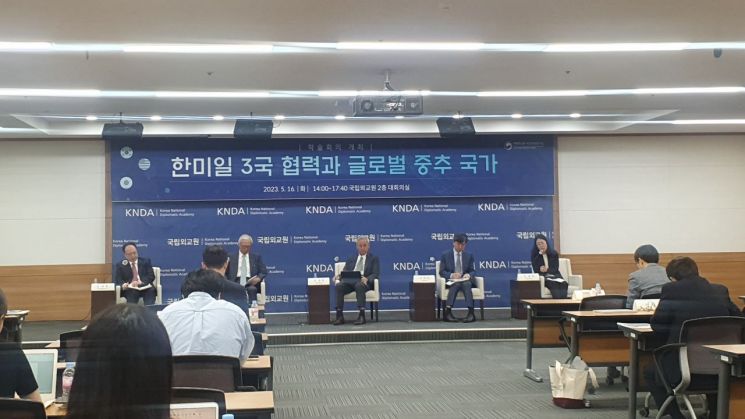 On the 16th, the academic conference "Korea-US-Japan Trilateral Cooperation and the Realization of a Global Hub Nation" was held at the Korea National Diplomatic Academy in Seocho-gu, Seoul. The photo shows the 2nd session, "Korea-US-Japan Trilateral Cooperation and the Realization of a Global Hub Nation." From left to right in the photo are Professor Ahn Se-hyun of the University of Seoul, former Ambassador to Japan Shin Gak-su, Economic Security Ambassador Lee Jae-min, and Professor Jeon Hye-won of the Korea National Diplomatic Academy.
Specifically, he proposed ideas such as strengthening the Korea-U.S.-Japan development cooperation system targeting underdeveloped Southeast Asia, South Asia, and Pacific island countries in the region, and jointly responding in areas like green growth and disaster relief.
Lee Jae-min, economic security deputy director, emphasized the need to expand economic cooperation among Korea, the U.S., and Japan amid the spread of “unilateralism” and “protectionism.” He pointed out, “Previously, our country approached the World Trade Organization (WTO) system with the idea of ‘producing good products, lowering tariffs, and achieving export growth,’ but with the decline of multilateralism, the norms that allowed our country to excel as a model student in the WTO system are being shaken.”
He stressed, “Our country ranks 9th in economic size and 6th among WTO members,” and evaluated, “The perspectives of the U.S. and Japan toward Korea have changed significantly. It is a time when we must play a leading role in democracy, climate change, and a norm-based international order to realize a ‘global pivotal state.’”
He added, “Korea, the U.S., and Japan have many overlapping areas of cooperation in automobiles, electric vehicles, batteries, and semiconductors,” and said, “If cooperation is achieved across both hardware and software industries, there will be many points that can contribute to achieving a global pivotal state.”
Professor Ahn Se-hyun of the University of Seoul proposed joint development of the maritime continental shelf in the 7th district among Korea, the U.S., and Japan. He said, “China has already declared its stake in the 7th district, and it is highly likely to take a more aggressive stance by 2028, so cooperation among the three countries would enable a counter-response.”
In Session 1 (Changes in the International Order and the Significance of Korea-U.S.-Japan Trilateral Cooperation), there was also a perspective that the international order shaped as Korea-U.S.-Japan versus North Korea-China-Russia should be closely examined.
Lee Ho-ryeong, senior researcher at the Korea Institute for Defense Analyses, mentioned, “In the Korea-U.S.-Japan and North Korea-China-Russia structure, the biggest beneficiary is North Korea. North Korea has framed the international order as a new Cold War system through its plenary meeting, and within this framework, it is very cautious of China and Russia.” He added, “However, since China’s burden may increase within this structure, even if China and Russia get closer to North Korea, we should identify areas where they suffer losses and set strategic goals for the Korea-U.S.-Japan trilateral cooperation.”
© The Asia Business Daily(www.asiae.co.kr). All rights reserved.
![User Who Sold Erroneously Deposited Bitcoins to Repay Debt and Fund Entertainment... What Did the Supreme Court Decide in 2021? [Legal Issue Check]](https://cwcontent.asiae.co.kr/asiaresize/183/2026020910431234020_1770601391.png)