When the Nursing Act is Enforced, the Entire Medical System Will Be Shaken
Discussion on Amendments to the Medical Service Act Including Nurse Treatment and Integrated Care
Yoon: "We Must Be Aware of Problems in Wrong Policies"
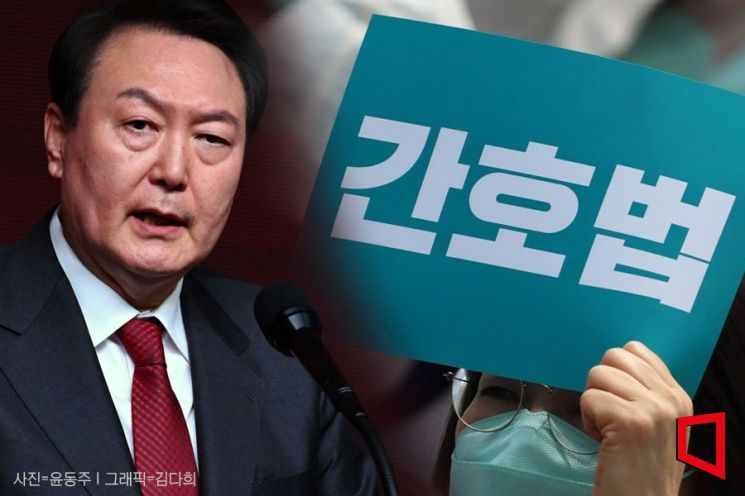
On the 16th, the Presidential Office stated that although President Yoon Suk-yeol exercised his right to request reconsideration (veto) on the enactment of the Nursing Act, he recognizes the need to amend the Medical Service Act framework regarding nurses' treatment and integrated care policies. Since healthcare concerns the health and lives of the people, the intention is to maintain the Medical Service Act, which includes a collaborative system, while improving nurses' treatment and working conditions.
A key official from the Presidential Office met with reporters at the Yongsan Presidential Office on the afternoon of the 16th and explained the background of the veto, saying, "The Presidential Office's position on the Nursing Act is clear. The most important thing is the health of our people, and if that is shaken, it takes precedence over any other policy. We judged this seriously based on that principle."
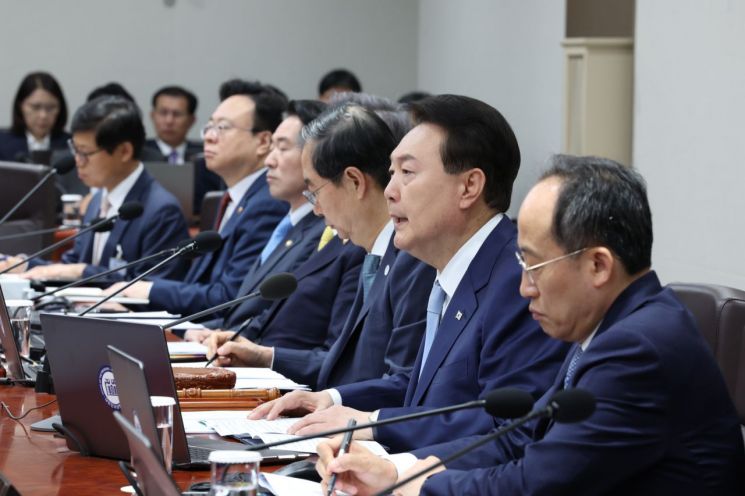
Earlier that day at 10 a.m., President Yoon presided over the first Cabinet meeting of the second year of the Yoon Suk-yeol administration at the Yongsan Presidential Office and reviewed and approved the veto on the Nursing Act enactment bill.
President Yoon emphasized, "The health of the people is something that cannot be exchanged for anything else. Politics, diplomacy, economic and industrial policies all come after the health of the people," adding, "People's health can be properly protected through collaboration among various medical professional occupations." He particularly pointed out, "It is regrettable that such social conflicts and anxieties were not resolved through sufficient consultation among professional groups and thorough deliberation in the National Assembly."
The official stressed, "If the (Nursing) Act is implemented, the entire medical system governed by the Medical Service Act itself will be shaken. Isn't stable change important? We are not turning a deaf ear to the demands of nurses."
He continued, "We need to look at changes considering the entire medical system, and although we do not know how the National Assembly will handle it, the government and the ruling party recognize that some changes are necessary within the current Medical Service Act framework," adding, "This is connected to the controversial parts related to nursing assistants during the Nursing Act promotion process, as well as integrated care policies."
Furthermore, he mentioned, "I expect negotiations to begin regarding necessary adjustments within the Medical Service Act framework through discussions between the ruling and opposition parties."
When asked about the Presidential Office's position on the repeated situation where the Nursing Act, following the Grain Management Act, passes the opposition party and the government exercises its veto, the official replied, "Basically, it is regrettable. If the National Assembly creates laws through bipartisan consultation, the government will also take measures," adding, "If a particular political force passes a law unilaterally without agreement, even if the government accepts it as is, it will not be easy for the people. There are special considerations according to the law, and we plan to continue assessing this."
Regarding discussions of collective action following the veto on the Nursing Act, he refrained from commenting, saying, "The relevant ministers will explain." Earlier, Minister Cho Kyu-hong of the Ministry of Health and Welfare, during a briefing that day, said, "We will visit more sites directly to share difficulties and promote necessary policies," "The state will take responsibility for improving nurses' treatment," and "We expect nurses to continue to stay by patients' sides," attempting to appease nursing groups.
Meanwhile, regarding President Yoon's recent increase in criticism of the previous Moon Jae-in administration's policies on nuclear phase-out, real estate, and welfare, Presidential Office spokesperson Lee Do-woon conveyed through a briefing at the Yongsan Presidential Office, "We should not criticize the previous administration unconditionally, but we must have a clear awareness of the problems in wrong policies to have a clear direction on how to proceed." President Yoon further urged, "Our government has put a lot of effort into a major directional shift, but since the public does not feel the changes, I ask the Cabinet members to promote policies so that the people can perceive the direction of change."
Referring to examples such as the Defense Advanced Research Projects Agency and the Boston Bio-Cluster visited during last month's state visit to the United States, he emphasized that the government's annual 30 trillion won scale research and development (R&D) investment method should foster government generic and applied technologies, while the private sector should develop commercial technologies.
Additionally, the spokesperson said, "From 2 p.m., a systematic drill on air raid casualty rescue activities was conducted with the participation of all staff," adding, "This is the first civil defense drill against air raids since 2017. The civil defense drill, which was suspended for six years due to false peace relying on the enemy's goodwill, has resumed." President Yoon said, "Since the drill has resumed after a long time, we plan to start with public institutions and schools to expand it without causing confusion among civilians," and requested, "Please set an exemplary standard at the Presidential Office."
© The Asia Business Daily(www.asiae.co.kr). All rights reserved.
![User Who Sold Erroneously Deposited Bitcoins to Repay Debt and Fund Entertainment... What Did the Supreme Court Decide in 2021? [Legal Issue Check]](https://cwcontent.asiae.co.kr/asiaresize/183/2026020910431234020_1770601391.png)
















