UN Committee on the Elimination of Discrimination against Women Criticizes China's Forced Repatriation Policy
North Korean Women's Human Rights Violations Raised as First Issue during China's Human Rights Review
"Forced Repatriation Policy Causes Human Trafficking and Family Separation"
A United Nations committee under the UN that evaluates the status of women's human rights worldwide addressed the issue of North Korean women in China exposed to the risk of forced repatriation as a major agenda item. This is the first time that human rights violations experienced by North Korean women in China have been raised against China rather than North Korea, and it is expected to exert considerable pressure on the Chinese government.
According to the UN Committee on the Elimination of Discrimination against Women (CEDAW) on the 16th, the committee discussed human rights violations faced by North Korean women in China during the review of women's human rights in China held in Geneva, Switzerland on the 12th (local time). The committee members pointed out issues such as the risk of forced deportation faced by North Korean women in China and the resulting problems including human trafficking and inability to register the births of their children.
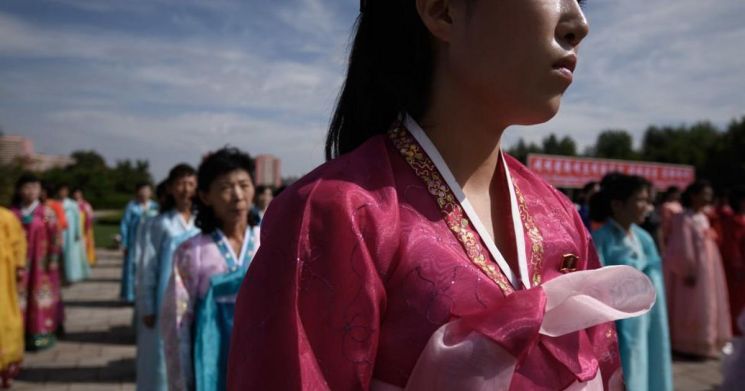 In September 2018, North Korean women dressed in hanbok participated in the "International March for Peace, Prosperity, and Reunification of Korea" held on the outskirts of Pyongyang. [Image source=AFP·Getty image]
Committee member Dalia Reinharte pointed out, "North Korean women in China are effectively unable to register the births of their children due to the risk of forced deportation because they are considered illegal residents." She added, "Chinese fathers only register the births after the North Korean mothers have been deported," and questioned the Chinese government, "This is an act of depriving motherhood; how many children have been registered in this way?" She also demanded answers regarding the scale of North Korean women forcibly repatriated to North Korea leaving children in China, and about China’s laws and policies to grant refugee status to North Korean women and their children.
North Korean defectors are subjects of humanitarian consideration under the UN Refugee Status Convention, but the Chinese government pursues a policy of forcibly repatriating them to North Korea. This violates the international Convention Against Torture, which was controversial during the 'forced repatriation of North Korean fishermen' incident, and is identified as a major cause exposing North Korean women in China to human trafficking.
However, the Chinese government has maintained a tough stance. A Chinese Foreign Ministry official responded, "The Chinese government does not grant refugee status to people who entered China for 'economic reasons'." Since most North Korean women enter China to 'earn money,' they refuse to recognize refugee status. The official also avoided criticism with a general response, saying, "Foreign women who marry Chinese men are guided not to register their marriages."
The UN’s direct addressing of the human rights issues of North Korean women in China is expected to place considerable burden on the Chinese government. China is a member state of the UN Committee on the Elimination of Discrimination against Women and is obligated to take appropriate measures to suppress "all forms of trafficking in women and sexual exploitation" within its territory. In particular, the Chinese government has actively promoted the advancement of women's rights since the 1995 Beijing Women’s Conference declaration.
"Exposure of North Korean Women to Human Trafficking"...Efforts to Publicize Proved Effective
Earlier, three human rights organizations?the North Korean Human Rights Citizens Alliance (NKHR), Transitional Justice Working Group (TJWG), and North Korean Human Rights Promotion Center (INKHR)?submitted a joint report on the human rights violations of North Korean women in China to the UN Committee on the Elimination of Discrimination against Women on the 10th of last month. This was the first report to raise the issue of North Korean women in China to the committee.
The report mentioned that the revenue generated from forced marriages and prostitution involving North Korean women and girls in China is estimated at $150 million (approximately 197 billion KRW), and pointed out that China’s forced repatriation policy has led to systematic human trafficking of North Korean women. It particularly expressed concern that this issue would lead to secondary harm such as forced family separation experienced by the children of North Korean women. Subsequently, at an NGO public hearing held on the 8th ahead of China’s review, Joanna Hosanyak, deputy director of the North Korean Human Rights Citizens Alliance, emphasized, "The human rights violations of North Korean women in China have been ignored by the international community for over 30 years," and reiterated, "Failure to properly protect North Korean women has created a situation more vulnerable to human trafficking."
Shin Hee-seok, legal analyst at the Transitional Justice Working Group, said, "Taking this discussion as an opportunity, we once again urge China to establish procedures to recognize refugee status including for North Korean women and to stop forced repatriation to North Korea," and added, "North Korean human rights organizations plan to continue raising the human rights issues of North Korean defectors in China at China’s 4th Universal Periodic Review (UPR) scheduled for early next year."
Meanwhile, the UN Committee on the Elimination of Discrimination against Women is a body that monitors the implementation of the Convention on the Elimination of All Forms of Discrimination against Women adopted in December 1979, reviewing reports from each country every four years and adopting recommendations. Since the efforts of our human rights organizations to publicize the human rights violations of North Korean women in China were effective in this session, attention is focused on what criticisms will be included toward the Chinese government in the conclusions to be released when the session ends on the 26th.
© The Asia Business Daily(www.asiae.co.kr). All rights reserved.