On the 13th, creation of the ‘Seongdong-type Green Carbon Pilot Zone’ with residents at Eungbong Nadeulmok, Jungnangcheon
Planting 6,000 eco-friendly Kenaf crops with residents, establishing a carbon neutrality model through expansion of carbon sinks
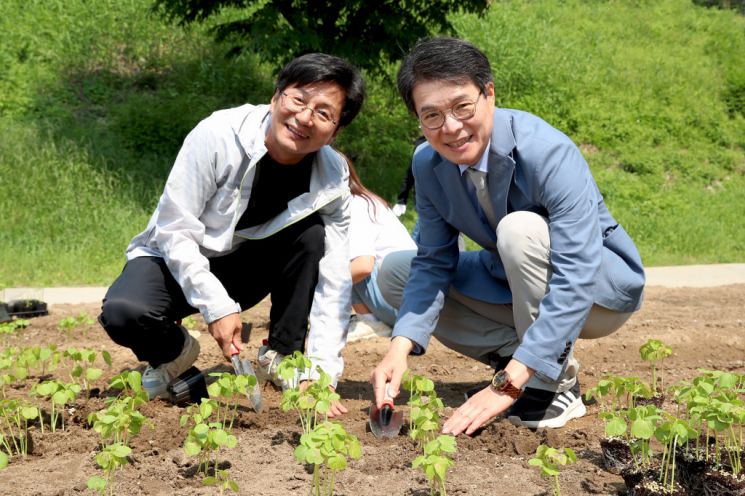
Seongdong-gu (Mayor Jung Won-oh) held a planting event on the 13th to create a green carbon pilot zone using the eco-friendly crop Kenaf, leading the transition to a carbon-neutral society.
The event took place at 10 a.m. near the green area of Eungbong Nadeulmok along Jungnangcheon, where about 50 residents participated and planted 6,000 Kenaf plants.
‘Kenaf’ grows rapidly and has a carbon dioxide decomposition capacity 5 to 10 times greater than other plants, making it highly effective. It is an eco-friendly crop known for reducing greenhouse gases and fine dust. Its harvest byproducts are also highly versatile, used for paper pulp, livestock bedding, insulation materials, and more.
The event proceeded in the order of pre-education on Kenaf’s characteristics and planting and management methods for participating residents, Kenaf planting, and installation of nameplates. The participating residents will join the Green Carbon Zone creation working group, a space contributing to carbon neutrality, and will also participate in future Kenaf growth management and byproduct production processes after harvest.
In the climate crisis caused by global warming, carbon neutrality is an important task given to all humanity worldwide. Following the enforcement of the ‘Carbon Neutrality Basic Act,’ the district enacted the ‘Basic Ordinance on Carbon Neutrality and Green Growth for Climate Crisis Response’ in May last year.
Additionally, the district has established a foundation for implementing carbon neutrality policies across various administrative sectors, with a particular focus on expanding green spaces within the urban area. While reducing emissions from major sources such as industrial processes and waste sectors must be prioritized in responding to the climate crisis, expanding carbon absorption through vegetation is also very important.
This helps prevent the urban heat island effect and reduces fine dust in the long term, protecting residents’ health from air pollutants. Accordingly, Seongdong-gu is promoting various projects such as ▲expanding green spaces in living areas ▲rooftop greening ▲vertical greening ▲creating fine dust blocking forests.
According to the ‘Carbon Sink Expansion Service for Carbon Neutrality’ conducted in April, an analysis of plant carbon storage in the region showed a decreasing trend until 2007. Since then, following the district’s green space expansion policies, carbon storage has steadily increased, reaching 18,596 tons in 2021, which is 2.7 times higher than the 6,878 tons recorded in 2007.
Having confirmed the effectiveness of the carbon sink expansion policy, the district plans to create a carbon absorption green space in the idle area of Cheonggyecheon embankment in Majang-dong, which will be opened to residents in July and used as a site for ecological education.
Jung Won-oh, Mayor of Seongdong-gu, said, “I hope the green carbon zone creation planting event with residents will contribute to overcoming the climate crisis and establishing a foundation for carbon neutrality implementation,” adding, “We will continue to expand carbon sinks through customized urban forest creation and street tree planting to become a leading city in carbon neutrality.”
© The Asia Business Daily(www.asiae.co.kr). All rights reserved.