Safe Haven Asset Concentration Likely to Continue
Will the Gold Price Rally Above $2000 Persist?
Where is the safeguard against a US debt default? As negotiations have not been concluded before the so-called 'X-day,' when the US federal government's cash runs out, warnings about the impact on the stock market crash and financial markets in case of a US default crisis are increasing. To avoid this US default risk, the trend of flocking to safe assets such as rising gold prices is expected to continue for the time being.
According to Bloomberg News on the 15th (local time), Market Live Pulse conducted a survey of a total of 637 institutional and individual investors from the 8th to the 12th, and half of the respondents (51.7% of institutions and 45.7% of individuals) said they would choose gold as an alternative investment if the US defaults.
The biggest reason for betting on gold is interpreted as a preference for safe assets. Demand for gold has increased amid expectations of an early end to interest rate hikes and economic recession uncertainties, and concerns about a US default have overlapped, creating a sentiment that "gold is the only trustworthy place." Gold futures prices traded on the New York Mercantile Exchange have continued to soar above $2,000 per ounce since April. Bloomberg reported that precious metals, including gold, have entered a full-fledged bullish cycle amid expectations that the 0.25 percentage point rate hike at the May Federal Open Market Committee (FOMC) meeting on the 3rd will be the last, and that debt ceiling risks could act as an additional upward driver.
The next safe investment choice was US Treasury bonds (14% of institutions and 15.1% of individuals). Bloomberg said, "The irony of investing in US Treasury bonds during a US default crisis stems from the experience in 2011, when, after the default crisis peaked and was resolved, the price of the 30-year US Treasury bond rallied to reach its highest level of the year." Bloomberg added that most investors participating in the survey expect that if the default crisis is resolved this time as well, the price of the 10-year US Treasury bond will surge sharply.
Bitcoin, considered a representative risky asset (7.8% of institutions and 11.3% of individuals), ranked third. The dollar, yen, and Swiss franc ranked fourth to sixth, respectively, trailing behind Bitcoin. This indicates that Bitcoin is perceived as a more reliable investment than major national currencies, which are traditionally considered safe assets. Amid the banking crisis triggered by the collapse of the US Silicon Valley Bank (SVB), which shook the institutional financial sector, investors feeling uneasy are choosing Bitcoin, known as "digital gold," as a refuge for investment.
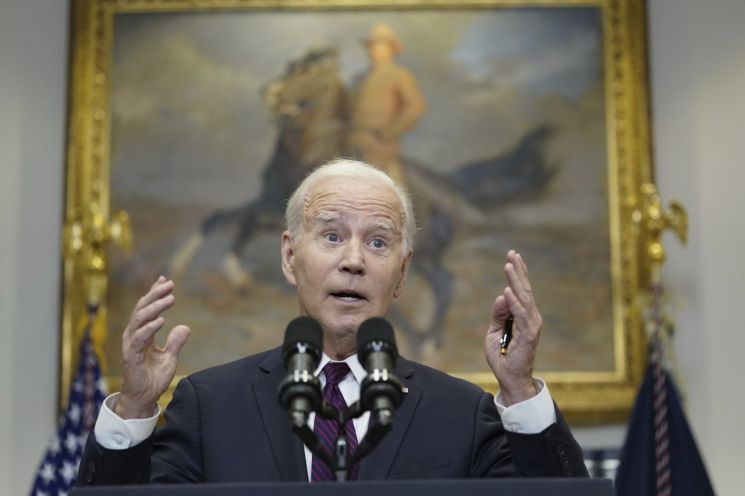
There is also a forecast that if an unprecedented default occurs, the shockwave on the global financial market will be greater than in 2011. Sixty percent of investors responding to the Market Live Pulse survey said the impact of this default crisis would be greater than the worst crisis situation seen in 2011. The debt ceiling crisis began to seriously affect financial markets after the 2008 financial crisis, and the delay in debt ceiling negotiations leading to a downgrade of the national credit rating and the possibility of default emerged almost only in 2011. In 2011, the S&P 500 index once plunged by up to 17%.
Regarding the outlook for the stock market impact, institutions and individuals showed somewhat differing views: 47.9% of institutions said, "There will be an impact on the stock market, but it will not be serious," while 35.5% of individuals expected a more pessimistic outcome.
US debt ceiling negotiations are a recurring political issue every year, and considering past cases, they will eventually be resolved. However, with the Republicans controlling the House and the influence of the Freedom Caucus (a far-right group within the Republican Party) growing, and President Joe Biden and the Democrats strongly pushing for fiscal expansion, it seems difficult to narrow differences in the short term. Jason Bloom, head of bond and ETF strategy at Invesco, said, "Considering the polarization of Congress due to differing views, the risk of (default) is higher than in the past," adding, "It seems difficult for negotiations to be concluded by the deadline (early June)."
© The Asia Business Daily(www.asiae.co.kr). All rights reserved.

















