Price Increase Power is Essentially 'Brand Power'
From diapers to luxury bags, product prices continue to soar. This is because companies, citing rising raw material and labor costs, are rushing to raise product prices to maximize profits. As the perception spreads that the ability to raise prices?passing cost pressures onto consumers during inflationary periods?is equivalent to 'brand power,' companies that have publicly announced price increase plans are seeing their market value rise noticeably.
The Wall Street Journal (WSJ) reported on the 14th (local time) that a company's ability to pass increased production costs onto consumers through price hikes (price increase power) has become a new symbol of corporate status. Simeon Siegel, senior analyst at BMO Capital Markets, said, "Publicly traded companies want to show investors that their brand power is strong, and the easiest way to prove this is by raising prices."
Generally, companies feel significant pressure to avoid raising product prices due to competition with other firms. However, companies with strong brand power and competitive advantages can raise prices relatively easily. These companies not only reflect the increase in production costs due to rising raw material and labor costs in their product prices but also raise prices beyond that to maximize profits. WSJ reported that price increases due to rising production costs are merely an excuse, and some companies are boosting profits enough to offset and exceed the impact of cost increases.
Among U.S. S&P 500 companies that have reported first-quarter earnings, 92% escaped losses for the first time in six quarters. This positive business performance results from leveraging strong competitive advantages to pass on cost increases caused by inflation over the past two years to consumers, defending profit margins, and capturing market share from other weaker competitors unable to raise prices. According to financial information provider FactSet, the first-quarter sales and net profits of the largest U.S. retailers, Walmart and Costco, are expected to have increased significantly compared to a year ago.
Tapestry, the parent company of fashion brand Coach, has raised the price of Coach handbags by 30% over the past three years. Joanne Crevoiserat of Tapestry recently indicated the possibility of further price increases during a corporate earnings presentation, stating, "We are assessing (our) pricing power across the portfolio." Immediately after announcing the 'additional price increase,' Tapestry's stock price surged 11% over two days. As Tapestry's price increase policy contributed to the rise in corporate value, its stock price has risen 35% over the past year.
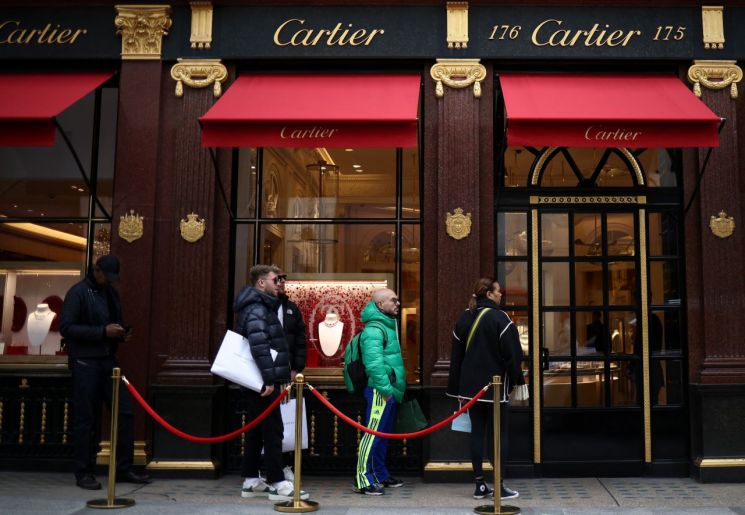
Global luxury brands such as Chanel and Cartier have also raised prices one after another. Johann Rupert, chairman of the Richemont Group, which operates the ultra-high-end watch brand Cartier, said after the earnings announcement on the 12th, "There was a mid-single-digit price increase last month," but added, "The rate of price increase was lower than competitors." Luxury goods have relatively low inventory and are produced in a supplier-dominant market, making price increases relatively easier. Moreover, due to the global supply chain disruptions caused by the COVID-19 pandemic and rising energy prices, prices of all goods surged, affecting the entire industry rather than specific companies, which led companies to be less concerned about consumer reactions.
As recession forecasts deepen and consumers' purchasing power is expected to decline, there is a clear trend of companies trying to pass the burden of reduced sales volume onto consumers through price increases. The University of Michigan Consumer Sentiment Index released on the 12th showed a sharp drop to 57.7, compared to 63.5 the previous month and the market expectation of 63.0. This is the lowest level since November last year. Although U.S. household spending in March increased compared to the previous month, the growth rate is slowing, indicating that the pain from rising prices is intensifying, WSJ analyzed.
© The Asia Business Daily(www.asiae.co.kr). All rights reserved.
![Clutching a Stolen Dior Bag, Saying "I Hate Being Poor but Real"... The Grotesque Con of a "Human Knockoff" [Slate]](https://cwcontent.asiae.co.kr/asiaresize/183/2026021902243444107_1771435474.jpg)
















