As the volume of apartment sales transactions in Seoul increases, a surge in rising home prices is occurring.
According to the Seoul Real Estate Information Plaza on the 14th, the total number of apartment sales transactions in Seoul last month was 2,671, surpassing 2,000 for three consecutive months following February (2,462) and March (2,981).
Since the reporting period (reporting transactions within 30 days after contract signing) still has about half a month left until the end of this month, the final transaction volume is expected to exceed 3,000.
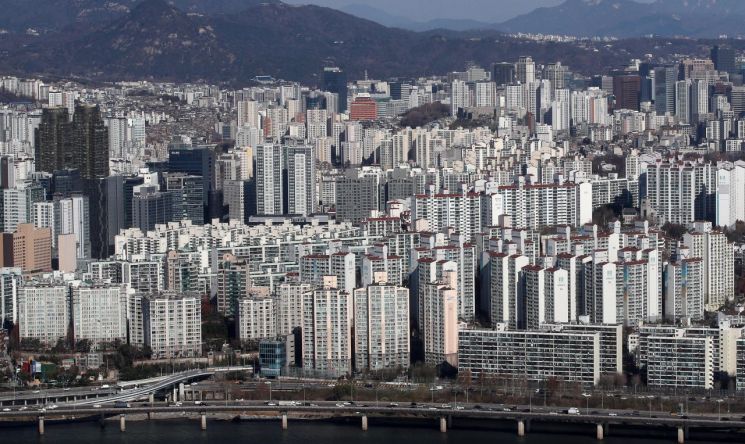
The volume of apartment transactions in Seoul, which was below 1,000 until December last year (834), exceeded 1,000 in January this year with 1,418 transactions for the first time in seven months, and has surpassed 2,000 since February.
This is interpreted as demand buyers who had postponed purchasing homes moving due to the government's relaxation of regulations through the 1·3 real estate measures at the beginning of this year, as well as market bank loan interest rates dropping to the lowest 3% range.
As transaction volume increases, sale prices are also rising. According to the weekly apartment sale price index in Seoul by the Korea Real Estate Board (as of the 8th), Seoul apartment prices fell by 0.04% compared to the previous week (-0.05%), showing a slowdown in the decline for five consecutive weeks.
In the Gangnam area, including Songpa (0.08%), Seocho (0.02%), Gangdong (0.02%), and Gangnam (0.01%), rising transactions continued, and in non-Gangnam areas such as Nowon (0.05%), Dongjak (0.02%), and Yongsan (0.01%), prices turned upward. Seongdong-gu also shifted from a continuous decline since the second week of May last year to stabilization after one year.
The Korea Real Estate Board's sales supply-demand index, which reflects Seoul apartment buying sentiment, rose by 1.1 points to 77.3 from 76.2 the previous week, showing an upward trend for 13 consecutive weeks. The sales supply-demand index quantifies the ratio of demand to supply, and a value below the baseline (100) means there are more sellers than buyers in the market.
Record-high prices are also emerging. According to the Ministry of Land, Infrastructure and Transport's actual transaction price disclosure system, last month, a 114㎡ unit in Yeomni Samsung Raemian in Mapo-gu recorded a new high price of 1.8 billion KRW. The 161㎡ unit in Sindorim e-Pyeonhansesang 4th in Guro-gu also set a new record at 2.175 billion KRW the same month. The previous highest price was 2.05 billion KRW in May 2021.
A 84㎡ unit in Resentz, Jamsil-dong, Songpa-gu was traded for 2.13 billion KRW on the 3rd of this month. The same size had dropped to around 1.9 billion KRW at the end of last year and early this year. In the same area, a 59㎡ unit in Jamsil Els was sold for 1.78 billion KRW (9th floor) on the 10th of this month, and earlier on the 6th, it was sold for 1.8 billion KRW (25th floor) and 1.75 billion KRW (24th floor), respectively. This is about 200 to 300 million KRW higher than 1.5 billion KRW (12th floor) in January this year.
Housing transactions in Nowon-gu and Gangseo-gu, where apartment prices had sharply declined, are also showing signs of recovery. A 126㎡ unit in Hwarang Harrington Place in Gongneung-dong, Nowon-gu, was recently traded at a record high of 790 million KRW. In Gangseo-gu, a 152㎡ unit in Gangseo Hillstate in Hwagok-dong was sold for 1.78 billion KRW, and an 84㎡ C-type unit in Hyundai 1st in Yeomchang-dong recorded a new high at 728 million KRW. In Hyundai 1st Apartments, a D-type unit of the same size was also traded last month for 775 million KRW, which is similar to the highest price of 797 million KRW recorded in 2020.
© The Asia Business Daily(www.asiae.co.kr). All rights reserved.

















