KIST Announces Plans at Meeting with Minister Lee Jong-ho of the Ministry of Science and ICT on the 12th
South Korea's bio-research technology is entering Boston, USA, the core of the global advanced bio-industry, to compete in technology commercialization.
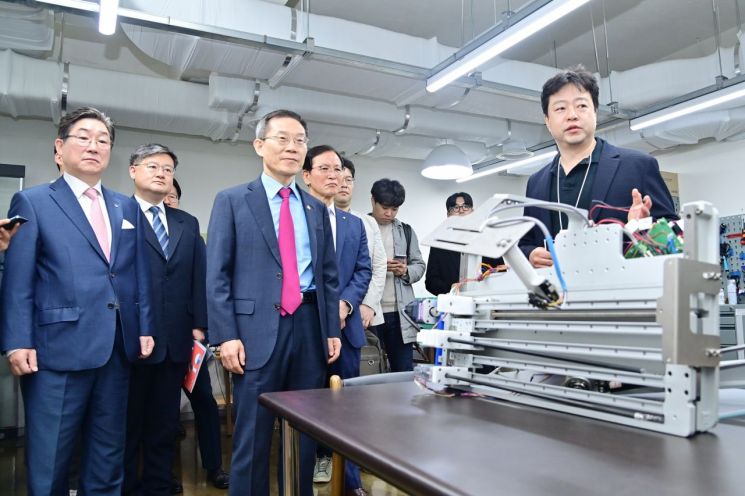 Minister Lee Jong-ho of the Ministry of Science and ICT visited the Seoul Bio Hub in the Hongneung Small Giant Special Zone, Dongdaemun-gu, Seoul, on the morning of the 12th and listened to an explanation of the 'Wearable Surgical Robot Process' from Hammer & Armor, a resident company. Photo by Ministry of Science and ICT.
The Korea Institute of Science and Technology (KIST) announced at a meeting held by Lee Jong-ho, Minister of Science and ICT, on the morning of the 12th that it plans to establish a local base in the Boston Bio-Cluster in the United States. KIST explained, "We will create a new model of technology commercialization for government-funded research institutes to nurture global companies that can compete worldwide with excellent achievements discovered or developed in Hongneung." KIST also introduced plans to open research capabilities and infrastructure to foster the Seoul Hongneung area, where some national research institutions including KIST are currently located, into a world-class bio-cluster.
The Ministry of Science and ICT also plans to support KIST's establishment of the base. The advanced bio-industry is currently experiencing rapid growth in the global market size due to accelerated innovation through digital transformation using recent artificial intelligence technologies. However, it is a technology-intensive industry where research and development are particularly important compared to other industries. The infrastructure and capital scale required are enormous, and related entities mainly form clusters characterized by close cooperation among participants. The Ministry of Science and ICT stated, "Against this background, it is necessary to refer to the successful case of the Boston Bio-Cluster in the United States, which houses more than 1,000 bio companies including global pharmaceutical companies, hospitals, and universities," adding, "South Korea also needs to strengthen the advanced bio-ecosystem by investing in research and development of core strategic technologies, attracting excellent talent, and advancing clusters to secure competitiveness in the advanced bio field."
The government previously announced a plan to foster national strategic technologies in October, focusing on the advanced bio field. In particular, it selected ▲synthetic biology ▲infectious disease vaccines and treatments ▲gene and cell therapy ▲digital health data analysis and utilization as key technologies. In March this year, the 'Special Act on the Promotion of National Strategic Technologies' was enacted. Since April, the 'National Strategic Technology Special Committee,' a public-private joint cooperation and promotion system, has also been launched and is currently operating.
At the meeting, Minister Lee said, "While investment in research and development is important, I believe it is especially important to create an ecosystem where cooperation occurs not only among the bio-related industry, academia, and research sectors but also with other fields such as IT," adding, "We will continue to spare no support to ensure that South Korea's bio-cluster can secure competitiveness along with research and development investment for fostering strategic technologies in the advanced bio field."
© The Asia Business Daily(www.asiae.co.kr). All rights reserved.

![Clutching a Stolen Dior Bag, Saying "I Hate Being Poor but Real"... The Grotesque Con of a "Human Knockoff" [Slate]](https://cwcontent.asiae.co.kr/asiaresize/183/2026021902243444107_1771435474.jpg)














