On the 12th, Imsil-gun, Jeonbuk Province announced that it conducted ‘Labor-saving Mechanized Cultivation Training for Rice Field Soybean Cultivators’ for about 100 rice field soybean farmers on the 3rd and 11th to promote efficient rice field soybean cultivation.
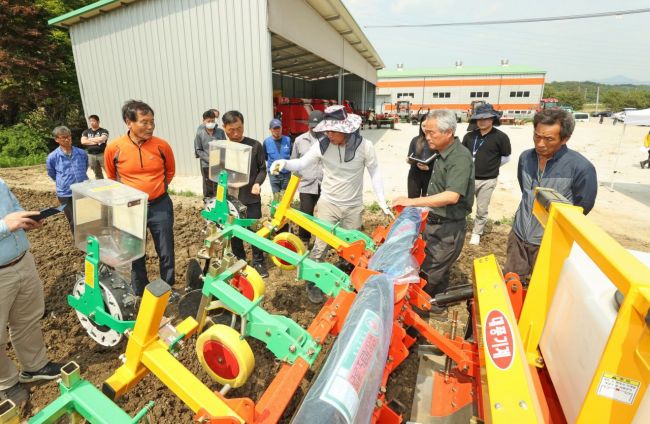 Imsil County conducted mechanized labor-saving cultivation training for about 100 rice field soybean farmers on the 3rd and 11th.
 [Photo by Imsil County]
The county is carrying out various projects such as providing strategic crop production subsidies and operating farm work outsourcing teams to stabilize rice supply and prices and improve food self-sufficiency rates.
This training was conducted to establish labor-saving mechanized cultivation techniques covering the entire process from rice field soybean sowing to management and harvesting. It included mechanized standard cultivation methods, cultivation management techniques such as appropriate fertilization and pest control, and explanations of rental agricultural machinery related to rice field soybeans.
A seed drill manufacturer was invited to hold a seed drill demonstration meeting, providing a good opportunity to resolve farmers’ questions about mechanized cultivation.
The county secured a total of 17 related agricultural machines, including seed drills, and placed them at rental centers to promote mechanized cultivation throughout the entire rice field soybean production process and timely use of agricultural machinery during the farming season.
When cultivating rice field soybeans, the county also operates a rice field soybean harvesting farm work outsourcing team to contribute to timely harvesting and expansion of rice field soybean cultivation areas.
The county has been vigorously promoting and encouraging participation in rice field soybean cultivation to successfully establish the government’s key policy, the strategic crop direct payment system, aimed at maintaining appropriate rice production levels and preventing rice price declines.
In particular, the county allocated a budget of 130 million KRW to support its own rice field soybean production subsidies separately from national funds.
When cultivating soybeans as a strategic crop in rice paddies, in addition to the national subsidy of 1 million KRW per hectare under the strategic crop direct payment system, the county provides an additional 1.6 million KRW of county funds. Furthermore, if winter wheat forage is cultivated followed by summer rice field soybeans as a double cropping system, an additional incentive of 1 million KRW is added, resulting in a total support of 4.1 million KRW, including the base rate of 1.5 million KRW, county funds of 1.6 million KRW, and incentives for double cropping winter forage wheat and rice field soybeans.
Also, when cultivating winter food crops and rice field soybeans, a total of 3.1 million KRW is supported, including the base rate of 1.5 million KRW and county funds of 1.6 million KRW.
Starting this year, a rice field soybean purchase incentive of 1,000 KRW per kilogram is provided by combining the county’s purchase incentive of 500 KRW with an additional 500 KRW support from local agricultural cooperatives (Imsil Nonghyup and Osu Gwanchon Nonghyup).
County Governor Shim Min said, “I thank the farmers who actively participated in cultivating non-rice crops. We will do our best to ensure smooth rice field soybean cultivation by focusing on cultivation training and securing related agricultural machinery, and we will thoroughly prepare the rice field soybean harvesting farm work outsourcing to ensure timely harvesting without any setbacks.”
Imsil = Asia Economy Honam Reporting Headquarters, Reporter Park Nosik baekok@asiae.co.kr
© The Asia Business Daily(www.asiae.co.kr). All rights reserved.

















