BOE Base Interest Rate Raised by 0.25 Percentage Points
While the US interest rate hikes are entering their final stages, the tightening cycle in the UK shows no signs of ending yet. With inflationary pressures unabated, including food prices soaring to their worst in 46 years, there are forecasts that the base interest rate could rise to the 5% range within this year.
On the 11th (local time), the Bank of England (BOE), the UK's central bank, raised the base interest rate by 0.25 percentage points to 4.5% per annum. This is the highest level in 15 years since the 2008 global financial crisis. The UK ended its ultra-low interest rate era of 0.1% and has consecutively raised rates 12 times from December 2021 to the present.
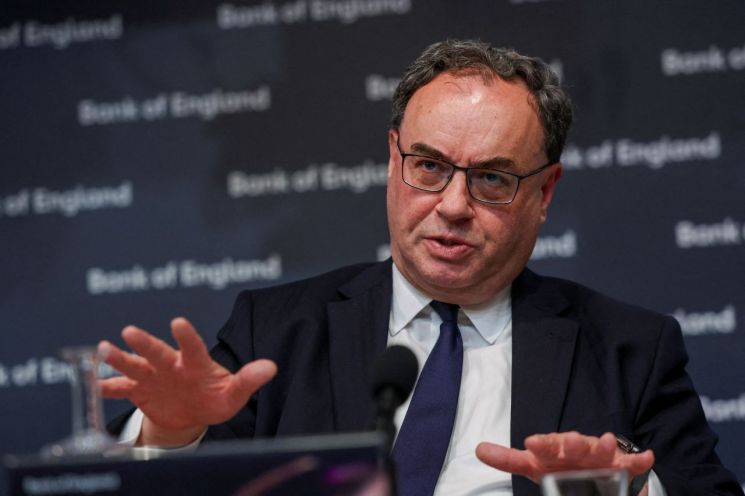
Food prices in the UK have surged to their highest level since 1977. In March, UK food prices rose 19.1% compared to the same month last year, approaching a 20% increase. Andrew Bailey, Governor of the BOE, stated, "There have been signs that the upward trend in food prices would slow down, but it is taking longer than expected." Although falling energy prices could reduce costs for food producers, it is expected to take a long time before this is passed on to consumer prices.
In its monetary policy report released that day, the BOE said, "Poor harvests due to bad weather and supply chain shocks caused by the Ukraine war have driven up food prices," and "persistently high inflation will impose long-term costs on households and businesses, which will be one of the factors slowing economic activity."
The consumer price inflation rate continues its double-digit high run. The UK’s consumer price index for March, announced last month, rose 10.1% compared to the same month last year. Although this is a slowdown from February’s 10.4%, it exceeded market expectations (9.8%) and has maintained an increase around 10% for five consecutive months. This level is five times the BOE’s target rate of 2%.
The background to the high inflation is attributed to the rise in energy prices following the Ukraine war, which has spilled over into increased housing costs and the food sector. Service items such as restaurants and hotels, which are influenced by both supply and demand, have also seen significant price increases. Foreign media have analyzed that cost increases caused by Brexit (the UK’s withdrawal from the European Union) limiting the free movement of people and goods between the UK and the EU have also made it difficult for inflation to slow down.
Bloomberg reported that food manufacturers purchase raw materials under fixed-term contracts, so it may take time for price adjustments to occur, and despite falling energy prices, the pressure on food price inflation is unlikely to ease immediately.
The market views additional tightening due to high inflation as inevitable. Global investment banks expect the UK’s terminal base interest rate to reach the 5% range within this year. Goldman Sachs, the largest US investment bank, forecasts that the UK’s base interest rate will reach 5.0% per annum by August.
© The Asia Business Daily(www.asiae.co.kr). All rights reserved.
![Clutching a Stolen Dior Bag, Saying "I Hate Being Poor but Real"... The Grotesque Con of a "Human Knockoff" [Slate]](https://cwcontent.asiae.co.kr/asiaresize/183/2026021902243444107_1771435474.jpg)
















