Korea Airports Corporation announced on the 12th that it has established and will implement a 'Comprehensive Plan to Strengthen Aviation Security' aimed at fundamentally improving the aviation security system.
Following the aviation security failure incident at Gunsan Airport last year, the corporation developed and applied measures to enhance aviation security capabilities, including stricter accountability for employees and strengthening subsidiary on-site management functions. It operated a focused period for enhancing aviation security levels to identify difficulties in the aviation security field and derive improvement measures.
However, despite these efforts, consecutive aviation security failures have recently occurred at Gimpo and Jeju Airports. In response, a joint aviation security relay countermeasure meeting involving the parent and subsidiaries was held under the CEO’s leadership to bring all internal and external issues hindering the strengthening of aviation security levels to the table for in-depth discussion.
The corporation diagnosed problems in the aviation security system such as subsidiaries’ lack of aviation security awareness and human capabilities, inadequate management systems, and the need to strengthen the corporation’s supervisory capabilities. To prevent recurrence of aviation security incidents and significantly reduce their occurrence, it prepared a 'Comprehensive Plan to Strengthen Aviation Security' reflecting human, operational/management, and institutional factors.
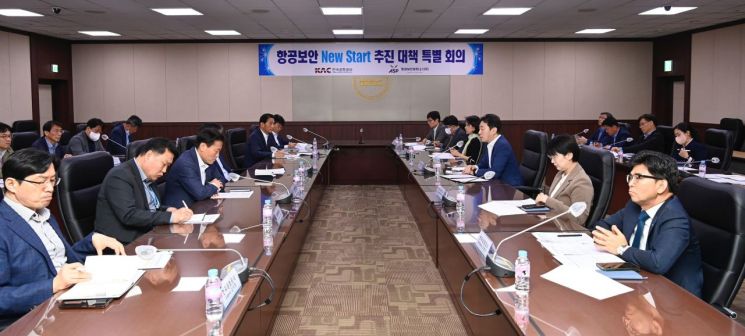
The corporation will operate a ‘Mobile Aviation Security Inspection Team (tentative name)’ to continuously inspect vulnerabilities in aviation security until a culture of strictly adhering to basic rules is rooted in the aviation security field. Violations will be immediately corrected, and strict disciplinary actions against related personnel and institutional improvements will be pursued simultaneously. Additionally, recognizing that management risks caused by subsidiaries’ inadequate internal control systems can directly translate into the corporation’s management risks, it plans to provide ongoing audit advisory consulting to strengthen subsidiaries’ internal control systems, including presenting standards for task performance to facilitate smooth rotation and enhance audit functions.
Alongside this, to minimize the main cause of aviation security failures?‘human error’?the corporation plans to expand advanced security equipment nationwide, including AI X-ray, CT X-ray, and centralized reading systems. AI X-ray machines that interpret prohibited items brought onboard through AI will be expanded from 6 to 15 units nationwide. CT X-ray machines equipped with 3D precision reading and automatic explosive detection functions will increase from 5 to 8 units, and centralized reading systems that remotely interpret multiple X-rays within security screening areas will expand from 2 to 4 locations by 2025.
The corporation has developed its own walkthrough metal detector monitoring system to continuously monitor situations such as walkthrough metal detector malfunctions and equipment operation stoppages caused by employee management errors. This system is already installed and operating at Gimpo and Jeju Airports and will be expanded to all airports nationwide by the end of this year.
To strengthen subsidiaries’ aviation security levels, the corporation will reflect adequate staffing considering on-site conditions to prepare for unavoidable vacancies in field operations and support securing an appropriate level of outsourced personnel through the introduction of a separate staffing system. Subsidiaries are currently conducting management diagnostics by external experts, and the corporation plans to actively identify improvements from the diagnostic results covering wage structures, work patterns, welfare, and aviation security personnel operation systems, reflecting them in subsidiary operations.
The corporation plans to consult with the Ministry of National Defense and self-defense product manufacturers producing electronic shock devices to fundamentally block the possession of security threat items and prohibited items onboard within airports. Additionally, following recent drone appearances near airports such as Jeju Airport causing temporary suspension of aircraft operations, the corporation will discuss measures to prevent illegal drone flights within airport control zones with related industries including drone associations, educational institutions, and manufacturers/distributors, and jointly respond to strengthen aviation safety.
Kim Subong, President of Aviation Security Partners, said, "With renewed determination and a fresh start, we will become a specialized aviation security company based on fundamental principles."
Yoon Hyungjoong, President of Korea Airports Corporation, also emphasized, "We will continuously monitor the implementation of the aviation security strengthening measures prepared this time to ensure they are felt on the ground and firmly rooted. We will do our best to improve aviation security levels so that the public can use airports more safely and conveniently."
© The Asia Business Daily(www.asiae.co.kr). All rights reserved.
![Clutching a Stolen Dior Bag, Saying "I Hate Being Poor but Real"... The Grotesque Con of a "Human Knockoff" [Slate]](https://cwcontent.asiae.co.kr/asiaresize/183/2026021902243444107_1771435474.jpg)
















