June 1 Crisis Alert Level Downgraded from 'Severe' to 'Caution'
7-Day Isolation for Confirmed Cases Recommended to 5 Days
Mask Wearing at Clinics and Pharmacies Also Relaxed
Patient Treatment Cost Support Continues
If the COVID-19 crisis alert level is lowered from ‘Severe’ to ‘Alert’ on the 1st of next month, the quarantine measures currently in place will be largely lifted. The mandatory 7-day isolation for confirmed cases will change to a 5-day recommendation, and masks will no longer be required at clinic-level medical institutions. This move, which goes a step further than the ‘Crisis Level Adjustment Roadmap’ announced in March, is interpreted as a determination to accelerate the return to normal life.
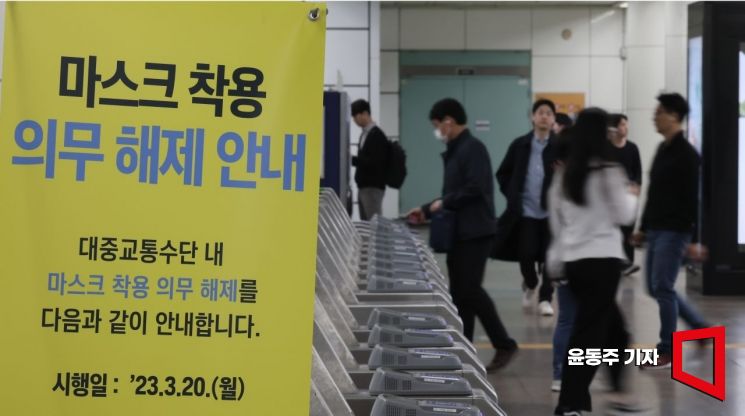 On the 11th, when the COVID-19 crisis alert level was lowered from "Severe" to "Alert" and the mandatory 7-day quarantine for confirmed cases was changed to a recommendation, effectively declaring the end of COVID-19, a notice about lifting the mask mandate was posted at the ticket gate of Gwanghwamun Station in Seoul. Photo by Dongju Yoon doso7@
Quarantine for Confirmed Cases Virtually Lifted
The biggest change following the declaration of ‘endemic’ (periodic outbreak of infectious diseases) after 3 years and 4 months is the lifting of quarantine for confirmed COVID-19 cases. The isolation period for COVID-19 patients has been gradually shortened from 14 days → 10 days → 7 days. Initially, health authorities planned to reduce the isolation period to 5 days while maintaining the mandatory status, and later consider lifting the mandatory quarantine, but to expedite the return to normal life, it was further relaxed to a recommendation rather than a requirement. However, the government encourages institutions (schools, workplaces, etc.) to establish and implement their own guidelines to foster a culture of ‘rest when sick,’ and asks for public cooperation to maintain quarantine measures in medical institutions and infection-vulnerable facilities.
Indoor mask-wearing will also be fully recommended rather than mandatory at clinics and pharmacies, except for hospital-level medical institutions where patients are concentrated and residential infection-vulnerable facilities (such as nursing homes). Additionally, the mandatory weekly screening tests for workers at infection-vulnerable facilities will be relaxed to be conducted only when symptoms such as fever appear or when there is contact with multiple people, and eating will be allowed for residents during face-to-face visits provided that quarantine rules are followed. Furthermore, the PCR test recommended on the third day after entry into the country will be discontinued.
The reason for accelerating the easing of quarantine measures is the reduced risk of COVID-19. According to the Central Disease Control Headquarters (CDCH), the average daily number of deaths due to COVID-19 over the past 4 weeks was 7, and the fatality rate was 0.06%. Considering that the majority of the population has antibodies and that medical response capacity is sufficient, the government believes that stable management is possible even if there is a gradual increase in cases for the time being.
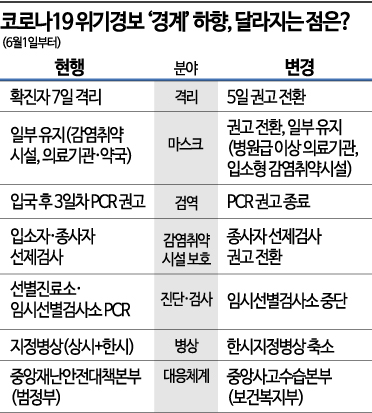
Disbandment of CDCH... Response by Central Disaster and Safety Countermeasure Headquarters
The government and local governments’ COVID-19 response will also change. With the lowering of the crisis level, the disaster and crisis management system will be downgraded from the Central Disaster and Safety Countermeasure Headquarters (CDCH, headed by the Prime Minister), which involves the entire government, to the Central Accident Response Headquarters (CARH) led by the Ministry of Health and Welfare. The daily announcement of confirmed case statistics will switch to weekly updates. While screening clinics will continue to operate to conduct PCR tests focused on high-risk groups, temporary screening clinics operated separately by local governments will be closed. Hospital bed management will also shift from temporary designated beds to a focus on regular beds.
However, to reduce the burden on the public and minimize health damage, support for treatment costs will be maintained for the time being. Accordingly, treatment costs for hospitalized patients, vaccination, and prescription of therapeutics will continue to be provided free of charge. The operation of 10,697 ‘one-stop medical institutions’ capable of diagnosis, treatment, and prescription, as well as medical consultation and administrative guidance centers for home-treated patients, will also continue.
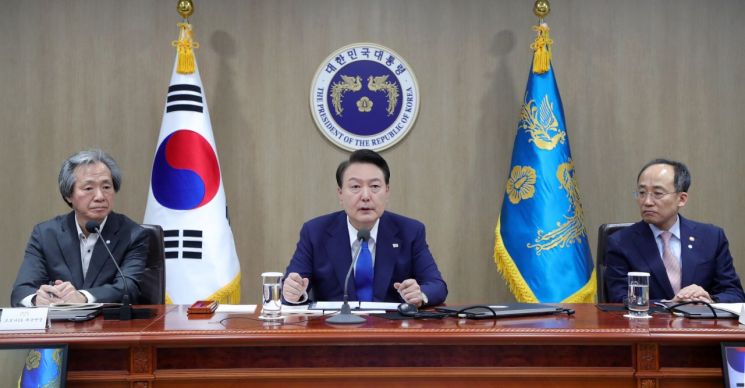 President Yoon Suk-yeol is delivering opening remarks at the Central Disaster and Safety Countermeasures Headquarters meeting on COVID-19 held at the Yongsan Presidential Office building in Seoul on the 11th. [Image source=Yonhap News]
“Not a Complete End”… Continued Monitoring of Outbreaks
Measures have also been prepared to effectively monitor the emergence of new variants and the spread of outbreaks after the easing of quarantine measures. Following the lowering of the crisis alert level and the expected adjustment of COVID-19’s legal infectious disease classification from level 2 to level 4 in July, a ‘COVID-19 positive case-centered surveillance system’ will be introduced and operated temporarily until the end of this year. This system will monitor clinical information, disease occurrence levels and trends, and collect and analyze pathogen information from confirmed cases.
When announcing the plan to ease quarantine measures, the government emphasized that it is promoting a swift and safe transition to routine management while prioritizing the protection of high-risk groups, vulnerable populations, and public health by maintaining the medical response system and government support. It also mentioned that it will continuously monitor outbreak forecasts and domestic and international quarantine situations and consider re-strengthening preemptive quarantine measures in case of a large-scale resurgence.
Jiyoungmi, Director of the Korea Disease Control and Prevention Agency, stated, “Although the national crisis situation has passed, all ministries, local governments, and health authorities will not lower their guard and will fulfill their responsibility to protect the health of the people.” She reiterated the importance of making infection prevention measures such as handwashing, ventilation and disinfection, and cough etiquette a daily habit to protect oneself and others.
© The Asia Business Daily(www.asiae.co.kr). All rights reserved.



















